Corrigall:
“Behind, in the trenches, the night is spent in watching. An hour before dawn, everyone ‘stands to’ until the day breaks – gray turning to silver, silver to gold – and the watch is over. The day is spent eating, working and sleeping, until twilight brings another “stand to’ and then dark. The German line was from fifty to one hundred yards away, and ran along the edge of Bois Quarante. Their wire looked thicker than ours. Fairly long grass and stubble covered no-man’s-land, so that shell holes made during the early days of the war were overgrown. At two hundred yard intervals, our machine guns were sunk into the parapets.”
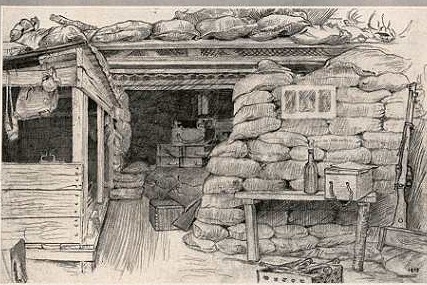
No doubt Keith and his buddies were becoming somewhat accustomed to trench life with all its perils, but there were other things to cope with.
Beaverbrook:
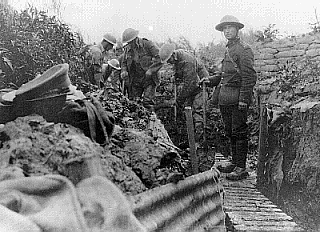 “In September and October, great efforts were expended on improving the line. The occupying battalions did the work and the troops in reserve came up night after night to assist and to create new secondary positions and fresh communication trenches. The weather was good and a great deal was accomplished.”
This shows the static nature of the war in this area at that time, with both sides working to preserve the status quo.
Since communication trenches are used to bring up food, water, ammunition and other equipment and to bring back the wounded, the need for smooth and dry surfaces underfoot and cover from enemy fire is essential. Poor trenches increase the workload for everyone and decrease the ability to provide timely support in the event of a major attack Secondary positions are also extremely important in successfully repelling enemy attacks by providing another line of defence and perhaps limiting gains.
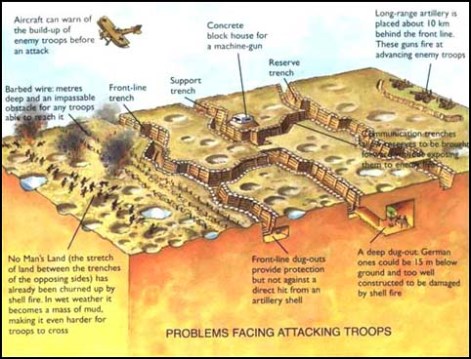
The British style was a layout of three lines of trenches behind barbed wire. A fire trench faced the enemy and a support trench lay behind it. A reserve trench was a third line of defence. Two of four battalions from each brigade were in the trenches. Each side dug saps (tunnels going forward from the front lines) and these had several uses. They might be used at night to give patrols and raiding parties faster access deeper into no-man’s-land without being observed. They could be a starting point to launch an attack and they could even be dug under the enemy’s front lines, filled with explosives and blown up.
McBride:
“On Oct. 12 the first use of smoke bombs was carried out by the 5th Brigade. At a given signal every gun behind our lines dropped smoke shells in a continuous row just in front of the enemy parapet. As each shell struck, it burst, sending out great streamers of white smoke that soon became a dense wall through which no on could see. Under cover, our bombers advanced, threw hand grenades into the enemy trenches and then returned. No attempt was made to take any part of the line – it was more in the nature of a tryout for the new shells and for harassing the enemy. Naturally they thought a general attack was under way and responded with artillery, machine gun and rifle fire but no one was hit.”
While the 21st was still at La Clytte, the Germans blew up a sap just in front of the Canadian lines.
Beaverbrook:
“ On Oct. 13, Lieut. McAvity, of the 26th Battalion, 5th Brigade, was ordered to investigate the mine crater. If it could be held with advantage, then do it: if not, the crater was to be abandoned. After our artillery had finished their pounding and the smoke bombs that we had prepared were let loose, the 26th charged from a saphead and raced for the crater over forty yards of open ground. One party rushed to within throwing distance of the German side of the crater and held off assault with bombs and rifles. Shielded by their efforts, they extended the supports right and left to ward off flank attacks. Faced with a shower of bombs, and enfiladed from both sides by machine gun fire, they went forward and gained the crater.
It was found inadvisable to remain in the crater, and the order to retire was given. And it came none too soon. Just as they cleared the crater, the Germans fired a mine trap and the whole force barely escaped destruction. Then the ground between the crater and our trench was covered with a hail of machine gun bullets and flying shells and bursting bombs. The explosion stunned everyone. Sergeant Ryer provided cover for his comrades and accounted for eleven of the enemy. The 26th Battalion losses were severe.”
Cpl. Roberts wrote :
“General Brooke praised our boys for their ability in the trenches and their discipline, just as if they had been used to the trenches for years.”
McBride:
“Early in October the rains started, rains that were to continue, with few interruptions, until the following April.”
On October 15, the 21st relieved the 20th in the new trenches M, N and O at Dickebusch (Dikkebus). Typically they would parade around 5 PM, march to their rendezvous point, and wait until dark, when they would be met and escorted through the roads and communication trenches by their guide. On this occasion they were able to move the slightly more than 4 kilometers forward at 4 PM owing to a thick mist. Although the situation was described as “quiet” for the first few days and then “lively”, the six men who were wounded would likely have disagreed and the two men killed would have said nothing.
The Allies were becoming impatient with the fact that many men were being lost and no significant progress was being made. It was decided that more detailed maps of the enemy’s trenches and fortifications were needed to assist the artillery to pin-point targets and to more accurately prepare for ground assaults. To draw such maps, detailed information was required. Much could be obtained by aerial observation and interrogation of prisoners. However the best way to know the ground was to crawl over it. General Haig had decided that his forces must take command of no-man’s-land, so, in addition to patrols, raids were carried out with much larger groups of men.
A soldier from another unit described a successful raid:
“Oct. 1915- Reaching a trench, which we thought to be unoccupied, we discovered our mistake when about twenty Germans appeared in our rear and one opened fire. We turned our machine gun around and covered them. They immediately surrendered saying – ‘No shoot, we got children at home, war over’.”
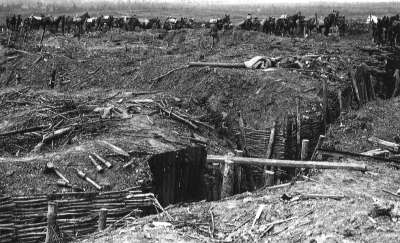 An abandoned German trench in the Messines area.
21st War Diary:
“Oct. 18 – Artillery very active sending over numerous shells – Enemy’s trench mortar also very active –Many flares sent up during night. (Flares had at least two purposes – to illuminate any hostile patrols or raiding parties and to keep the enemy in the trenches from getting too comfortable.)
Oct. 19 – Enemy’s artillery very active – persistently wasting shells in empty fields behind our trenches – Several enemy working parties observed in AM and PM – Enemy’s aircraft flew over, trying to ascertain the results of their artillery fire.
Oct. 20 – Enemy patrol met and dispersed by bombs at 1:30 AM.”
A. J. St. Dennis died on October 20 and the unit retired to Brigade Reserve at Ridgewood on October 21.
Corrigall:
“Much work had been done by the 21st and the trenches were more comfortable.”
However, being behind the front lines did not guarantee anything; three men – V. Aitkins, H. Ashton and G. Lytle – were killed and two wounded working on a communication trench on October 22.
Ridgewood was a mile and a half behind the front line and covered about five wooded acres, which provided reasonably good cover from view. Accommodation consisted of sandbag shelters scattered throughout the wooded area. On October 23, 490 men of the 21st were sent forward to dig new trenches. During the third week in October, the weather started to get cooler with lots of mist.
Beaverbrook:
“ Because of the mist, there was considerable activity on the part of patrols. But a new horror was added to life- the discovery of land mines laid down by the Germans between the lines. Some were fired by trip wires and others were electrically connected by wires to the German trenches.”
4th Brigade War Diary:
“October 27, Inspection of the Canadian Corps by His Majesty the King.”
Corrigall:
“It was at this inspection that His Majesty’s mount fell with him, frightened by the cheering of the troops who lined the street.”
Kenneth Haig wrote:
“The King stopped by my stretcher in Bailleul and said ‘Well my boy how are you getting on?’ I don’t know what I said but had to stop myself from saying ‘Fine and Dandy’.”
The inspection did not include all of the 21st because some were on their way back to the front lines with their new issue of goatskin coats and waterproof capes. Keith and the others would battle again with the scourges of the trenches – rats. Many veterans described them as their worst nightmare. There were millions of rats in the trenches but the biggest population was in this area. Once they had cleaned out the food cans that the soldiers threw over the parapet, they invaded the trenches and dugouts searching for more; even stealing what the soldiers were still eating. The more they ate, the more they grew and the bolder they got. They would crawl across the bodies and faces of sleeping men. But worse still was the knowledge that rats would eat the corpses of dead soldiers who had fallen in no-man’s-land and could not be retrieved. Clubbing, attacking them with bayonets and even shooting at them did little to reduce the rat population. A related condition in the trenches was the smell. If your trench happened to be in the area of a prior battlefield, the air was full of the odor from decaying bodies, or parts of bodies, that could not be removed because of the danger, or because they had sunk into the mud out of sight.
McBride:
“I saw a party of newcomers coming down a communication trench, with an officer carrying a dog. Dogs were strictly ‘taboo’ on our lines. Just as the officer came to a bridge, a big rat scampered out from under his feet and dove into the creek. The dog saw the rat, jumped from his master’s arms, landed on the bridge and bounced into the water after the rat. With never a thought for anything else, the officer and other newcomers started after that rat. Up along the shore they raced, right out in the open, where all Germany could see them, trying to spear the rat with bayonets. Frantic calls to get down and seek cover were ignored. They had the hunting fever and were determined to get that rat. A few weeks later they would have been accustomed to having the vermin crawl all over them in the dugouts, but they were new and didn’t know that. In less than a minute, the whiz-bangs came, bursting with terrible accuracy over the whole area. It lasted only a few minutes but at least a dozen men were dead and as many more wounded. I learned after that the dog was an Otter Hound and had been brought in to see if that kind of dog would be of any use in ridding the trenches of rats.”
Of course the Germans had rats too.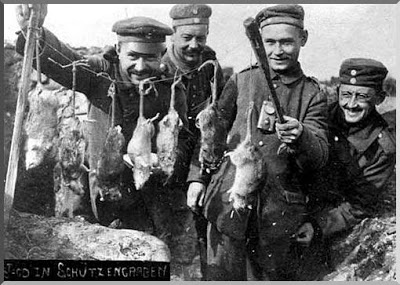
Chaplain Beattie wrote:
“I went to Kemmel to bury two men out of twenty-two who were killed when the Germans set off a mine under our trench. Many soldiers lay on the fire step trying to sleep. It was raining and they were vainly trying to cover both head and feet with a rubber sheet.”
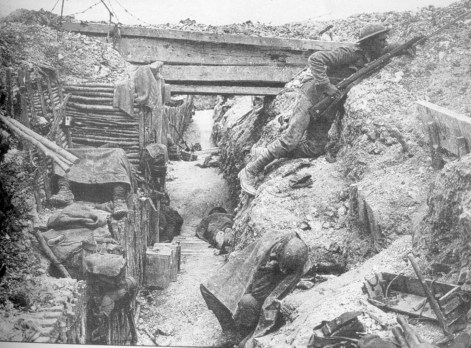
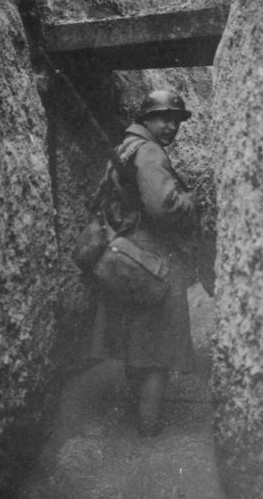
See what it might have looked like, although this picture was taken of British soldiers in a captured German trench some months later.
One soldier said:
“Sleep, sleep; if only we could sleep. Each face is a different shade of gray. Some are chalk-coloured, some with a greenish tint, some yellow. But all of us are pallid with fear and fatigue.”
The action heated up on the October 29. 21st War Diary:
“ Enemy artillery more active and attitude more aggressive than usual. Our retaliation to their artillery caused much damage to their front line parapet opposite O2. Casualties – 3 wounded and 2 killed. (R.J. Deegan and R. B. Lancaster).
An American in the CEF described his reaction to shelling this way:
“ I am terrified. I hug the earth, digging my fingers into every crevice, every hole. A blinding flash and an explosion howl a few feet in front of the trench. My bowels liquefy. Acrid smoke bites the throat, parches the mouth. I am beyond mere fright. I am frozen with an insane fear that keeps me cowering in the bottom of the trench. I lie flat on my belly waiting…. Suddenly it stops.”
It rained every day that week. What Keith didn’t know then was that this would become the coldest, bitterest winter since 1880. In the meantime, they would have to cope with the mud, which because of the high water table (around three feet) had turned the trenches and the earth all around them into a hopeless quagmire.
Mc Bride:
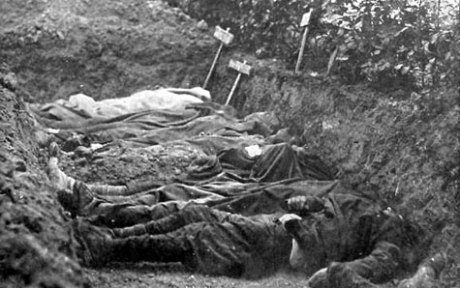
“Mud, nothing but mud- without any bottom. We had no trenches; they were simply sandbag barricades between the enemy and us- it was a constant struggle to keep them built up. They ooze away like butter. Anything that lessened the work of filling sandbags and building parapets and traverses was welcomed by the Canadian soldier. He was always willing to fight but hated like hell to work with a shovel. Some of this was due to the fact that it was almost impossible to dig anywhere within our lines without disinterring bodies of men who had been buried by previous occupants of the position. That whole Ypres Salient was one vast graveyard. British, Canadian, Indian, French and Belgian soldiers were everywhere. It should be an international shrine. There are a few places where every foot is consecrated and holy ground but none can compare with the Ypres Salient.”
Beaverbrook:
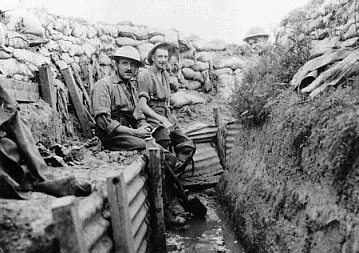
“Two days’ rain in the horrible clay of Flanders turned every trench into a millrace. Traverses, parapets and parados, which in the summer sun had become as solid as Egyptian monuments, collapsed like melting jelly as the torrents tore under the foundations. Men struggled waist-high in water to repair the damage, only to hear the splash of more falling earth and sandbags.”
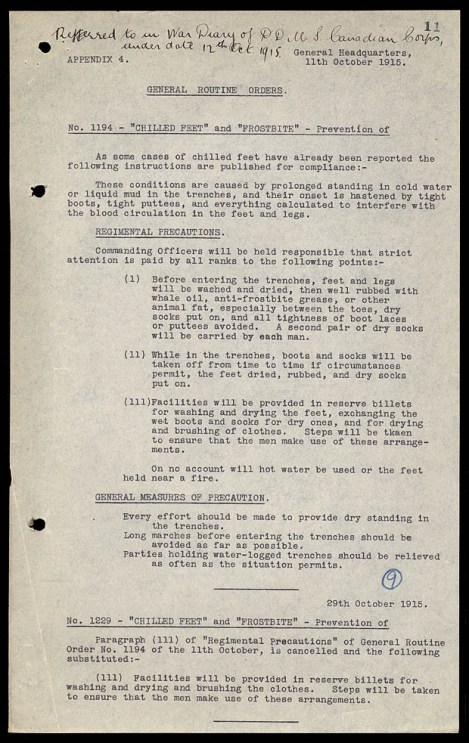
The current position of the German trenches was on higher ground, so they could pump the water over their parapets where it poured down to our trenches anywhere from seventy-five yards to 250 yards away. Aside from the work required to keep the trenches usable and safe, the water underfoot could lead to trench foot. This was a fungal infection caused by prolonged exposure to damp, cold, unhygienic, conditions that sometimes led to amputation of toes.
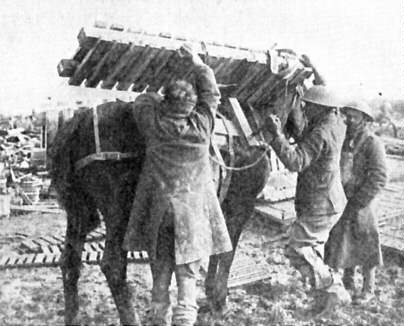 The use of duckboards (left) and waterproof footwear (probably not Hughes’ 3-button galoshes), along with regular foot inspections, greasing of toes and frequent changes of socks, helped.
McBride:
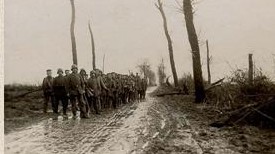
“Because some trenches became unusable, we had no recourse but to go in and out of the trenches ‘overland’. We were continually losing men from rifle and machine gun fire. Only with artillery fire was the mud our friend for, unless a shell dropped squarely on top of you, it would do no harm.”
The picture (below) shows German troops in muddy Flanders.
Cpl. Love of the 1st Brigade wrote:
“I have been sick from rheumatism in my legs and shoulder for two weeks. I am some better now but always in pain. Cpl. McIntosh has also been bad with it and in bed for a week. If you are fixing up a Christmas parcel, a pair of gloves would come in handy on these cold nights.”
Cpl. McIntosh wrote from hospital:
“I don’t know what they are going to do with me. My legs and back are painful and the wet and cold don’t seem to let me get better. For two weeks I never slept day or night. I would like to get better so I can go back, but I’m not sure what the wet and cold will do to me.”
Because there had been many battles fought here, the area was criss-crossed with discarded old trenches.
McBride:
“It was difficult to dig anywhere for earth to fill sandbags without uncovering bodies. The whole place was one continuous graveyard – some marked and many not. Here one of our sergeants found the grave of his brother who had served in the King’s Royal Rifles. There was a maze of old French and English trenches, some in front of our line and many behind it, filled with bodies that had never been buried. There were plenty of Germans mixed up with the lot. I found eight of them outside a farm building and inside was the body of a French soldier who had apparently accounted for the eight before they got him.”
I’m sure that Keith and the others would have had many similar stories to tell.
21st Medical Officer:
“Oct. 29 – One man was killed and three wounded by our shells falling short.”
21st War Diary:
“Oct. 31 – Our patrol reports enemy very busy at night rebuilding front parapet damaged by our artillery.”
McBride describes a patrol:
“When opposing lines are so close together, say less than one hundred yards apart and the ground is level and the flares are going up almost continuously, it would seem impossible for any man or a group of men to venture into no-man’s-land without being seen and fired upon by the enemy. But, for some, it is part of the nightly routine. They slip over the parapet and patrol up and down the line to prevent any surprise attacks. There are also times when large parties of men must work for hours out there laying or repairing barbed wire within a stone’s throw of the enemy. Every man is rehearsed in his work until he can do it perfectly, quickly and quietly. They all know when a flare goes up they must freeze in whatever position they are in. Movement could mean discovery and perhaps death.”
Beaverbrook:
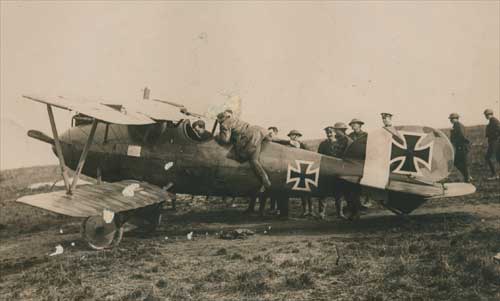 “One warm and bright day in late October, a German Albatross (Above) soared over the Canadian sector, glinting like silver in the morning sun. The snow-white blobs of bursting shrapnel from our anti-aircraft guns followed its graceful sweeps and curves, but never caught it, as thousands of our men stared. A British plane appeared flying low out of the west. The men in the Albatross were so intent on the landscape beneath them and trying to stay ahead of the anti-aircraft fire that they didn’t see the British plane until it was too late.”
In the ensuing battle, the Albatross’ gun seized and the damaged plane spiraled into the ground between the front and support trenches of the 14th Battalion. The pilot was dead but the observer, slightly wounded, crawled to our support trenches and surrendered. The German artillery tried to
destroy the plane but most of it was retrieved by the 14th including the machine gun that had jammed during the fight. Close examination revealed the gun was one of the original guns of our 14th Battalion, which had been abandoned during the Second Battle of Ypres, six months before.
The 21st Battalion was relieved on Nov. 1 and moved to Ridgewood in brigade reserve and then marched to La Clytte in divisional reserve. It was not very pleasant because it rained steadily for three days.
McBride describes the billets there as:
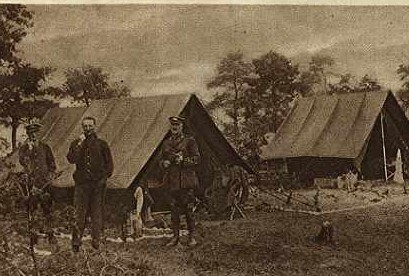
“Abominable. They consisted of so-called huts, which were simply floors with roofs over them: no walls at all – just a sloping, tent-like roof on top of a rough board floor. Outside they were partly banked up and smeared with mud as a camouflage.”
It was turning very cold now and would get much colder. One pleasure they had was to shower and clean up themselves, their weapons and their clothing. Then they were right back at drilling, with special instruction for the bombers and machine gunners, smoke helmet drill and a route march. Bill Nesbitt rejoined them on November 2 after his tour in hospital. They moved into the trenches again on November 7.
McBride:
“The winter of 1915-1916 was a wet one. It rained almost every day, although the nights were always cool enough to cause keen discomfort. The water and liquid mud in our trenches was anywhere from ankle to waist deep. We lived like muskrats. Looking back I don’t see how any human beings could have survived it but the amazing fact is that we not only did survive but there was very little illness.”
This time at the front the weather was mostly wet and perhaps because of that the action was called “quiet.” Still the 21st suffered three killed – S. Comego, T. H. Cochrane and E. Wilkie – and 8 wounded on this tour.
21st War Diary :
 “Nov. 8 – Germans were observed pumping water over their front line trenches. Our trenches are very wet, being over knee-deep in water in many places, making a diving suit more serviceable than the ordinary issue of clothing. Nov. 10 – Enemy quite active, sending over 120 artillery shells. (Imagine what it would be like; not only waiting for 120 incoming, but also to listen to the constant response from artillery and sniper fire from both sides while knee-deep in cold water in the pitch black of night)
Our bombers were successful in landing three bombs; two of them square into a working party. Nov. 12 – Only one Communication Trench is open and some rations and trench supplies are being carried to the front line at night in the open. The enemy is evidently in the same position. Because of the rain, nearly all the dugouts in the front line have fallen in and the parapets have fallen down. A new breastwork is being built behind the parapet in the left sector. Lord Brooke left the brigade to assume a new command. Nov. 13 – We were relieved and moved to Ridgewood in brigade reserve. Until we returned to the front on the 18th, we supplied all fatigue parties for the left subsection. This tour was the hardest one of all up to the present.”
Two men – C. Wendt and G. W. Gendron – died of wounds on November 16 and 17.
Corrigall:
“Nothing stands out more clearly in the minds of those who endured the rigors of that first winter than the constant demand for work parties. During the eighteen days in the forward area, the battalions of the 4th Brigade had an average of two hundred men working each night, and on several occasions as many as six hundred. One party would have to carry ‘knife rests’ from the Brasserie to the front line- sometimes two trips a night- another would work on the new breastworks being built behind the “O” trenches, another to fill and build up sandbags, another to work on the “Chicory Lane” communication trench, and still another to carry forward trench mats, wire and other materials. Night after night, under the direction of tireless NCO’s, in all sorts of weather, these fatigues continued.”
Maheux:
“ The last night we were in the trenches, one poor soldier got a pair of rubber boots from his wife. He put them on the same night he was killed. That is the fortune of war.”
Pte. Smith of the 5th CMR wrote on November 17:
“We arrived in our billet after having a bath. One hundred go into the baths at once, and then are issued clean underwear, new socks and grey shirts. We all leave our dirty clothes there. Everything is run on a perfect system here. We get five minutes to undress, fifteen minutes in the bath, and ten minutes to dress. It seems a funny coincidence, but Halloween night I was on picket duty, all alone, from 2 AM to 6 AM and I was thinking about the old boys in Colborne, wondering if they were doing the same old stunts at home. There is joy all around the hayloft where we are tonight. Nearly everyone has a letter or parcel from home. All have a candle reading them. I also received the Colborne Express and appreciate it.”
I should make it clear that any “rest” activity was also a working activity. The infantry was expected to supply labour for all kinds of activity such as – digging and repairing trenches, building and repairing roads, burying the dead, loading and moving supplies and maintaining camp areas. Because their time in camp was often the occasion for a General’s inspection, their “spare” time was taken up with drilling, and polishing and cleaning equipment. Enlisted men were sent to England on leave for one week per year. It was never well received by the men that officers might get three or four furloughs per year.
One private wrote:
“I am proud to say we have men as well as officers in the 21st Battalion who are ‘the bravest of the brave’ and should receive recognition. Capt. Morrison is one and Lieut. Miller another.”
Daylight usually saw the majority of the artillery activity, which Beaverbrook estimated at about 30,000 shells a month. But at night, two 1st Division Battalions carried out a series of 10 raids in November, using as many as ninety men per night. One on November 16 captured German troops and a new kind of German gas mask. Another killed at least fifty Germans and brought out twelve prisoners. The main objectives were to gain information and capture prisoners, lower the enemy’s morale, and kill as many Germans as possible before retreating. Two keys to their success were the careful planning and rehearsal of each raid (aided by aircraft and patrol observations) and the use of grenades in attacking enemy trenches. Such raids were not without costs and added significantly to the Canadian Division’s total of 688 killed and 2004 wounded in the 2-½ months from mid-September to the end of December 1915.
When the 21st returned to the front lines on November 18, another item they would continue to deal with in the trenches was dysentery, which was caused by bacteria from infected food or contaminated water. Sanitation in the trenches was very poor. Latrines holes were dug four or five feet deep somewhere near, but not in, the trench. They were treated with quick-lime and were supposed to be filled in when they got to within one foot below the surface, but this being a war zone, that was not always possible. The combined smell of the contents and the lime was awful. Anyone who fell out of favor with his officers might draw latrine duty for a few days. In addition, fresh water was not always available, which often lead men to drink whatever they could find. Both these factors contributed to the dysentery problem.
Again McBride talks about a patrol:
“One dark rainy night Lucky, from our machine gun section, decided to try and locate a new German machine gun emplacement. The lines were only seventy yards across at this point. He crawled along a shallow ditch, stopping frequently because of flares. The body of a soldier was lying in the ditch and, in trying to roll it out of the way, he pulled off one of the feet. It took him about an hour to work through the enemy’s wire. He then crawled along outside their parapet until he found the new gun emplacement, which he marked so our troops could see its location the next day. Then he got the bright idea to bring back the flag flying in front of the German lines. Avoiding garbage and tin cans in front of their trenches, he crawled a hundred yards more until he found the flag. The flag was tied with wires, which he cut, but as he attempted to yank it free, two shots rang out. It must have had one more wire attached which set off the rifle fire, breaking the flagstaff just below his hand and slightly cutting his hand. He rolled into a slight depression and waited until the resultant rifle and machine gun fire died down and then returned to his own lines. He gave the flag to the Colonel the next morning.”
4th Brigade War Diary:
“ Nov. 19 – One officer wounded at Brigade bomb school.
An enemy aeroplane landed at 4:45 PM in a plowed field and turned turtle. An unarmed party took a lieutenant and a sergeant prisoner. The plane suffered only slight damage and the crew was sent to the 2nd Division for interrogation.”
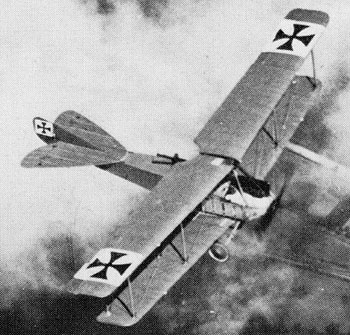 Many aircraft such as the German LVG 2 (right, or its predecessor LVG 1) were 2-seaters used in 1915 as reconnaissance planes. They flew over enemy territory, mapping or taking pictures of the trenches, to provide their artillery with better target information than could be obtained by observation from personnel sighting on the ground. It is quite possible that one of these was the type of aeroplane mentioned above. The 20th relieved the 21st on November 22, during a period of daylight fog, and Bill and Keith and their unit moved back to La Clytte.
On the second day of their next shift in the trenches, the Brigade Diary reported:
“Nov. 27 – Six men including Lieutenant Wilgress of the 21st Battalion were killed and three wounded. It was reported that one of our own shells exploded in our trenches causing a number of these casualties.”
McBride:
“Nov.27 – With no functioning communication trenches, our ration parties had to go overland – exposed to the enemy. Two men set out a bit late, so that it was light when they started. About fifty yards down the road they were in plain sight from the enemy line. A sniper fired and got P. H. Lanning through the lungs. G. P. Dupuis knelt down to assist and he got a bullet through the head, killing him instantly. One stretcher-bearer dashed out to help and was instantly shot, as were three others who attempted to get to the spot. Lieut. G. K. Wilgress stopped the stretcher-bearers and, with help of a Sergeant, found a route through a small ditch to retrieve the bodies. Four were dead and two wounded, one of whom died a few hours later. The bearers had worn the Red Cross on their white armbands, but were shot from a distance of one hundred yards anyway. An hour later, Lieut. Wilgress, who had been very popular with the officers and men alike, was killed- with others- by artillery fire. He was the first officer the battalion had lost.”
Also lost on that day were W. Ennos, H. Lewis, R.F. Trevor and J Fitzpatrick.
Nurse Drucilla Bowcott:
“The pain men suffered was frightful but we had nothing to give them. Aspirin was not much good but between that and morphine there was nothing. Morphine injections made them unconscious so it was given in only extreme cases.”
21st War Diary:
“ Nov. 27 – This was a bad day for the battalion. Our artillery retaliated quite heavily on the Huns and did a great deal of damage.”
I wonder whether this “retaliation “ was just out of frustration after the friendly fire or whether the Brigade didn’t tell the Battalion what happened and they were assuming the enemy was responsible. Bill and Keith had been exposed to a major incident of “friendly fire.” No doubt they were well acquainted with these men and perhaps even had to assist the wounded or help bury the dead. In any case I’m sure it would have had a devastating impact on them and the other men of the 21st Battalion.
However, an odd episode of friendly fire happened in the 20th Battalion. The cook told the men that he had rice but, if they decided to have rice pudding, there would not be enough sugar for their tea. They decided on rice pudding. The cook asked the sergeant to taste the rice pudding and, just as he was going to do so, a friendly “dud” anti-aircraft shell fell through the roof and landed in the pudding – sending it all over and upsetting the sugarless tea. A few moments later, there was a fire in the Company Headquarters. In trying to put out the fire someone knocked over the rum ration, which went up in blue and green flames. The result that night was no rice pudding, no tea and no rum.
To get food to the front it was necessary to send 6 men from each company back to the Brasserie each night to meet the transport. Both the trip back and the return to the front with the food supplies became much tougher as the winter brought frequent rain, sleet and snow. They could also expect periodic machine gun fire to liven the activity. One thing that everyone waited for was the mail from home that was sent in with the food. Mail might bring great joy and great unhappiness and probably in both cases, make the men wish they were somewhere else. I wonder at times like that if they thought back to their eager enthusiasm to join the “great adventure” and wondered how they could have been so naïve.
The next day, enemy artillery destroyed one of the brigade reserve huts at Ridgewood, although no one was injured. The snipers of the 21st claimed hits on one officer and seven men that day.
21st War Diary:
“Nov. 29 – Patrol could do nothing with an enemy patrol because they were unable to get in touch with them.”
Patrols had become a nightly occurrence and were somewhat helpful. One source says that all men were required to take part in patrols, so we can assume that Bill and Keith would have been involved. Men were often ordered to attempt to occupy a shell hole, which had been created in front of the enemy lines, to spy on the Germans. With blackened faces, they would crawl on their stomachs in the dark, hoping to spot any patrol activity from the other side before the enemy spotted them. R. Merolla was killed on December 1 and the 21st was relieved the next day.
21st War Diary:
“Dec. 2 – Continuous fatigue and working parties were supplied to the trenches during this stay.”
They spent three days in reserve at Ridgewood before going back to the trenches on December 5. Also on that day J. Cody died of wounds – probably received on the previous tour.
Corrigall:
“At the end of November the snow came, followed by a bitter cold. Standing on duty, sometimes knee-deep in mud, the agony of frozen hands, feet and body often made one involuntarily whimper. The chilling winds at dawn, whistling through the barbed wire, would hiss like a thousand snakes and lash the rain or snow against the pale faces of the peering sentries and staggering shapes with heavy loads on their backs passed all night along the slippery trench mats.”
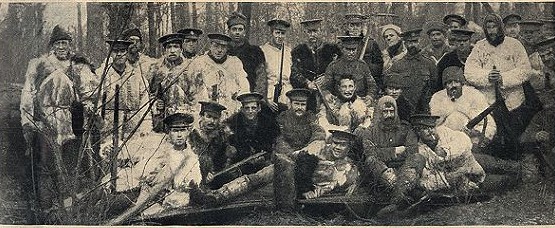
British soldiers are pictured (below) in some imaginative winter outfits.
Armageddon:
“Canadians knew about winter but few were prepared for Flanders. A driving, relentless continual rain filled every trench and shell crater. Mud liquefied and oozed from sandbags. From their higher ground, Germans added their drainage to the shells and sniper bullets they poured on the Canadian trenches. Sleet, snow, and bitter winds were countered only by the morning tot of rum.”
The Brigade diary stated that it was quiet during their next shift in the trenches and that it rained every day until they were relieved on December 10 and returned to La Clytte.
A Cobourg private wrote home:
“Dec.14 – We are just out for a rest and we are getting some bad weather. It rains five days out of six.”
McBride also wrote about a chance he had to shoot at a German burial party, but he declined until he learned that German snipers had just killed a stretcher-bearer and the wounded man he was helping. He opened fire and “could see numbers of Germans lying about on the ground.”
Anthony Eden described a British patrol:
“We worked our way across no-man’s-land without incident and began to cut the enemy’s wire. We made good progress and there were only a few strands to cut when suddenly two German heads appeared above the parapet and began pointing into the tall grass. We lay flat and still for our lives, expecting every second a blast from a machine gun or a bomb in our midst. But nothing happened. We lay still without moving for nearly an hour. There were no abnormal noises from the German lines so we decided to go on. The job was nearly done when all hell seemed to break loose in front of our faces. Rifles and machine guns blazed but nothing touched us, presumably because we were much closer to the German trench than they ever thought possible. They fired into no-man’s-land or into our trenches.”
It is interesting to think how future events might have been changed on that night, because Eden went on to become Prime Minister of England.
A man, whose unit I don’t know, wrote:
“My Lieutenant sent me out to repair some barbed wire. I went through the mist with two chaps and was lying on my back under the obstacle when suddenly the moon popped out. Then the Boches saw me and opened fire. They broke the entanglement above my head, which fell on me and trapped me. My companions got back to our trenches and said I was dead so the Lieutenant ordered a volley of fire. The Boches did the same and the artillery joined in, with me bang in the middle. I got back to the trench, crawling on my stomach, with my roll of barbed wire and my rifle.”
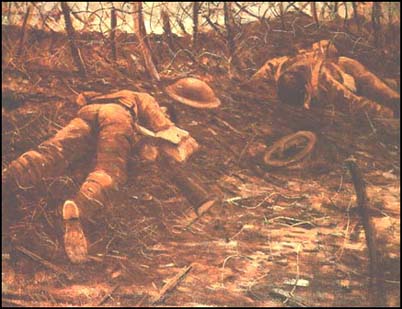
For another perspective on patrols, this is what a former army Lieutenant (unit unknown) wrote, although I find it hard to believe that he would actually commit this to paper:
“After this I went on patrol fairly often, finding that the only thing respected in young officers was shell. Besides, my best way of lasting through to the end of the war would be to get wounded. The best time to get wounded would be at night and in the open, with rifle fire more or less unaimed and my whole body exposed. Best also to get wounded when there was no rush on the dressing station services, and while the back areas were not being heavily shelled. Best to get wounded, therefore, on a night patrol in a quiet sector. One could usually crawl into a shell hole until help arrived.”
He got his wish and lived to tell the tale
During the shift in the trenches that started December 16 for the 21st, the weather was described as fine but there was not much action. Nevertheless there were several wounded and A. Carman was killed. On the 18th, there was a period of four hours when gas from a German position drifted over the area, causing some eye and throat trouble but no serious damage. On the 22nd, they retired to Ridgewood in Brigade Reserve.
21st War Diary:
“Dec 23 – The usual fatigue and working parties were provided by the battalion. The accommodation at Ridgewood was far from pleasant.”
At the front that same day, the Germans landed a bomb on a machine gun post of the 20th Battalion, which contained three men. Two were wounded but the third man could not be found until someone noticed that he had been blown right over the parapet and his body was found draped over our own barbed wire. 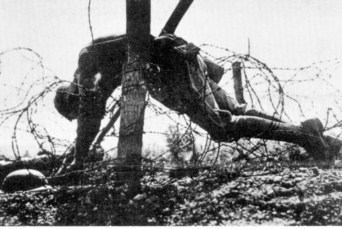
(Perhaps like this picture ). Snipers fired upon the party that was taking one of the wounded men back to the aid post along Sniper’s Barn Road. Two were killed and several injured and the wounded man died six weeks later. This incident was also described by McBride of the 21st Machine Gun Section, who saw it from a reserve trench and opened fire on the German snipers to provide cover to permit rescue of the wounded. Afterwards, he went for Christmas dinner of turkey and plum pudding at the Café de Dickebusch Etang, which had been an exclusive roadhouse before the war but was now surrounded by Allied artillery.
Corrigall:
“After that, out thoughts were filled with anything but ‘peace and goodwill’ towards our goose-stepping friends across the way. Rain and cold on Christmas Day did not help brighten things up.”
21st War Diary:
“Dec 25 – Christmas Day – Rest Day. No fatigues or working parties. Celebrated in a very quiet manner with plenty of Christmas puddings.”
I wonder whether they felt they had anything to celebrate, except perhaps the fact that they were still alive.”
McBride:
“Christmas 1915 was a quiet day on our front. There was no firing of any kind and both our men and the enemy exposed themselves with immunity, even going into no-man’s-land to hunt for souvenirs. However there was none of the visiting and the fraternization that took place on the previous Christmas.”
They were back in the front lines on the evening of December 28. The next day nineteen Allied planes flew over in the afternoon, dropping bombs on German trenches.
21st War Diary :
“They all returned safely in spite of the efforts of Hun anti-aircraft guns to destroy them.”
The year 1915 ended with German rifle grenades and machine gun fire being answered by heavy Canadian artillery fire. E. H. Turner and E. G. Thomas were killed.
 Stories