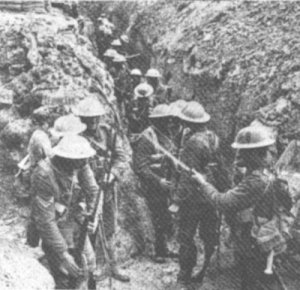
 Meanwhile, the battle at the Somme, which had started in July with a British attack, continued. Each side was yielding little but losing a lot in manpower. The picture (left) shows British troops moving up. The picture (below) shows the aftermath of one of the early battles.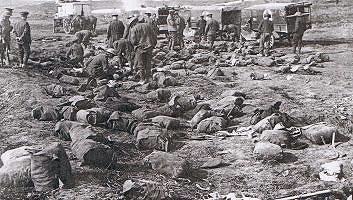
After their brief training period the Canadian troops began the fifty-mile move south to Albert. The 1St Division arrived in Albert on September 1, followed by its Divisional Artillery a few days later, and moved quickly into the front under a German barrage, which was meant to shake their morale before they could get settled. The 2nd Division, including the 4th Brigade, 21st Battalion and 4th TMB, started out on September 5 by foot, by train and by foot again. They traveled about fifty miles from Audruicq to Auxi-la-Cateau, Fieffes, Rubempre, Vadencourt and finally to the Brickfields at Albert. War Diaries were no longer kept for the Light Trench Mortar Batteries, although they continue to be mentioned in the Brigade Diaries, so specific information about them has been harder to find.
Excerpts from Instructions for Movement:
“Each train consists of one Officer’s Carriage, 14 Flat Trucks (for freight and vehicles) and 24 Covered Trucks. Each Covered Truck will take 6 heavy-duty horses or 8 light-duty horses or 40 men. Units will arrive three hours before departure of the train. (Hurry up and wait). Pickets must be provided at all stops for each end of the train to prevent troops leaving.”
Corrigall:
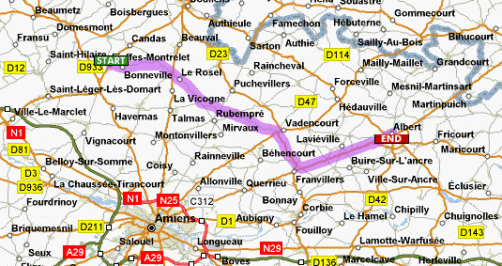
“We entrained at Audruicq and at 10 PM, started traveling southward all night long through a well-populated part of the country, interspersed with numerous villages. No one slept well, owing partly to overcrowding, partly to continual stops and starts, but mainly to the excitement caused by the nature of our mission. The following morning we detrained at 6 AM.”
After the train ride, all the units of the 4th Brigade marched for 3 ½ days, from Fieffes- Montrelet to the Brickfields outside Albert, arriving at noon on September 9. On one of those days, the brigade reported 12 marching casualties.
Not much has been said about the bayonet but, on September 8, while the 21st was en route to Albert, 200 bayonet-wielding Germans attacked twenty-six soldiers of the 1st Division. Roberts:
“They succeeded in forcing their way into the position but the little party of defenders held their ground with bomb, rifle and cold steel until reinforcements came up, whereupon the assailants were expelled with heavy loss.”
Two days before the 4th Brigade arrived at the Brickfields, Donald Fraser of the 6th Brigade wrote:
“At the Brickfields, the brigade bivouacked, crowded into small sloping oblong tents. Our bivouac tonight was extremely cold and very few slept. The camping ground was windswept and towards evening bitterly cold. Many more nights of this and our usefulness will be on the ebb.”
Corrigall:
“The weather has been beautiful. The marches have not been long and we all enjoyed passing through a country which is so different from Belgium. The people are more hospitable and appear to be more prosperous than in Flanders. Their farms are larger and their buildings more extensive. We caught sight of the familiar names “Massey-Harris” and “McCormick” on some farm implements. We passed units of the 3rd Brigade on their way out for a rest after their first experience in the Somme. Their casualties during a three-day tour had been heavy, due mainly to severe shell fire. As soon as we reached the Brickfields, we marched to the nearby River Ancre for a badly needed bath.”
 4th CMR History”
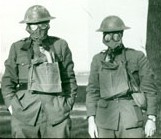
“Innumerable troops billeted themselves in tents, lean-tos and old German dugouts. Unshaven, tired, and worn companies silently coming out passed noisy, high-spirited battalions, laden with rations, ammunition, sand bags and gas masks (left). The Brickfields were congested with bell-tents and transport lines. An occasional shell would frighten a horse from the picket line and start him careening through the tented area, followed by an irate groom and cursed by the inmates of the tents.”
102nd Battalion History:
“Albert impressed the beholder with the dull feeling of stark misery. It was not wholly destroyed but for the most part it was deserted.”
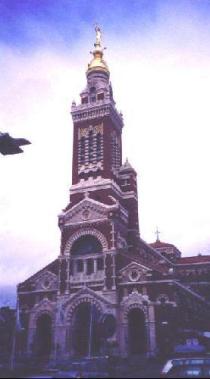
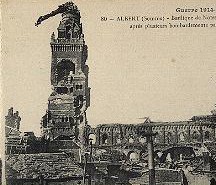 “At Albert we were all very interested to see the figure of the Madonna and Child leaning at right angles from the spire across the street (right in 1916 and below left as seen today). We were shown an open space known as the ‘Brickworks’, a spot in which we were to spend the night, managing to secure a few ‘Bivvies’ to protect us from the weather. As these ‘Bivvies’ held about twelve men and were open at both ends and as the weather at this time was very wet and cold, it can be imagined that not much sleep was obtained.”
Corrigall:
“September 10 – The C. O. attended a demonstration of a new war machine, which was reported to possess great destructive powers and was going to be used for the first time in the next attack. The brigade diary referred to them as ‘Caterpillars’. We were told that our 2nd Division was to make an attack on September 15 and that we were to be part of the assaulting troops. The plan was for the 4th and 6th Brigades to lead the attack with the 5th Brigade in support and the 15th British Division on our right and the 3rd Canadian Division on our left.”
Roberts:
“September 10 – The 2nd Brigade drives back several German raids, repulsing a strong and determined attack from Mouquet Farm. 3rd Canadian Division arrives at the Somme.”
“On the 11th, Major-General Turner, commanding the 2nd Division, transferred his headquarters to Tara Hill and assumed command of the sector. Throughout the nights of the 10th and 11th, the 2nd Division was busy relieving the 1st Division, the relief being carried out under extremely trying conditions at the cost of many casualties. The lines being relieved and all the stripped and tortured waste behind it were swept by an unceasing storm from the German gun positions. Communication trenches had been pounded out of existence and landmarks obliterated. The enemy also was sending over many gas and tear shells. Some platoons went astray in the darkness and bewildering uproar, and were hours late in reaching their trenches.”
Despite heavy shelling, the 19th Battalion worked feverishly for several days, digging new tunnels and saps to push forward the jumping-off points 100 to 150 yards closer to the German lines. In the 21st Battalion. T. Beaupre was killed.
102nd Battalion History:
“Tara Hill, on the Bapaume road, had an encampment of bivouacs (probably pup tents or improvised shelters). You could look down from the camp on the hill to the road below. It was literally alive by day and night, with a never-ending stream of vehicles of all kinds, laden with ammunition going east or crowded with weary soldiers coming west, ambulances, ration-wagons, and motorcycles. All the traffic of an army actively engaged poured ceaselessly back and forth along this main highway, which miraculously escaped destruction by the enemy artillery.”
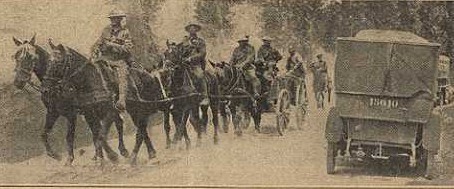
An Australian Journal:
“We moved out of the trenches to Tara Hill. Just as we were preparing to go to sleep, Fritz lobbed shells around us and one went into a deserted gun pit where several men were sleeping. Our Colonel escaped with only shell shock but four of our best officers were gone in a second.”
Also on September 11, just in time for the proposed attack, Corporal Keith Roblin reported once again for duty with the 21st Battalion. They had moved to the reserve trenches the day before, in an area known as the Sausage Valley. That was the name given to a shallow valley south of La Boiselle. It was so named because the Germans often flew an observation balloon, which the British called a sausage, at the head of the valley. To get there they had to pass through the ruins of Pozieres (seen before the war, below).
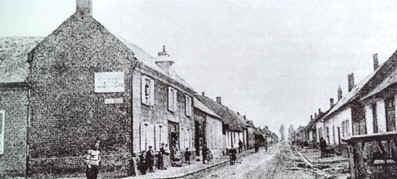
The Australians and the British had destroyed this village on July 23rd. It was quickly overrun as they advanced toward Pozieres Ridge but the Allies soon bogged down and it had taken two weeks for them to finally capture this strategic outlook.
Even though they were in reserve the 21st reported 1 Officer and 2 Other Ranks wounded. Bill Nesbitt and the TMB were in the front lines.
21st War Diary:
“Sept 12 – A German biplane was brought down behind our lines by one of our planes. It was on fire coming down and the pilot and plane were completely buried on reaching the ground.”
R. Airth and A. Kean died that day. About four miles east of Albert stood the remains of the village of La Boisselle (the picture shows a portion of the tiny village of La Boisselle before the war)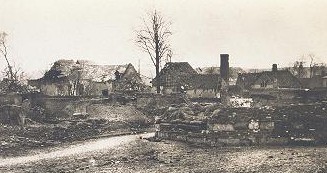
4th CMR History:
“The men saw for the first time on either side of the road the devastation of the Somme battlefields. Not a tree was standing; La Boiselle was a heap of rubble and the remains of its buildings had been used to fill the shell holes in the road. Shell cases were strewn along the roadside or marked old battery positions. Tangled wire (along with mine holes and craters – below) and mutilated trenches covered the barren waste as far as the eye could see.”
102nd Battalion history:
“About four miles east of Albert the road forks into a “Y”, here at the apex once stood the village of La Boiselle, of which one stone did not remain upon another. Close by were two enormous craters worthy of note.”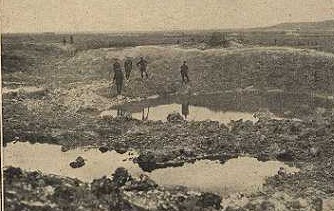
 Stories