The Situation in Europe
From the top of Tolsford Hill, adjacent to the camp, they could see France.
McBride:
“From ‘the promised land’ we could hear the big guns nearly every night and we could not understand why we were not allowed to go over and settle the whole business.”
In the previous few weeks there had been an ongoing battle around Ypres, where the Germans mounted a major offensive against the French, using poison gas for the first time. The Germans made a significant advance but were stopped by the British Second Army. As a result, the Allies lost considerable high ground around Ypres and German artillery demolished the town. Heavy fighting and further gas attacks caused huge losses on both sides and continued until April 25, 1916, shortly before the 21st arrived at West Sandling. The loss of 6,000 killed, wounded or missing in the 1st Canadian Division came as a great shock to Canadians everywhere.
At a memorial service held in London’s St. Paul Cathedral, the Bishop of London said:
“It was on that tremendous day, when French and British had been overpowered by poisonous gas, that the manhood of Canada shone out like pure gold. The example of these men will never die, but will remain as a perpetual inspiration to their successors.”
West Sandling
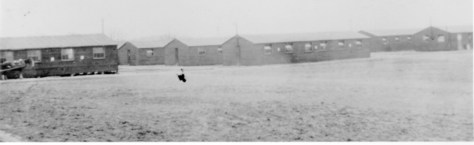
Corrigall:
“Our camp, which was adjacent to the camps of the 5th and 6th Brigades, was laid out in the form of a large square, divided into four parts – one to each of our Battalions. Each part contained a parade ground, sleeping huts, offices, stables and stores.”
The British training officers, assigned to the 21st, told the soldiers that their months of training in Canada had been worthless. The officers of the 21st, who had been appointed because they could attract volunteers, had no time, knowledge, or inclination to be instructors or disciplinarians. British instructors rated newly arrived Canadians as “two-week recruits” and drill, route march and shooting began all over again.
Among the first activities at the new camp was the appointment of five staff sergeants from the School of Musketry to instruct in fire discipline and training. Many 21st Battalion officers were sent to other places in England to take British Army courses. The first few days were devoted to musketry instruction, physical drill, bayonet fighting, company drill, battalion drill and lectures on marching discipline. Reveille was at 5 AM and parade usually started at 7:30. Because of the large number of men to be trained and the stress placed on shooting well, the rifle ranges were in use daily from 5 AM to 7 PM. West Sandling had special significance to Bill because he was appointed to the rank of Sergeant on May 20.
Beaverbrook:
“It is the old story of learning to do things under favourable conditions so thoroughly and completely that in moments of stress they are done almost sub-consciously, leaving the mind free to grapple with anything novel there may be in the situation or in the actions of the enemy.”
In the beginning, the men were given individual skills training as scouts and bombers but as the weeks passed they moved to company, battalion, brigade and divisional training and exercises. The latter often featured mock battle scenarios against other units and, of course, included lots of marching.
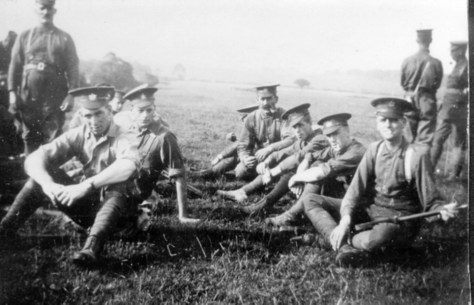
McBride:
“We marched all over Southern England and I know I have slept under every hedge-row in Kent. We dug trenches one day and filled them up the next. We made bombs and learned to throw them. We mastered every kind of signaling from semaphore to wireless, and we nearly wore out the old Roman stone roads hiking from Hythe to Canterbury. But what a tough lot of soldiers it made us. Without that seasoning we would never have been able to make even the first two days’ march when we finally got across. The weaklings fell by the wayside and were replaced. I believe that battalion was about the toughest lot of soldiers who ever went to war.”
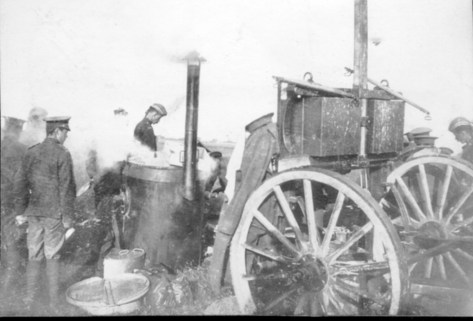
At the Battalion Commanding Officer’s parade on May 28, the men wore equipment, which had just been issued to them. In the rush to recruit and train them, equipment manufacturing had not kept pace with the needs of the army. Several route marches were added to their training regimen in June. One activity that occurred on a daily basis for several days was – “Instructions in paying compliments”??
McBride:
“There was one thing about which we had a real grievance and that was the food. This was the only period when we did not have plenty of good food. In Canada and later in Flanders and France we had an abundance of the best quality. Anyway we survived and were none the worse for it.”
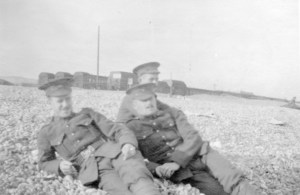 One of the most frequent entries in the War Diaries is about the constant parade of men going to and coming from area hospitals. Two big pluses for the 4th Brigade was that they were training during summer and their location gave them plenty of towns such as Hythe, Margate, Ramsgate, Canterbury and Dover, where they could spend their off hours and off days. The picture shows George Jones (left) and Bill on the beach at Folkestone. At the end of June, the 4th Brigade was taken over by Colonel Lord Brooke of England.
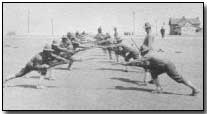
At the same time there were three days of bayonet fighting (above), company drill and battalion drill and on June 30 Private X was charged with conduct to the prejudice of good order and discipline and Private Y with desertion. Later there was a lecture to officers on entrenching and improving trenches. Sundays always featured Divine Services
Maheux saw training this way:
“Their hundred of poor fellows here, when they join the army in Canada they thought it was only fun, but now they see their mistake but it is too late. Every night I am played out but I don’t care, I am getting the money.”
Brigade War Diary
“July 1- Battalion Sports in the afternoon, this being Dominion Day.”
“July 5, Brigade commenced Battalion training.”
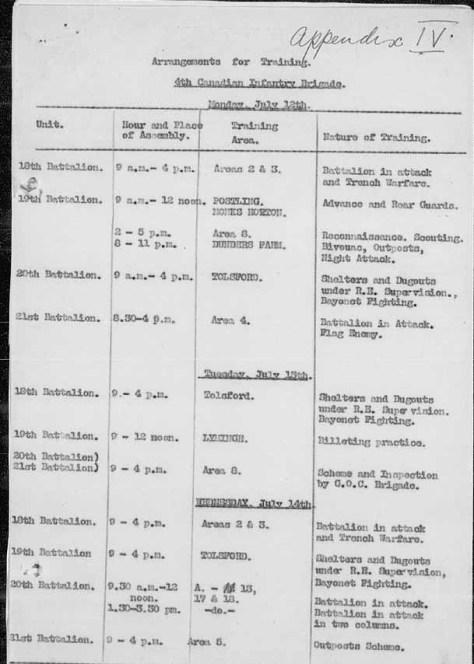
On July 8, the Minister of Militia and Defence sent a telegram:
“Please convey to all Canadians my appreciation of and congratulations for their splendid work at the front and in Britain.”
July 16 had a Divisional inspection by the Prime Minister Robert Borden and Sam Hughes with the 21st Battalion reporting for muster at 6:30 AM, having rehearsed for the event the previous day.
Lieutenant Peterson of Cobourg wrote:
“This was our first and it certainly was a great sight.”
Brigade War Diary
“July 20, Commenced Brigade March and billeting scheme.”
Tactical training sessions included Battalion in Attack, Occupation of a Defensive Position, Night March and Attack, Protection and Rest, March Discipline, Protection on March from and to Camp and Tactical Scheme with Flags. In late July there was a mock battle against 20th Battalion and a brigade attack. On August 3, there was an all-day brigade march and billeting scheme, with light rain before they left and pouring rain later.
Sam Hughes and Bonar Law, the Canadian-born British Secretary for the Colonies, inspected the 2nd Division the next day. Midway through the inspection there was a thunderstorm and heavy rain and the troops were soaked. I wonder what was going through Bill’s and Keith’s minds. Were they patriotic, tired, proud, annoyed, anxious to get on with things, aching for their next leave or just plain miserable? Did they know that they were far more comfortable than they would be for the next few years?
After the soggy march past of superbly fit Canadians, Law said:
“The world knows what you have sacrificed and that every one of you is prepared to face danger and death and to give a good account of yourself when the time comes.”
In their rush to sign up for the big adventure, how many of them had seriously considered that they might be injured or killed? Doesn’t it always happen to the other guy? Afterwards the 20th Battalion was allowed to shelter under trees, until the Brigadier spotted them and demanded: “Outrageous! Get your men back at once.” Perhaps he had a pretty good idea of what they were to face in Europe.
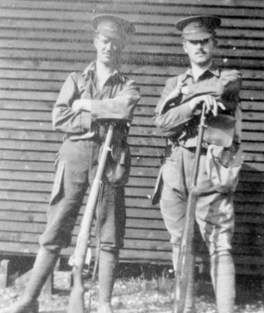 The very next afternoon the Battalion, including Keith (on the left outside their barracks) and Bill, were hard at work digging and carefully constructing a third line of trenches on Tolsford Hill in pouring rain. The next week stressed Battalion training in tactical schemes with flags and entrenching and bayonet fighting. Whenever possible, musketry, machine gun, bombing and scouting practice sessions were held. On August 19, Private McBride of the Machine Gun Corps was promoted to Lance Corporal. This is the McBride who became a Captain before the war was over and wrote “The Emma Gees” and “A Rifleman Went to War.” The latter part of August was spent on brigade and division schemes with the troops billeting away from the camp.
Maheux:
“We are so tired of drill we are ready to take any hardship.”
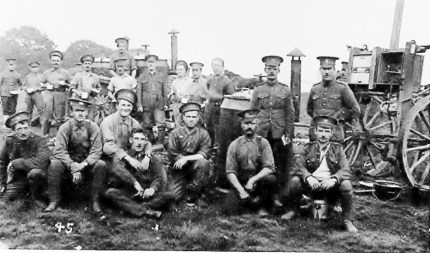
In the picture of the men taking a break (below) Keith, with rolled up short sleeves, is fifth from the left in the second row and Bill is on his left in the unbuttoned tunic.
Corrigall:
“Training in the digging of trenches and the weaving of wire entanglements was carried out on Tolsford Hill. Every type of trench was traced out and constructed. Sandbags were carefully laid; each piece of revetting was scrupulously set in place; fire steps were symmetrically built and parapets had neat armrests. One night we did a practice relief and occupation of the trenches after dark. Owing to lack of proper instruction, it was badly done.”
On August 26, the Battalion received instructions for proceeding abroad. The next day, the men of the 20th, unhappy to hear that their C/O was being returned to Canada, staged a demonstration as he left and were saved from severe discipline by several battalion officers, who persuaded them to go for a quick swim and then return to camp. For the 21st the month ended with a court marshal hearing.
The British had created a tradition that a Royal Inspection was held when a division was ready for action. Therefore King George V of England, with Lord Kitchener, British Secretary of State for War, inspected the 2nd Division at nearby Beachborough Park, Shorncliffe on September 2, 1915.
21st War Diary:
“The men are dressed for Marching Orders and the officers do not wear swords. The weather – fine.”
Beaverbrook:
“Under a grey and gloomy sky. ”
His Majesty:
“Six months ago, I inspected the 1st Canadian Division before their departure for the front. You are leaving to join them, and I am glad to have the opportunity of seeing you today, for it has convinced me that the same spirit that animated them, inspires you also. The past weeks at Shorncliffe have been a period of severe and rigorous training; and your appearance at this inspection testifies to the thoroughness and devotion to duty with which your work has been performed. You will meet hardships and dangers, but steadfastness and devotion to duty will carry you through all difficulties. History will never forget your loyalty and the readiness with which you rallied to the aid of your Mother Country in the hour of danger. My thoughts will always be with you. May God bless you and bring you victory!”
Lord Kitchener was killed nine months later, when a mine blew up the HMS Hampshire off the Shetland Islands on its way to Russia. The 21st Battalion spent the rest of the week in trench warfare activities.
With departure imminent, the battalion concentrated on organization and continued physical fitness in fine weather. The unit was brought up to strength according to the War Establishment, several NCOs were returned to the ranks and several others were transferred to other commands, while privates and lower NCO ranks were promoted to replace them. On September 9 and 10, they filled in the practice trenches they had dug on Tolsford Hill.
Several 2nd Division sources state that the battalions were issued new British uniforms, boots, webbing and equipment- all of it new and stiff. This would be consistent with the
Brigade War Diary: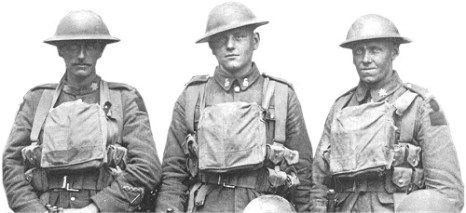
“The Oliver equipment was exchanged for Web equipment “.
The steel helmet was not issued until March 1916).”
McBride:
“We received the Web equipment which was much more satisfactory in every respect. The shoulders straps were broad and comfortable to the body; the pack-sack was large enough to carry all necessary clothing, and the haversack easily held all the little personal items as well as a couple of days’ rations. The ammunition pockets were all at the front. This not only made them easier to get at but served to balance the weight of the pack on the back. The water bottle, holding a full quart, was carried on the right hip and the bayonet on the left, with the haversack just behind it. The entrenching tool was carried in the middle of the back. When going into action, the pack was detached instantly. On the whole, I consider it the most comfortable and satisfactory equipment I have seen for foot soldiers. At West Sandling, we wore a peaked cloth cap with a flat, round top. Later these were replaced in Belgium with a soft crowned cap with side flaps to cover the ears. In addition we had a Balaclava cap or toque. Our uniforms were of a good woolen material. Heavy woolen socks were supplied in abundance by Canadian women’s organizations. The shoes were heavy and clumsy but they had to be to stand the wear.”
It occurs to me that this might have kept Bill and Keith from dwelling on what was coming. On the day before departure, the Honorable Captain W. E. Kidd was appointed Chaplain.
 Stories