The Command
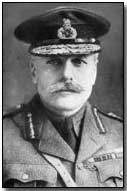
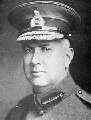 With two divisions now in Europe, they became the Canadian Army Corps but were still under the control of the British Army’s Sir Douglas Haig (left). Despite lobbying by Sam Hughes, the new corps was commanded by the British General Alderson. Canadian Generals Arthur Currie (right) and Sir Richard Turner led the 1st and 2nd Divisions respectively and Malcolm Mercer commanded the Canadian Corps Troops.
The 3rd Canadian Division would not arrive in its entirety until January 1916. In Bill and Keith’s 2nd Division under Turner, British Lord Brooke commanded their 4th Brigade and W.S. Hughes continued to lead their Battalion. These were a few of the men who would hold the fate of our boys in their hands.
The Situation in Belgium and France
After the 2nd Battle of Ypres in April 1915, the British would have preferred to hold back future offensive moves until well-trained reinforcements became available in 6 months. The French pushed for attacks and pointed out that the Germans had diverted many of their resources to the Eastern front against Russia and Poland and besides a large part of their country was being occupied. A month-long battle at Artois in May succeeded in gaining some territory for the French at the cost of 35,000 killed and 65,000 wounded.
In a supporting action at Festubert, the British (including Canadians) gained ½ mile of territory at the cost of 3,620 dead, 17,484 wounded and 4,321 missing. Similar losses to the German side resulted in both sides digging new trenches and settling in again. Urged on by the French General Joffre, Canadians again attacked a month later on June 15th at Givenchy. When the 1st Brigade attacked, a British mine exploded prematurely and the 2nd Battalion, trying to attack over uncut barbed wire lost nearly 400 men in a few minutes. This is where things stood when the 2nd Division arrived in Belgium in September.
McBride:
“General Alderson looked us over and told us what a fine body of troops we appeared to be, and for that, he was going to let us go right into the front line, instead of putting us through the usual preliminary stages in reserve and support.”
It was also true that there were too few troops on the front lines and the 2nd Division was needed to fill gaps and extend coverage further north. The next day, September 18, the 21st had another hot march of about 15 kms. from Eeke to Dranoutre .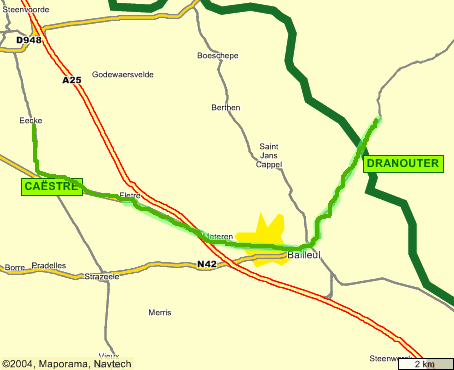 Along the way they passed ordnance workshops, reserve ammunition dumps, transport depots and an airfield on the grounds of an asylum.
McBride :
“ We moved out at dawn and had another heart-breaking march as the weather turned very warm. We stopped for an hour in Bailleul, a famous ancient city. The Hotel de Ville and the Hotel Faucon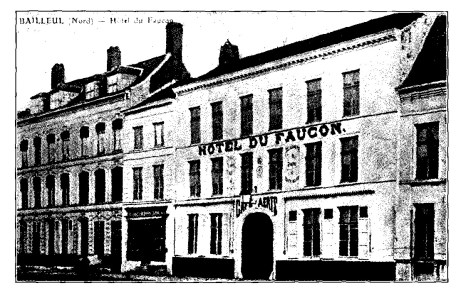 particularly interested me: the former with its twelfth century weather vane and the latter because it had real beer on ice.” (How did he know?) We saw evidence of war – a grave beside the road, a house that showed the effect of shell or rifle fire and we saw firing at both Allied and German planes. We bivouacked in a field adjacent to Dranoutre and were allowed to ramble about and visit in the town itself. Very few of us had money enough to do much in the way of celebrating, so it was a very tame proceeding.”
Soldiers of the Pioneer Corps were busily engaged in repairing the roads, and in this work, they were assisted by detachments of German prisoners, each wearing on his back the conspicuous P G
(Prisonnier de Guerre).”
21st War Diary:
“Weather fine- very hot. They went under canvas for the night.”
Corrigall:
“There were no stragglers on this march.”
As was customary, the officers of the 21st Battalion went forward to inspect the trenches that they would be taking over and to discuss their position with the British troops who now occupied them. They had to make all relief arrangements after dark so the Germans would not see them. “A” and “C” Companies, with Bill and Keith, were to take over their trenches the next night. Corrigall says that his battalion sang songs on the six-mile trip to the front such as “Keep your head down Fritzie boy” (one of Keith’s favorites), “Keep the home fires burning” and “Pack up your troubles.”
General Alderson once told another unit:
“New troops shoot at nothing the first night. You will not do so for it wastes ammunition, hurts no one and the enemy says – ‘These are new and nervous troops’. As a result you will be attacked.”
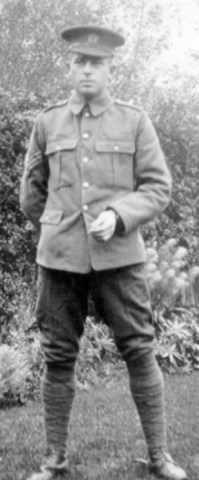 However fate had something different in store for Bill (left) who was finally sent to the # 14 Ambulance train to treat his pulled groin. At the 2nd Canadian General Hospital the diagnosis was changed to a hernia and, after a few days there, he was sent to England on the Hospital Ship Anglia for treatment of boils. He was admitted to the 3rd Northern General Hospital for 2 ½ weeks and rejoined the unit, without having surgery, on November 2.
Beaverbrook:
“An interval of calm, or such calm as modern warfare knows, was in effect. It is well for the soldier that there should be such intervals, for the strain of modern action, were it never relaxed, would destroy the mind and nerve of man as surely as the continuance of its shell fire must destroy the body. The scene is laid in a sector south of Ieper (Ypres) and to the north of Armentieres. Its most southerly position is marked by a number of spinneys, small eminences, and commanding heights such as that at Kemmel, (below) from which the enemy lines can be overlooked. But portions of it are dead level.”
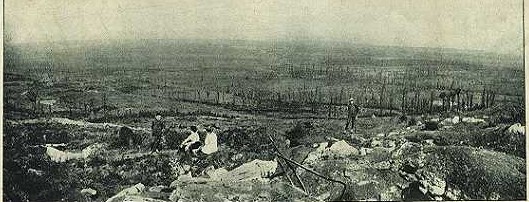
The 21st, which shared these trenches with the 20th, would have looked at their new surroundings as Corrigall did:
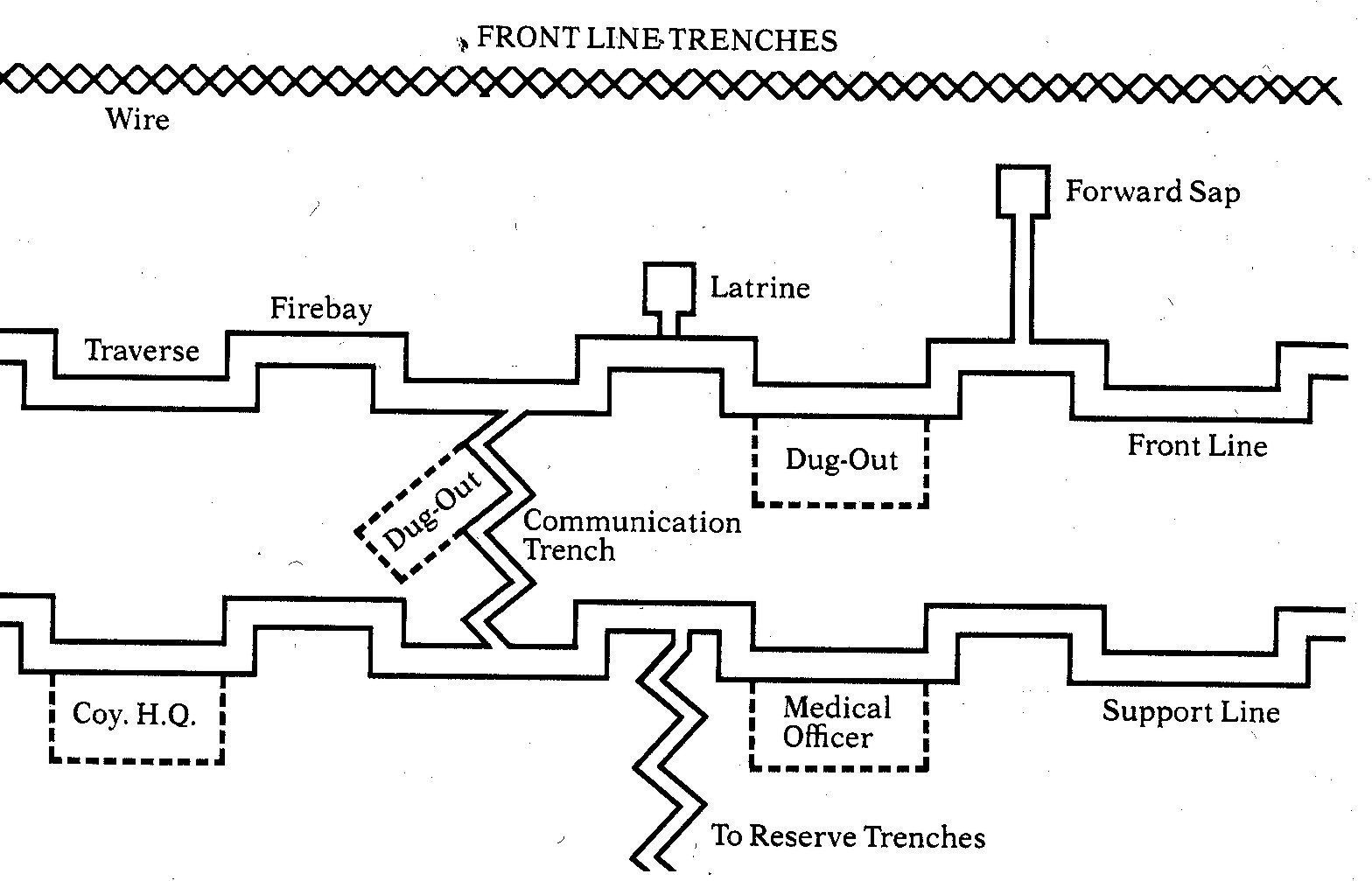
“In the shadows in the darkness, we stood on the fire-step to peer through the gloom to the German lines, trying to restrain the nervous excitement within us. Sentries were on duty, listening posts had been manned and, out in no-man’s-land, the scouts were on patrol forming a protective screen against surprises. The stillness was tense and eerie, broken only by the crack of single rifle shots, occasional burst of machine gun fire or salvoes of whiz-bangs. Star shells burst in brilliant sprays, illuminating the area for a moment as brightly as day. In the morning they explored the sniper’s loopholes, gas gongs, bomb stores, cookhouses, sergeant-major’s quarters where the rum was kept, officer’s dugouts, machine gun emplacements and, most popular of all, the periscopes through which one could watch the enemy lines in safety.”
Periscopes had a short life, as they were a favourite target for enemy snipers.
The 21st War Diary described Keith’s first day in the trenches:
“Snipers report eight probable hits and some ‘possibles’. Weather fine and dry. Bombardment by our artillery at 4 PM. No Casualties.”
Brigade War Diary:
“The trenches taken over were in a first class state.”
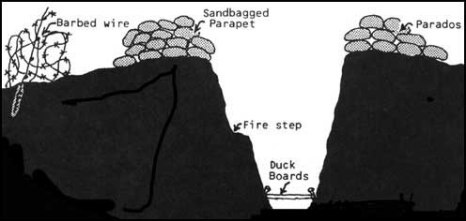
Nevertheless the Engineers Battalion worked on the trenches and dugouts continually, both to improve them and to repair enemy fire damage.
Some members of the battalion were designated as scouts. McBride says that the regular business of a scout in the trenches – “Was to exercise control over the permanent battlefield that was a feature of this war: checking the condition of the wire on both sides and enemy outposts and front line positions; establishing listening posts and daylight observation posts; checking on all enemy activity and undertaking various special investigations.” They would start on these activities immediately.
McBride was in the Machine Gun Corps and he describes his first trip to the front with a small party that went in daylight:
“It was a bright Sunday morning. Our sector was known as the ‘C’ trenches (See black line on map), running north from the Neuve Eglise-Messines (Nieuwkerke-Mesen) road and directly between Wulverghem and Messines.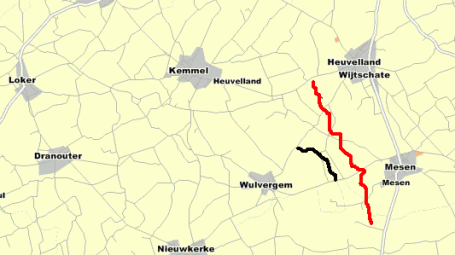
Although this region had been ‘quiet’ for several months, there is always artillery firing and sniping going on, along with rifle grenade and trench mortar activity.”
‘Quiet’ means that there is no attempt being made, by either side, to attack in force and to capture and hold captured ground.
(As we look at some of the maps in our story, it should be noted that there were often 2 or 3 names for the same place, depending on whether the Belgian, French or English spelling was used – e.g. La Clytte / Klijte, Messines / Messen, Neuve Eglise / Nieuwkerke, Wytschaete / Wijtschate, Dranoutre/Dranouter and Wulverghem might or might not have an “h” in it. As long as you allow for this you shouldn’t get lost.)
We took a roundabout route (from Dranoutre) that took us to Wulverghem. Along the way we passed more graves with crosses, houses and barns torn by shells, a bridge and railroad track blown up and trees shattered until we finally came to utter desolation (see trench near Wulverghem, below). Wulverghem had been a village, and probably a prosperous one, but now it was nothing but a ruin. No person lived there, every building having been utterly destroyed by German shells. Even the church had been destroyed, with only one side of the clock tower remaining. The enemy persisted in shelling the ruined edifice every day that we were there. Thousands of shells were wasted on that little place and the partial clock tower was still there when we left.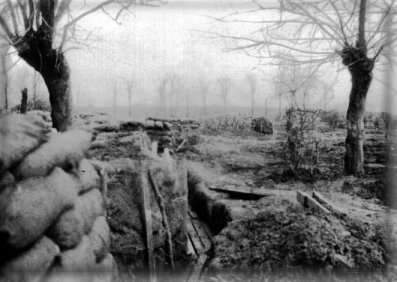
Our Battalion headquarters was located 200 yards south of Wulverghem. Just as we arrived there we took cover because of German airplanes. As we moved forward again, we entered a communication trench called Surrey Lane. At various points we came across intersecting trenches until we came to the front line trench, which was dug down four feet and built up four feet with sandbags. It was dry and clean and comfortable. We did not properly appreciate it at the time, but I must admit that it was the finest trench we ever occupied. We were immediately offered tea, bread and butter and jam by the splendid British soldiers.
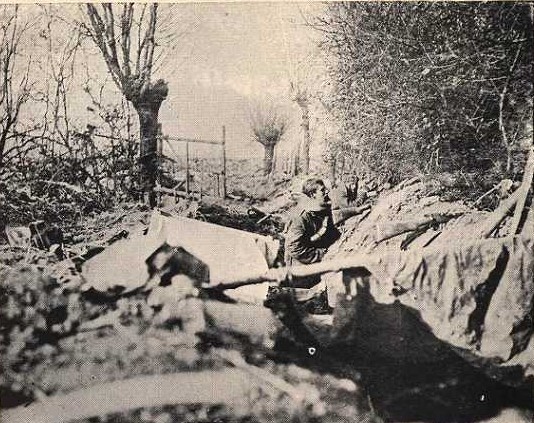
From this point we could see the whole valley, which separated us from the Messines Ridge. The enemy was firmly established on its crest, with his advance lines in the valley and, at some places, on the sides of the slope below us. Our lines were from about 150 to 300 yards apart. The town of Messines was in plain sight about a mile away and the town of Wytschaete (Wijtschate) was a little to its north. We had Mont Kemmel, a prominent hill that gave our artillery the sight of our whole front.”
Corrigall :
“The outline of the German trenches could be seen against the outline of Wytschaete Ridge. They were guarded by tangled coils of barbed wire. Behind them flowed a stream called the Steenebeck (red line on map on previous page), behind that wooded slopes. On the crest of the ridge, the ruins of the villages of Messines to our right and Wytschaete to our left looked like crumbling monuments in a cemetery.”
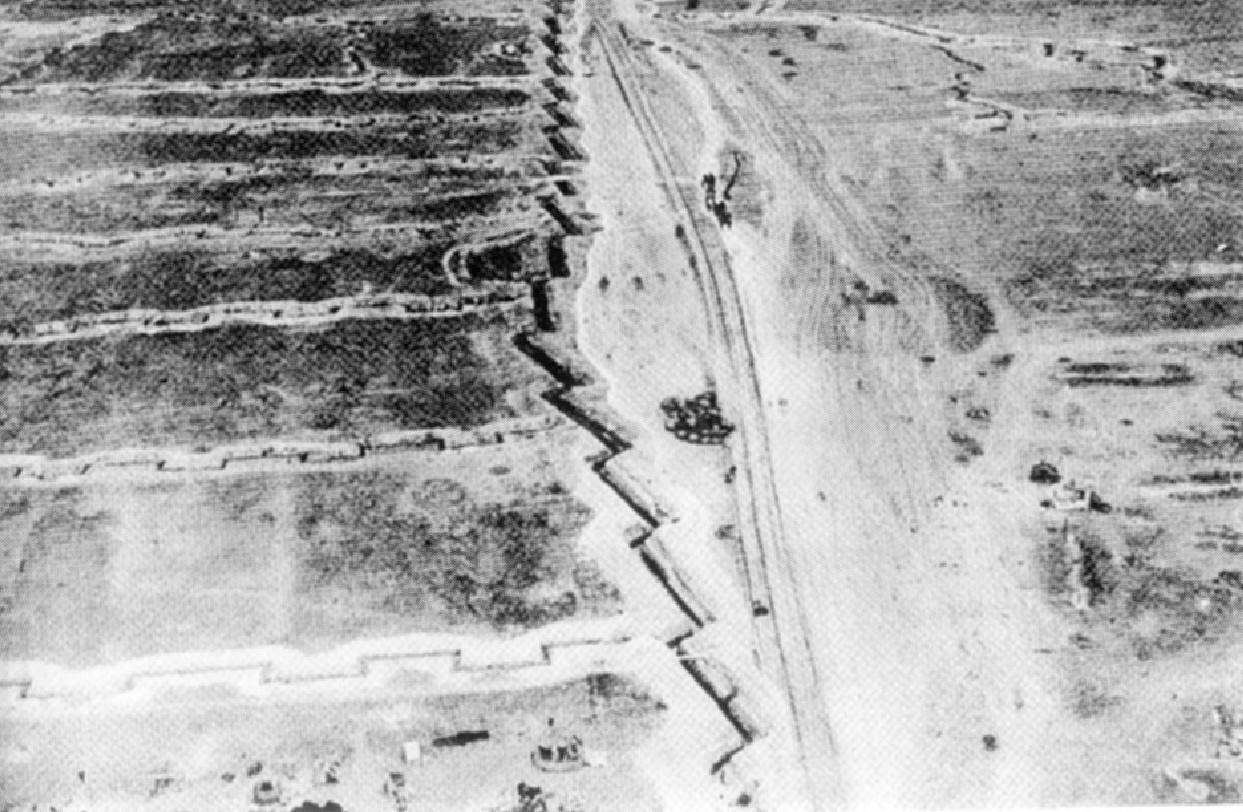
The picture shows an aerial photograph of well-constructed Allied communications trenches on the left leading up to the zigzag front trenches.
McBride:
“Things had been very quiet, but just a soon as our infantry had taken over the position, the Germans gave us a welcome. They knew just who we were and when we had taken positions, to an hour, as the rear was full of their spies. The day after we came in they put over a furious barrage of shells, causing considerable damage to our parapets and seriously wounding several men. We were deeply impressed but it gave us the opportunity to make the acquaintance of the sounds and effects of various kinds of shells. Our trenches were shot up badly, necessitating much work with pick and shovel for the next few days.”
 Stories