Both sides in the conflict decided that it would be necessary to end the static trench warfare, where each side built sophisticated trenches and stayed there, pounding away at their opponent. Some sort of breakthrough seemed desirable. I doubt Bill, at the front, would have much information about what was happening but Keith, who was with the 39th Reserve Battalion at Shorncliffe, would soon begin to hear about the combined French and British attack in the Somme area of France. This offensive, which was planned to relieve the pressure on the French forces at Verdun, to introduce many new British recruits to battle, to weaken and destroy German manpower and to affect a breakthrough in the German lines, started on July 1, 1916. It would continue in the form of a campaign of many great battles until March 1917.
After having bombarded the German lines for eight days with 3,000 guns firing more than 1,700,000 shells, the attack began with the British moving on a 15-mile front, north from Albert towards Bapaume, with the French on their right flank. The plan called for a creeping artillery barrage, followed by a modest advance on the British right front and a significant breakthrough on the left, with the cavalry standing by to rush through the gap and divide the German lines. It was quickly determined that the cavalry would be unsuited to the terrain and they were withdrawn.
Although the artillery used in this operation had been far greater than at any time before, it had not been entirely successful. It had poured fire at both forward and reserve trenches and artillery emplacements, but it had not cut barbed wire in many sectors, it had failed to sufficiently penetrate the deep, well-reinforced German trenches and concrete bunkers, and had not damaged enemy artillery to any great extent. Another big problem was the number of dud artillery shells. Air observations and patrols seemed to provide conflicting information about the state of the enemy wire and the size of forces occupying their front lines.
A German Lieutenant:
“Our second and third trenches were bombarded to prevent our bringing up reserves. All the communication trenches leading from the rear to the front were kept under incessant fire. All the main and side roads and all the crossroads were kept under fire so that approaching troops, munitions, supplies, and provisions had to pass through several lines of fire. All places up to ten miles behind the front were brought under incessant heavy artillery bombardment.”
A German deserter:
“ June 29 – we had expected an attack and wished it would come, as the men had had no food for three days.”
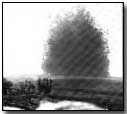 When the artillery barrage ended and seventeen mines were blown at 7:30 AM (picture of the explosion which created the Hawthorn Crater right), 600,000 British troops, who outnumbered the Germans nearly two to one, climbed out of their trenches (below) and, heavily-laden and expecting little opposition, walked across no-man’s-land straight into fire from the German machine gunners, who had endured the artillery in their well-built dugouts and then surfaced when it stopped.
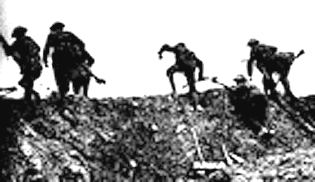
A British machine gunner:
“The next morning we surveyed the dreadful scene in front of us. The attack had been brutally repulsed. Hundreds of dead were strung out like wreckage washed up to a high watermark. Quite as many died on the enemy wire as on the ground; like fish caught in a net, they hung there in grotesque postures. Machine gun fire had done its terrible work.”
The British suffered 19,000 men killed and 41,000 wounded on the first day, including all but sixty-nine of the 801 men of the First Newfoundland Regiment. (Newfoundland was not yet a part of Canada). 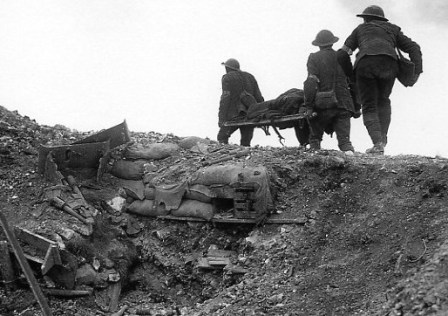
Armageddon:
“On July 14, a night attack by 22,000 raw troops took the German front line. German counter-attacks almost wiped out the gains. Each gain was contested to hold every inch.”
The battle continued for months, with the British gaining some territory and the Germans bringing in reinforcements. Little territory changed hands, although the British gained a slight edge. This activity continued until the 2nd Canadian Division arrived in September.
German Commander Crown Prince Rupprecht reported to his superiors on September 14th:
“Our losses in territory may be seen on the map with a microscope. Their losses in that far more precious thing – human life – are simply prodigious. Amply and in full coin they have paid for every foot of ground we sold them. They can have all they want at the same price. We have a reserve, constituted of trained officers and trained men, which has not yet been drawn upon. We are not, like the Entente Generals, forced to throw raw, untrained recruits into the very front of the fighting. It saddens us to exact the dreadful toll of suffering and death that is being marked up on the legend of history, but if the enemy is still minded to possess a few more hectares of blood-sodden soil, I fear they must pay a bitter price.”
It is amazing how Rupprecht can seem to reverse the situation and characterize the French, who are simply trying to take back their own soil and the British who are helping them, as the attacking enemy.
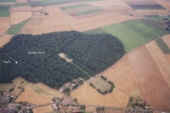
Delville Wood was the site of early fighting during the Somme campaign. These pictures show the devastation in 1916 and what it looks like today. At the centre of the wood is a war memorial.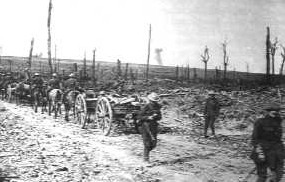
 Stories