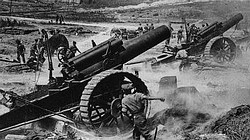
 The Canadians and British had assembled, in an area behind the Arras-Bethune Road, 377 heavy guns and 700 pieces of field artillery and, about three weeks before the attack, they stepped up their daily bombardments, although only using half their guns. In addition, new armour-piercing and delayed fuse-action shells were used, which penetrated twenty feet into the ground to blow up deep trenches. Also mines were laid under the German front lines to be detonated thirty seconds after zero hour. On April 2, the bombardment was ramped up to its maximum strength.
McBride:
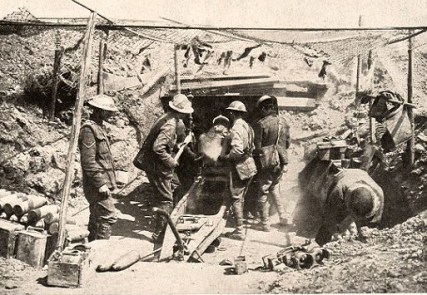
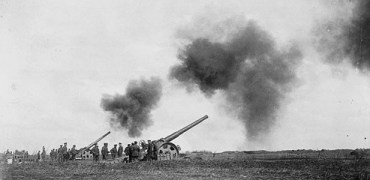 “The rifles and Lewis guns were up front, along with the grenades and trench mortars; then the machine guns and heavier mortars, followed by the 18-pounders backed up by their bigger brothers right on down the line until you came to the big naval gun (above) somewhere miles back of the line. There it was, all spread out, stocked up with ammunition ; wait
 ing and, at the same time, working, improving positions, making new emplacements, providing for concentration of guns and men in an emergency.”
Tom Wood talked about his experience in the artillery (slightly edited for clarity):
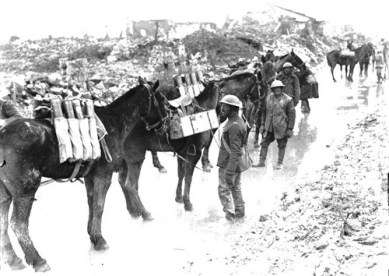
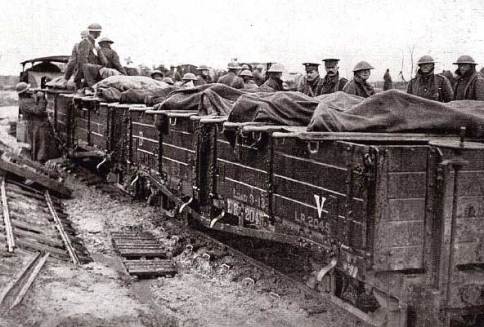
“At Vimy that was the largest barrage ever in any war. We had them shooting from twenty-one miles away from the front. That is why we won Vimy Ridge, because we had so much artillery behind us. (I hope he didn’t tell that to the infantry). In our battery we had six horses to a gun and four horses to the ammunition limber. People don’t seem to realize that you could fight with just horses. There wasn’t an automobile or a truck. There was a small-track railroad, which kept us supplied with ammunition and took our wounded back.”
War Diary – Assistant Director of 2nd Division Medical Services:
“Apr. 3 – Heavy gale at night. Frost, snow and a bitter wind from the north continuing all day.”
A Battalion War Diary:
“Apr 3 – Our artillery is very active. All ranks are in good spirits and very keen in anticipation of coming operations.” (It seems to me the diarist wrote what the brass wanted to hear).
Corrigall:
“Apr. 5 – We found that the trenches were muddy, with a layer of from one to two feet of liquid slime at the bottom. It was arranged that, when the 21st Battalion had passed through to assault the Red Line, the remaining 20th Battalion troops would move in front of our wire (in no-man’s-land) in order to miss the enemy barrage which was certain to come down on our front line.”
McBride:
“The rum ration is issued just before zero hour and is taking effect by the time the word comes along to be up and away. It serves to make men alert, mentally and physically, and their chances of reaching the first encounter with the enemy are much greater than if they are tired, benumbed with cold and apathetic. After that they uncover new and unsuspected sources of energy that will take them through the rest of the day.”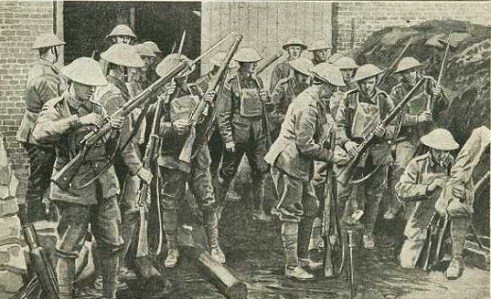
Canada At War:
“By early morning on April 8, the whole field of battle was one mass of mud caused by beating rain and snow (fortunately blowing toward the enemy). The troops were bitterly cold and drenched by the rain.”
Corrigall:
“The evening before zero hour was made more memorable by a peacefulness and a splendour of sunset that none of us had seen equaled in France. Larks were caroling in the sky. Blue smoke curled slowly upwards from the chimneys of the cookhouses near the gun positions. The artillery barrages had ceased but this quietness went almost unnoticed, the exertion of the work we had to do leaving us no time for thought.”
Berton:
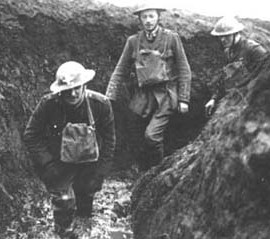
“Thousands of men were moving through the gloom, wading through the long communication trenches…slopping through the mud and water, their paths marked by luminous stakes until, cramped and cold, they reached the assault positions in the mud and the chalk of no-man’s-land. The mud was so bad that some men couldn’t be extricated by simply grasping their rifles and pulling. It took several men to save the orderly-room sergeant of the 20th. The party stretched a pole across the top of the trench, made slings of their belts, and finally tugged him to safety, minus his hip rubber boots.
There were twenty-three battalions in the forward line, thirteen more waiting directly behind, and another nine along with three British battalions in reserve waiting to leap-frog through: more than thirty thousand men stretched over nearly four miles of front, the leading troops already half way across no-man’s-land, lying flat in shell holes or shallow ditches. Clouds began to obscure the bright moon, and a light, cold drizzle started to fall.”
21st Battalion Report:
“They moved to Mont St. Eloy during the afternoon of April 8 and stayed in Bois des Alleux, resting until 8:15 PM, when they proceeded by a new overland route to the forward area to take up their position in the ‘jumping off’ trench, which was a new trench dug about 100 yards east of Mill Street. Trenches and approaches to ‘jumping off’ trench were in very bad condition, though a comparatively safe overland route was in good shape.”
From what we heard about trenches until now, a trench ‘in bad condition’ must have been really awful. From the description of other units, these were filled with mud and water and were probably partially collapsed. It also suggests how bad they must have been when the battalion was allowed to approach the front by a ‘comparatively safe’ overland route.
A letter home to Pembroke from Private Leo Kelly of the 38th Battalion:
“At about 3 o’clock we had a breakfast which was a very good one. It consisted of bacon, bread, butter, tea and oranges; a meal we do not get very often out here. I guess the cooks opened their hearts for once. They knew the boys would have a hard day and that it would be the last meal for quite a few of them.”
At 4 AM the 21st Battalion, using its code name of Cabbage, reported to Brigade that they were in position with twenty-four Officers (including Lieutenant A.E. R. Jones of Brighton) and 677 Other Ranks. At 5 AM, the TMB under Lieutenant Jago (perhaps including Sergeant Keith Roblin of Brighton) signaled they were in position. Between 4 and 5:30 AM one Officer and three Other Ranks were wounded.
Corrigall:
“There was naturally much congestion and confusion due to the assembling of about three thousand troops in an area seven hundred yards long by two hundred yards wide. Zivy Cave was like a beehive, since in addition to medical personnel, the 21st Battalion and the 4th Brigade Headquarters occupied portions of it. The assembly of the assaulting troops was carried out so quietly and in such excellent order that the enemy appeared to be unaware of their presence in no-man’s-land…. Even though the enemy trenches were less than a hundred yards distant.”
Berton:
“They lay out in no-man’s-land, twenty thousand young men of the first wave, crouching in the liquid gruel of the shallow assault trenches or flat on their bellies, noses in the mud, holding their breath for the final assault. They did not expect to die… surely if they did as they had been trained to do, if they hugged that advancing wall of shells… they would survive the day.”
Corrigall:
“It looked as though the weather on the 9th might be cold but fine. However as zero hour approached, the sky became overcast and a chill wind with snow started to blow. While we watched the minutes pass, we thought of the thousands of others lying as we were, ready to leap forward, of the waiting trench mortar and machine gun crews, of gunners standing by to fire, of the services in the rear already moving forward, and of the staff of many formations preparing for developments. We wondered if they felt as nervous as we did.”
28th Battalion:
“Apr. 9 – The day brought a conglomeration of weather conditions. A cloudy, threatening dawn with early morning rain about zero hour, followed by sleet and snow. Later came spasmodic sunshine, then more rain and a cold wind from the north-west.”
Canada At War:
“At zero hour – 5:30 AM – 1,000 guns (including the 4th TMB) opened fire and men said that they had never imagined such pandemonium before. The whole front seemed lit up with a sheet of flame. (It was estimated that, by this time, more than a million artillery shells had battered the Germans.) Special attention was given to recently-identified German battery positions, which were dealt a massive blow, and to the forward trenches, which were completely destroyed.”
Corrigall:
“Precisely at 5:30 AM and just immediately before we left the trenches, the barrage began with an uproar beyond description. In the infernal din were blended the raucousness of machine gun fire, shrapnel and high explosives, together with muffled thudding of ‘heavies’ and trench mortars and the shrieking crescendo of flying shells.”
Berton:
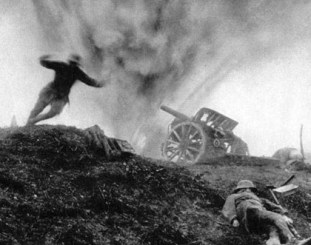 “An ocean of lightning seemed to have struck the German positions, obliterating everything and everyone who wasn’t underground. At the same time, the earth trembled as mines, hidden in tunnels under the enemy positions were touched off, creating miniature volcanoes. Hundreds of German rockets sizzled up from the dark bulk of the escarpment. These were SOS flares – four miles of dazzling fireworks, daubing the sky in gaudy steaks of green, yellow, orange and red, calling for an artillery bombardment of the Canadians. Those German guns that were still intact answered the call. But most had already been silenced, and the remainder uselessly hammered assembly trenches that were already empty of men.”
Berton:
“One soldier, waiting in reserve, saw the sea of mud stir into life. Out of the maze of dark shell holes and bits of trenches thousands of khaki-clad figures suddenly emerged; some leaping, some crawling in the mud, some stumbling and lurching forward against a lurid background of flame from belching guns. Later he saw the lines of prisoners. (It was estimated that the Allied forces took over 12,000 prisoners). How he wondered could they have survived? It seemed that no inch of ground held by the enemy could have escaped that rain of death. Another saw that every foot of ground was churned and dug up: thousands of gaping shell holes were slowly filling with bloody water, arms, legs, pieces of dismembered bodies and equipment.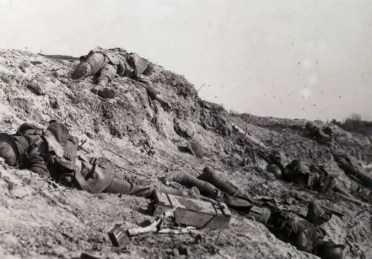 As another soldier clambered out into the mud he came face to face with the horror of war: wounded men (perhaps like those above) sprawled everywhere in the slime, in the shell holes, in the mine craters, some screaming to the skies, some lying silently, some begging for help, some struggling to keep from drowning in the craters, the field swarming with stretcher-bearers trying to keep up with the casualties.”
Corrigall:
“We scrambled forth with bayonets fixed at ‘high port’. Across no-man’s-land, walking, running and jumping, we followed the whitish-grey puffs, which lifted every four minutes as we advanced. We passed through the enemy’s wire and jumped into his trenches, (finding no one there) pulled ourselves out and went on, the attacking waves continuing to follow the barrage while we, the ‘moppers’, broke off at prearranged points to search the trenches and dugouts. In ten minutes the Black Line was captured.”
Canada At War:
“As the infantry moved forward (below) between the shell holes filled with icy water, they began to come under heavy machine gun and rifle fire, which caused many casualties. At the start, the ground was in such appalling state that the troops could not keep up with the barrage, groping along because of the storm. Hour after hour Germans and Canadians fought on, often hand to hand.”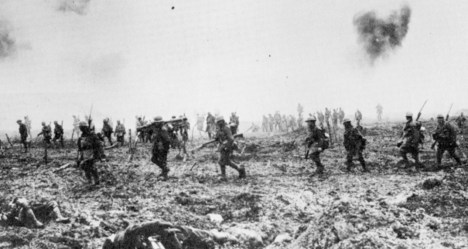
Berton:
“It occurred to another soldier that the scene of the attack was nothing like the popular conception of a line of shoulders racing forward and bayoneting the enemy. What he saw instead were clumps of men, scattered over the entire front, toiling slowly up the ridge. He passed one man lying in a deep shell hole crying ‘Water! Water! The top of his head had been blown off, exposing his brains.”
21st Battalion War Diary:
“At zero plus 35 minutes (6:05 AM) it was reported that the Black objective had been gained and everything was going fine. The Battalion reorganized and at zero plus 60 it proceeded to capture the Red objective, which it did at zero plus 105, and in doing so completed the advance of the 4th Infantry Battalion: all objectives being captured. The enemy machine guns and mortars were the chief resistance encountered.”
Orders had called for eight guns of the TMB to be placed at the disposal of the 21st Battalion at zero plus 75, when they passed the Black Objective. The War Diary went on to say that the enemy artillery was largely destroyed and most of their trenches were barely discernable. At least one hundred and forty prisoners were taken and one Field gun, five machine guns and three trench mortars were captured.. At this point there were two Officers killed, seven wounded (including the Commanding Officer Lieutenant Colonel Jones) and one missing and 205 Other Ranks killed, wounded and missing – that is forty percent of Officers and thirty percent of Other Ranks.
Corrigall:
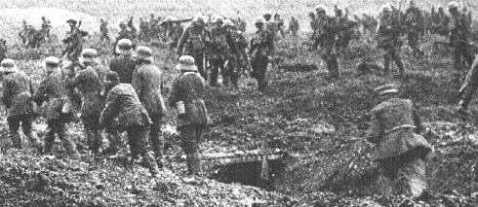
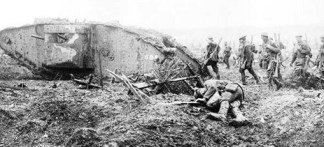 “The tanks (left) failing to cross the German front-line system, the infantry moved on without their aid. Our artillery had done its work so well that it had not only completely destroyed the German trench system but their morale as well. We had no hand-to hand fighting, the Germans coming out of their dugouts (below) and putting up their hands without any hesitation. The night of April 9 was bitterly cold, but we were all able to find cover in advanced dugouts and trenches.”
Leo Kelly, who arrived safely at the Red line:
“I was looking for souvenirs when I got hit with shrapnel in the left hand. One of our officers sent me out to a dressing station.”
Keith, too, was slightly wounded, also suffering from a shotgun or shrapnel wound to his left hand. This would have occurred somewhere between the jumping-off point and the Red Line near Thelus, which was as far as the 21st Battalion went that day. The first wounded men reported to a Regimental Aid Post at 6:30 AM. All we know for sure was that Keith was treated some time that day at the 9th Field Ambulance Station (supporting the 3rd Division, rather than Keith’s 2nd) at Villers-Au-Bois. To get there from around the Thelus area he might first have been treated at a Regimental Aid Post.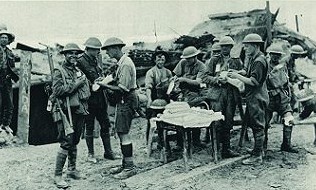 The battle plan called for him to go to the 20th Battalion Regimental Aid Post and/or the Advanced Dressing Station at Aux Rietz near La Targette.
Berton:
“The stretcher-bearers trying to clear the battlefield worked without sleep. Enemy sharpshooters picked off even the walking wounded. One medic tried to lead five bleeding men back to the dressing station only to have three killed en route; the other two crawled back on their hands and knees. In the forward stations each man got the same treatment whether his wound was slight or mortal: a bandage to hide the dirt, some bits of gauze to mask the protruding viscera.”’
Four Canadian stretcher-bearers and two captured Germans assist wounded (below).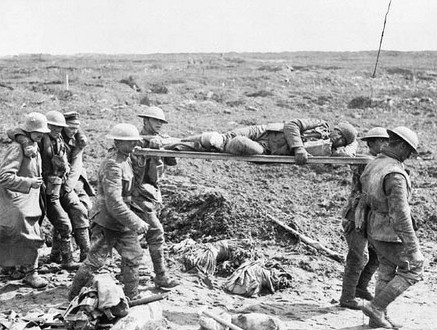
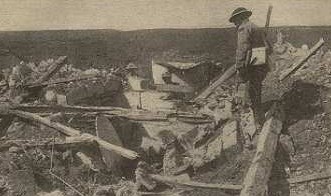
Since Keith was mobile, he might have walked or crawled back through the ruins of Thelus (below). There he would see that there was nothing left standing over six feet in height. However if he had taken the time, and I sure he didn’t, he could have explored the vast network of tunnels and underground caverns to see the recently vacated German emplacements.
 Les Tilleuls would be his next landmark. There, one soldier asked for directions to Les Tilleuls and was told by a military policeman that he was standing in the middle of it. There was nothing left, not even a stump of its famous Linden trees. Until Keith was able to go overland, he would have had to wade through the muck and slime of the flooded communication trenches, with each step taking him farther from the horror and the danger. He would be aware of the continued shelling but not necessarily of what took place a few hours after the assault began. On then to Neuville St. Vaast, formerly noted for it’s friendly women and bawdy houses and through the ruins of Carency to the battered village of Villers-Au-Bois- a distance of six or more miles from the front.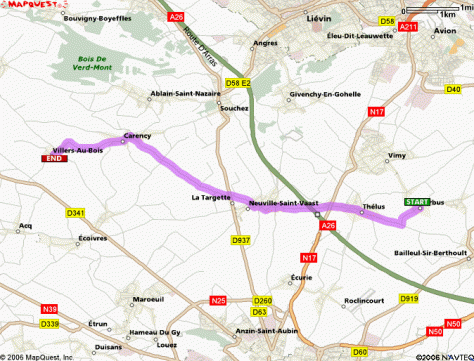
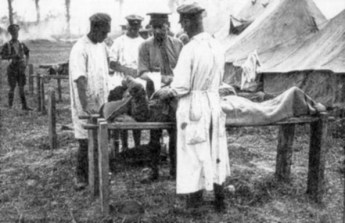 From the diary of the 9th Field Ambulance we learn that the stretcher cases and walking wounded were separated and four trestles were set up to care for the stretcher cases. The walking wounded such as Keith received Anti-tetanus Serum, a dressing, if necessary, and a Field Medical Card was attached to them. Then they were fed by the YMCA and marshaled for transport, with all pertinent data recorded at the Field Ambulance to maintain a paper trail for each soldier.
9th Field Ambulance War Diary:
“The wounded began to straggle in at 8:15 AM. Between noon and 3PM there was some congestion but by 6 PM all patients had been dressed and by 8:30 all were away. 2,500 patients had been admitted from 9 AM to 6 PM – an average of 280 per hour.”
Berton:
“At 9:35 AM, right on schedule, the barrage again began to creep forward. Observers in the rear could witness a spectacle they would never see again: the wall of exploding steel sweeping up the slopes of Vimy Ridge like a rainstorm, with the youth of Canada following directly in its wake. Alas tragedy mars the best-planned assaults. Some of the so-called silent batteries of Canadian field guns, pushed forward at the last moment and concealed until now from the enemy, opened up, only to fall tragically short. In that short advance toward Thelus, more men were killed by their own shells than by the Germans. The survivors soldiered on firing their Lewis guns from the hip.”
As the afternoon wore on and their objectives had been attained, the able-bodied soldiers began to dig in to establish their positions, string communication wires, assist the wounded and bury the dead. What they were not able to do was to exploit the sudden victory and turn it into a rout. Unfortunately they had reached the limit of their artillery range.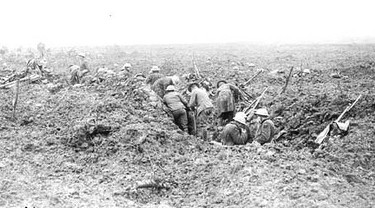
However, what the artillery did to the village of Farbus (below) at the limits of the 2nd Division advance is clearly evident in this picture.
Berton:
“The irony was that the very arm of the service that had made the capture of Vimy Ridge possible – the artillery – had rendered itself impotent. The guns had given the battlefield such a harrowing that they could not be hauled forward to hammer the fleeing enemy. The melting snow completed the work of the barrage. It took as many as one hundred horses and eight men to haul a 60-pounder a quarter of a mile, and the horses were dying under the strain. It was four days before the 5th Brigade could get its field guns through Neuville St. Vaast and into the ruins of Thelus. By then the enemy had begun to consolidate and further advances could not be made at that time.”
After treatment at the Ambulance station Keith moved (likely by lorry and train) sixty-seven miles to the 8th Stationery Hospital at Wimereux near Boulogne. Now he had his “blighty” and on the day that the battle of Vimy Ridge ended – Apr. 14 1917 – he boarded the Hospital Ship Jan Breydel for England He was then sent to the 3rd Western Hospital in Cardiff, Wales on Apr.16, where he received treatment for his injured hand. “Bullet penetrated web of thumb and came out of ? eminence. Hand swollen, hard and painful.”
He was discharged from this hospital 3 days later and moved to the Canadian Convalescent Hospital at Woodcote Park, Epsom, where he remained for another six weeks.
On April 10, the London Morning Post said:
“The Canadians hold Vimy Ridge and dominate the beaten enemy beyond it. They fought their way from the foot to the crest and continued their progress down the steeper eastern slope today. It is the bitterest German defeat of all. Prince Rupprecht regarded The Ridge as an impregnable fortress, capable of resisting any assault. Yet the Canadians took it on a time-table and flung the Bavarian front back into the ruins of Vimy.”
Corrigall:
“To get a view of the Douai Plain, it was only necessary to go forward a few hundred yards to the crest (below). We could see the disordered columns of the retreating Germans. With imagination we could visualize German troops with eyes turned towards their ‘ impregnable’ fortress, scarcely believing it to be occupied by the enemy.”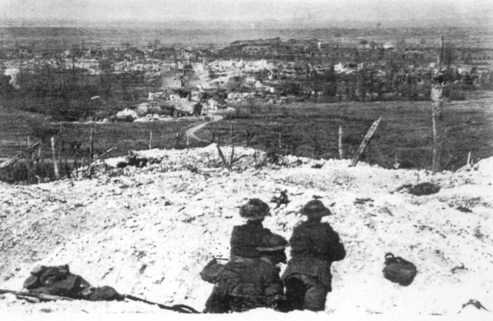
21st Battalion Report:
“The weather during the last 3 days was of the most unpleasant description; very cold and a good deal of snow falling.” The writer of the report also made some observations on the battle and the battle plan, most of which were complimentary. These are a few of the many notes he recorded:
• One machine gun was captured and used against the enemy.
• The field artillery barrage was excellent and the men were able to follow close up to it. Unfortunately a few shells fell short between the RED and BLUE objectives, causing us some casualties.
• The heavy artillery appeared to have battered the enemy’s defences out of existence.
• The detailed training, maps and aeroplane photos were invaluable.
Private Edison Blue from Campbellford wrote home:
“May 11, 1917 – Of course you know I have been wounded and that I have reached England. I was wounded in the left hip and the left breast with shrapnel. It was on the first day of attack on Vimy Ridge. I tell you, Mother, it was great. If the Canadian people could only have seen their boys for a few hours there, going for the Fritzies like good fellows. They were red with German blood and the Germans were lying on the ground like bees. I would not have missed that attack for all the world.
The artillery, big and small, was going like machine guns. Our aeroplanes were flying twenty or thirty feet off the ground, firing their machine guns at the Germans and their reinforcements coming up. The way we bagged prisoners was not slow. We made good use of the prisoners, too – putting them to carry out wounded. Four of them carried me for two miles. I am feeling like a lord in spite of my wounds.”
The King sent the following message to Field-Marshall Haig:
“The whole Empire will rejoice at the news of yesterday’s successful operations. Canada will be proud that the taking of the coveted Vimy ridge has fallen to the lot of her troops. I heartily congratulate you and all who have taken part in this splendid achievement.”
An artillery officer from Cobourg wrote:
“April 12, 1917 – Yesterday was Easter Monday and it was a day to be remembered. As you will have read in the newspapers we attacked at 5 PM. I was up at 4 AM and returned from the front about seven hours later. On the way back I was informed that a friend of mine had been killed. We had good times together and I thought a lot of him.”
I wonder how many times over the last eighteen months Bill and Keith had experienced the same loss of friends. Of course Bill was not there to see that his buddy Keith had been wounded, but I’m sure they found a way to get together some time later in England.
Without their commanding officer, who was wounded late in the day, and without Keith, the 21st passed a quiet night in the new forward area. The next day they moved to a new position and that day and night again passed quietly, although the weather was cold and snowy. On April 13, the Battalion successfully, although with twelve more casualties, moved forward to occupy a portion of the railroad line including the railroad station at Vimy around 7 PM. Later that night they were relieved to the support area and then on April 14 those who were left marched back to Bois des Alleux to reorganize and reequip. In addition they supplied a working party of 400 men on April 18 and 430 men the next day to assist the 186th Tunneling Company.
On April 20 they moved up to support the 20th Battalion closely behind the front lines for three days and then took over the front for another three days, while they worked to consolidate their new positions. The weather warmed up but they were under constant artillery fire. A summary of casualties in the 4th Brigade, which appears not to include officers, shows that, from April 9 to April 14, there were 42 killed, 157 wounded and 32 missing in the 21st Battalion and 2 killed and 14 wounded in the 4th TMB. The dead were often buried where the lay, in communal graves, sometimes as many as a hundred in a grave.
This is where we leave the 21st Battalion in our narrative. They continued to serve with distinction and were a valuable part of the action at Hill 70, Passchendaele, Amiens, Cambrai and Mons.
Parts of the 4th CMR had been in the trenches for four days from April 5 and moved supplies and ammunition forward and cut enemy wire in anticipation of the attack. Their attacking party consisted of seventeen Officers and 627 Other Ranks. They fought with many casualties until they were relieved on the night of April 11.
4th CMR History:
“They had been in the line for sixty-three hours under the most trying weather conditions without blankets and greatcoats and with a very meager rest the night before the attack. They were in a snowstorm and tramped back through the mud to Neuville St. Vaast. The condition of the ground and the weather was so terrible and the men so tired that the Battalion had great difficulty getting out. They were bitterly disappointed to find themselves in an improvised camp, which had hardly been completed. The men had only the sodden ground on which to rest after this unusually arduous time.”
There followed several days of moving camp and supplying up to 600 Other Ranks to repair and build roads and assist the Mayor of Neuville St. Vaast. Bill Nesbitt spent about two weeks with CBD – a small unit used to improve camp areas and then was sent back to the 4th CMR on April 19. If he actually arrived on that date he only had a day or two to get reoriented before they moved to the front again. To support a British force on its left, a small force from the battalion was ordered to advance its left flank toward a railroad embankment. Severe machine gun and rifle fire, along with failure of the British units to advance to their targets, resulted in a decision to withdraw. After fighting off a counter-attack by 150 enemy troops, they withdrew with severe casualties. Several members of the party received medals for their role in this action.
The next night they returned to Villers-au-Bois to spend the rest of the month in comfortable huts where they re-equipped, had baths, were paid, were drilled and engaged in some battalion sports.
4th CMR history:
“More reinforcements arrived which made the number received during the month seven Officers and 312 Other Ranks. A review of the month (253 prisoners, including three officers, four machine guns and three trench mortars were captured) reveals the effectiveness of the Battalion, although acting on a small frontage. The casualties were not too severe (Four Officers killed and six wounded. Forty-eight Other Ranks killed, 175 wounded and twelve missing) considering what was accomplished.”
By the end of the battle of Vimy Ridge, all objectives had been met and the Germans were no longer prepared to counter-attack. The ridge had been taken and held. Keith and Bill had survived the most famous battle in Canadian history, which many people say displayed the greatness that marked Canada’s emergence as a nation; no longer under the shadow of Great Britain. At Vimy, there were 3,598 dead among the 10,602 Canadian casualties and more than 5,000 German were taken prisoner along with sixty-four guns and howitzers, 106 trench mortars and 126 machine guns. The daily confrontations continued.
The New York Tribune:
“No praise of the Canadian achievement can be excessive. Canada has sent across the sea an army greater than Napoleon ever commanded in the field.”
The New York Times:
“The battle would be, in Canada’s history, one of the great days, a day of glory to furnish inspiration to her sons for generations.”
The victory at Vimy Ridge relieved the threat of attack on Arras and demoralized the Germans, who had viewed it as one of their most impregnable strong points. Very little more developed in this area for some time but Canadians, from all parts of our country, had triumphed, earned the respect of Britain and the United States, and helped foster a spirit of national unity at home.
 Stories