4th CMR History:
“With the advent of May the weather improved; there were a few showers but for the most part the days were bright and warm. The ground was drying and altogether both living and working conditions were vastly improved.”
For the first five days of the month, large working parties were supplied to the 3rd Canadian Railway Company – no doubt moving the railways forward to service the territory taken in the recent fighting to facilitate the movement of ammunitions and supplies to the new artillery positions and forward trenches. Other groups buried cable, and worked on carrying, digging and fatigue parties. On May 6 they moved forward to La Folie Ridge and there were several casualties although their time in the trenches was considered to be quiet until their relief on May 12. That day there had been many aircraft fights and at least four unidentified planes were shot down.
The next week was spent in Divisional Reserve at Villers-au-Bois and consisted of drill and some sports. They set up a Lewis gun at camp to fire at enemy aircraft, although there are no reports of any successes. That was followed by another week of huge work parties, with some burying cable and others preparing triple row barbed wire. There were also reports of enemy aircraft dropping bombs, apparently with some success. The remainder of the month passed in the same manner although the battalion occupied the Forward Support trenches. One notable event occurred late in the month.
4th CMR War Diary:
“May 26 – A serious accident occurred about 8:30 PM. Whilst engaged in a game of baseball, a soldier picked up a blind shell which exploded, killing eight men and wounding eleven more.”
4th CMR History:
“The month of June was very similar to the previous month. Two tours were made in the front line, both about 1,500 yards south of Avion, in front of Mericourt (probably about half way along the D40 from where it starts on the right of the map to where it ends at N17). 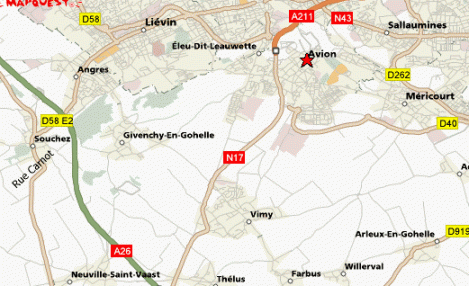 Their position on the second tour was adjacent to the scene of their fighting of April 23, the lines around Avion having advanced very little in a month. On the first tour a strong German patrol was seen approaching one of our posts in the early morning. Two parties successfully closed in on the raiders, killing four and capturing an unwounded prisoner.
The enemy dropped numerous gas shells and at intervals bombarded our lines. The warm sunny days and their long evenings gave excellent visibility; consequently aeroplanes were continually crossing and re-crossing the line. Large bombing flights could be seen returning at sunrise or heard going over in the night. The diary recorded almost daily this activity and gave it equal importance with the shelling and counter-shelling which was continually in progress.”
In June there was one Officer and one Other Rank killed and three Officers and forty-three Other Ranks wounded. On July 3, Bill left to spend five weeks at the Canadian Corps Training School, was also given ten days leave and returned to the 4th CMR on August 28 as Acting Captain (a rank he held for one month).
During Bill’s absence the battalion had spent a great deal of time and effort training for an attack at Mericourt that would never happen. The month of August was very wet with rain falling every day. A big offensive in Flanders was also suffering because of the weather. When Bill rejoined them they had just come out of the support lines and were at Divisional Reserve in huts at Bouvigny.
4th CMR War Diary:
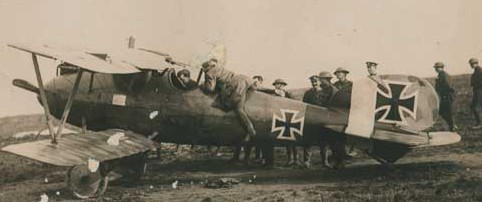
“Sept. 3 – At 8 PM a German Albatross scout plane flew amid a violent anti-aircraft bombardment over our camp and dropped a message attached to a streamer, which fell beside the guard tent.” (See below)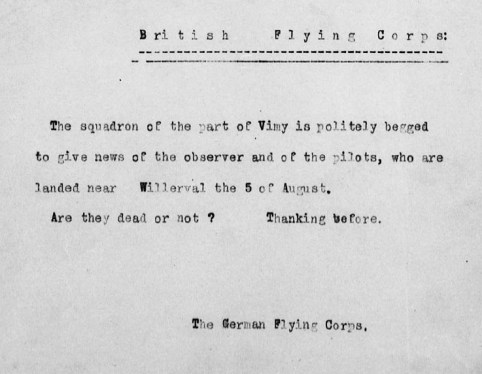
In their next tour on September 4 they were sent to the Support Trenches at Mericourt where they received a very unpleasant surprise.
4th CMR History:
“The Battalion left Bois-des-Alleux about 3:30 PM, halted at Neuville St. Vaast for tea and went over the ridge at dusk. Exactly at midnight they were subjected to a heavy bombardment of high explosive and gas shells for half an hour. The gas shells, which sounded like duds, were not discernible in the noise of the H.E. It was the first trial of “Mustard Gas” against the Canadian Corps.
The men were not aware of it at the time. The officers at Battalion Headquarters felt the effects on their throat and stomachs and put on their respirators before much damage was done.
The brunt of the shelling fell on “C” Company occupying the brick fields, but they did not realize their danger until the morning when the sun rose and began to vaporize the gas, which had lain dormant in the shell holes and in the damp bricks. The men going about without their (gas) helmets were suddenly stricken and collapsed in scores. Ten were killed and over one hundred were seriously gassed. All the officers had to be evacuated because they remained all day looking after their men. While none of them died from the effects, only one returned to France. The remnants of the company had to be sent to the rear in charge of the Padre. The gas left a distinct odour of mustard in the air. It made the men vomit and remove their mask. Swellings, blisters and blindness resulted.”
An unidentified soldier suffers from the effects of mustard gas.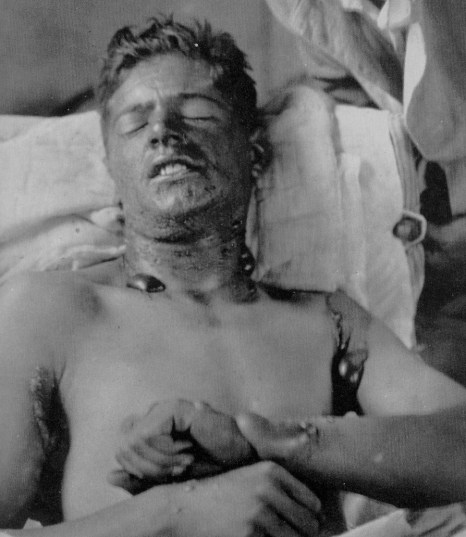
The unit alternated between Support and Forward trenches until they were relieved on September 18. After cleaning up and reorganizing, they began a two-week period of training in bombing, rifle fire and wiring in a practice (taped) trench area as plans were being made for the assault at Mericourt. The battalion was notified on October 4 that the planned assault had been cancelled and the “tape” exercises were stopped.
4th CMR War Diary:
“Oct. 6 – The battalion was placed in quarantine for diphtheria. Seven cases to date. The Commanding Officer completed kit inspection of the whole battalion and found the unit better equipped than it had been in a long time. Oct. 10 – The battalion is warned to assume a mobile condition. Oct. 11 – Pay parade, route marches by companies and final gas helmet inspection. A delicate situation arose over the payment of the men and the rigid quarantine restrictions. This was relieved by card games and much singing, well into the night. Oct. 12 – The Battalion paraded to the Baths at Caucourt.
Oct. 12 – Battalion Parade and half-holiday. Oct. 13- Battalion church parade, the quarantine being lifted.”
Meanwhile the British and French had stepped up activity in Flanders, with the objective of capturing the high ground around Ypres that had been held by the Germans for a long time. There had been two major assaults in late July and mid August.
 Stories