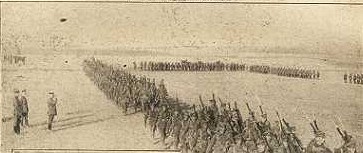
Sam Hughes inspects a line of marching Canadian troops in the latter part of September 1916.
Three more days of marching found Keith and the 4th Brigade back at the Brickfields, via La Vicogne and Vadencourt. At some point this week the 21st Battalion received a small draft of reinforcements. At the Brickfields the 4th Brigade temporarily came under the orders of the 1st Canadian Division and was sent to Tara Valley in reserve.
Corrigall:
“ September 25 – We left the Brickfields at 6 PM, marched to the Tara Valley, where we had a few hours of fitful sleep, lying on the ground in the cool of the night. After a breakfast of hot bacon from the cookers, and a tot of rum, we moved on at 4 AM.”
The 21st Battalion moved to Bailiff Wood (few trees were left) on the 26th, and stayed there in reserve.
Corrigall:
“After a morning of heavy bombardment the attack was launched at 12:45 PM. It was a lovely afternoon with a strong westerly breeze blowing. We rested in the reserve trenches, listened to the barrage and subsequently watched the wounded being evacuated on the flat cars of the trench railway, with the help of enemy prisoners.”
On the 27th there was heavy enemy shelling and the battalion got very little rest. The next day they were assigned to the 6th Brigade and moved at 4 AM to the Quarries, north of Courcelette in the area of the German-held Regina Trench.
General Rennie, Officer Commanding 4th Brigade:
“Between the hours of three and five o’clock in the morning, the enemy subjected our forward positions to a severe shelling. Notwithstanding this activity, our positions were improved by the establishing of several posts 150 to 200 yards in front of our front line trenches. These posts were manned by bombers and Lewis gun crews. The work of improving our trenches was pressed forward vigorously.”
21st Battalion War Historical Calendar:
“September 28-30 – Pushing forward series of posts and connecting up as a system of trenches. Relieved by the 18th Battalion in the evening of September 30 and moved to trenches in reserve.
Killed were H. Disney, P.J. Logan, E. E. Morris, T.E. Govenlock and J. Hill.
German Prince Rupprecht:
“The enemy has gained some ground, but a decision of the situation is not to be thought of. One thing is certain; everything has now been so well provided for by us that one can quietly await coming events. The offensive will certainly not be at an end very soon. One may look forward to an offensive of great endurance, with very violent attacks, prepared for by a colossal expenditure of ammunition. Our artillery has been strengthened and our flyers also. Our troops have given their all and the nut was too hard to crack. I am of the opinion that the enemy is seeking a decision here and this year, and in this he has failed.”
21st Battalion War Diary:
“October 2 – The Battalion remains in dugouts yesterday and today. It is raining and the men are very uncomfortable.
M. J. Scott was missing and W. St. John died yesterday.”
Corrigall:
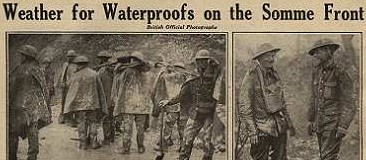
“On October 2, the weather was wretched; rain and mist made things uncomfortable and observation difficult and at night heavy rain fell. It rained all day on October 3, completing the work of soaking us thoroughly. We were relieved by the 21st Battalion and we wended our way wearily back again to Sausage Valley, slipping and sliding and falling many times in the mud and dropping fast asleep at each short halt.”
21st Battalion War Diary:
“October 3 – We relieved the 20th Battalion at midnight. Our Marching Out Strength was eight officers and 305 Other Ranks. No casualties going in despite heavy hostile shelling. The front line was not continuous but was held by five detached posts with about 100 rifles and five Lewis guns. Rations were brought up by cooks and batmen about 11 PM. Two patrols of five men each patrolled our front all night. During the next day there was intermittent shelling and occasional machine gun and rifle fire and it rained most of the day.”
G. Andrew and G. Wright died of wounds.
Corrigall:
“From September 25, when we left the Brickfields, until the night of October 3, when we returned to the Sausage Valley, it was the most exhausting days the Battalion had experienced since its arrival in France.”
After the early gains at the Somme and around this time, McBride described the landscape:
“My duty this time took the form of commanding a pack train. We began work at nightfall and had to be finished by daylight, and we had such pack animals as we could get, mostly horses. The front lines were now far advanced, separated from the furthest reach of motor transport by a trackless morass of shell holes and barbed wire, cut by battered trenches, old gun pits and dugouts and strewn with the debris of battle.
By day it was a desolate waste, inhabited, if at all, by dwellers underground or small detachments of engineers, artillerymen, pioneers – all maintaining communications or establishing lines of transport, new battery emplacements etc. At night the place stirred with life, but it was isolated, detached; like men adrift on an uncharted sea. No one could tell you how to reach any particular unit, because there were few recognizable fixed points and no established trails leading anywhere. Everywhere were the same grotesque, blurred shapes, like a mad scene in a fantastic nightmare. It was a chaotic world.”
The 21st Battalion was relieved late on October 6 and casualties from the 3rd to the 5th were G. Ralph, R. Warrilow and C. W. Scott killed and sixteen Other Ranks wounded. So it hadn’t just been a routine trip to the front and their already depleted ranks were thinned again. They returned to the Brickfields for a hot meal and, when the entire battalion had reported, they marched to the huts at Bouzencourt where they stayed for the night. The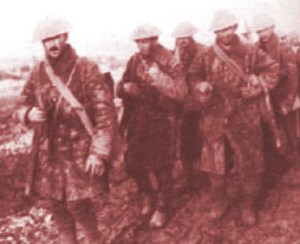 troops would soon get notice that they were leaving the Somme and moving to another field of battle. Canadian soldiers (right) are shown returning from the Somme battlefields. On October 8, W. Ward died of wounds.
Regina Trench had been the primary target since September 26. In this last tour the 21st had been involved in an effort to consolidate whatever gains had been made to that point and to provide a solid base for continuing the assault on Regina Trench. The 4th Canadian Division came to assist the 1st and 3rd Divisions and the 2nd Division was moved to the Arras-Lens Front.
102nd Battalion History:
“The conditions on the Somme were truly awful. Mud in the trenches was often up to the hips and it was not an uncommon sight to find men stuck in the mud and having to be dug out. The weather was very bad. There were long hard tramps from the Quarries up to the trenches and back. Places like the Quarries and Tara Hill provided the maximum of hardship and discomfort. This period of seven weeks in the Somme area will never be forgotten. The long dreary stretch of the Albert – Bapaume road seemed like a nightmare and the little YMCA coffee stalls were veritable oases in the desert.”
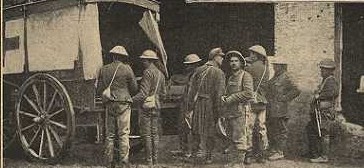
Red Cross Wagon
Fighting was fierce andheavy autumn rain poured over the land, but bit-by-bit the Canadians advanced, until the position finally fell on November 11, 1916 and, shortly after that, offensive activity ceased for the winter. One source indicates, that in six months of fighting, the Somme offensive had gained the Allies a mere six miles, at a total cost of over 620,000 dead and wounded. Canadians, during the slightly more than two months on the Somme, had 24,029 dead and wounded, the 4th Brigade 76 officers and 1,824 men dead or wounded, and the 21st Battalion had been decimated. Still many of the objectives set six months before the battle was launched, were not reached.
Lloyd George, British Minister of Munitions:
“The Canadians played a part of such distinction that thenceforward they were marked out as storm troops; for the remainder of the way they were brought along to head the assault in one great battle after another. Whenever the Germans found the Canadian Corps coming into the line they prepared for the worst.”
 Stories