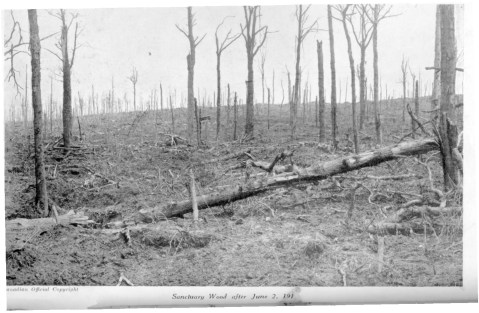
The army went into high gear to rebuild the shattered regiment. Men were promoted and new officers and men were added quickly, including the new commanding officer, Lieutenant Colonel Gordon. By the end of June, they were supplying large work parties and, after a period of training, the unit returned to the trenches on July 23- oddly enough, in the same line of trenches the Canadians had occupied on June 2nd. During that interval, the Irish Guards had used these trenches. Rudyard Kipling described them:
“On June 18, their right line, for nearly half a mile, was absolutely unrecognizable. The shredded ground was full of iron and timber, which made digging difficult, and, in spite of a lot of cleaning up by predecessors, dead Canadians lay in every corner. It ran through what had been a wood and was now a dreary collection of charred and splintered stakes, to the top of which hung tatters of khaki uniform and equipment.”
4th CMR History:
“To the 4th CMR this shattered wood was indeed a sanctuary.”
Near the end of August, they were withdrawn and started to move to the Somme area, where battles had been raging since July 1st. On September 15, they were part of the successful battle at Courcelette. Although thirty-four men were killed and fifty-six injured, they had captured the enemy territory assigned to them and had seized two machine guns and taken 50 prisoners.
Two weeks later the unit was once again beaten up badly in a valiant but futile attempt to take the heavily fortified, German-occupied, Regina Trench. On October 2, there strength was reported as only 175. In the middle of October they were withdrawn again and started the move to a new and relatively quiet area near Vimy Ridge. One platoon was so decimated that only his batman, two stretcher-bearers and one Other Rank, accompanied the Platoon Commander.
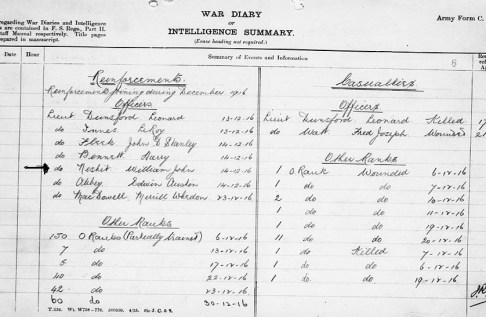
November saw five Lieutenants and 207 Other Ranks taken on strength and in December 1916 they added seven Lieutenants, including Bill Nesbitt (see black arrow), 150 partially trained troops and 154 others.
Armageddon:
“Grudgingly and seldom did the regular Canadian soldiers accept the special privileges of junior officers when they knew that a commission in the Canadian Expeditionary Force usually rewarded social or political ‘pull’ or a few extra years of education. Until 1916, commissions were awarded to men who could persuade a militia colonel in Canada to make them officers. Even officers promoted from the ranks were suspect, perhaps all the more so because they had abandoned their comrades for a life of relative privilege. Like army food and the weather, soldiers accepted officers as part of a temporary and unnatural existence, but some day there might be a reckoning. One soldier wrote home – ‘I guess you will notice that a number of officers have been killed or wounded. It seems a hard thing to say but, from what we can learn, the ones that used the men dirty over here sometimes get accidentally shot during a charge.’”
Even though this area was described as quiet, December casualties included one officer wounded and Lieutenant Dunsford, who had arrived in the unit on December 13, was killed on December 17. There were three Other Ranks killed and seventeen wounded during the month. The pattern of four days in the trenches and four days in billets continued for the month and heavy rains created considerable damage to the trenches. Most trench work uncovered unpleasant evidence of previous battles in the area. On December 20, the 4th created a diversion to allow the 1st CMR to do a trench raid on the Germans. Its tactics were so realistic that the 1st was able to complete its operation effectively and with no casualties. 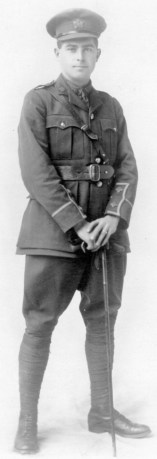 However Bill (left) and the other men of the 4th CMR had to endure such retaliation from the enemy that they received many casualties and had to abandon the diversion. The unit received commendation from the Brigade for its unselfish part in the operation and was rewarded with five extra leaves for its role.
4th CMR History:
“They went into Divisional Reserve in Etrum where they spent their second Christmas; few being still with the Battalion who came to France with it. They had a good Christmas dinner and lots of fun after dinner before heading back to the trenches for the New Year.”
 Stories