Preparations
None of the nations involved realized how long the war might last or what the cost might be. Indeed it was generally felt that things would be over “by Christmas.” In the early 1900’s, there had been a trend towards establishing a strong militia in Canada and by 1913 there were more than 55,000 enrolled and 44,000 cadets had gone to camp that year. However in the next two years, enthusiasm for the military had started to fall off. Nevertheless, Sam Hughes, the Federal Minister of Militia, had begun investing in equipment and his department had recently completed a mobilization plan for 25,000 men and a “War Book” detailing the steps to be taken should war break out. At the beginning, Canada had only 3000 regular soldiers, and a massive recruitment campaign was needed.
Ignoring the Mobilization Plan, Hughes sent telegrams on August 1 to militia colonels asking them to recruit volunteers; age eighteen to forty-five, physically fit, able to shoot and, if married, with their wives’ permission. From all over the country, led by the unemployed and those of British descent, recruits assembled (see some recruits at the University Avenue Armoury in Toronto, right) and were sent to Valcartier, north of Quebec City for training.
By September 4 there were 32,000 men and 8,000 horses. Amidst much confusion, Artillery, Engineer and Infantry Brigades, along with support units, were formed and wartime production was started for uniforms, equipment and arms. More than thirty transport ships containing the First Contingent assembled in the Gaspe Basin and sailed for England on October 3, 1914.
Belgium and France
While Canada was preparing, the war in Europe continued. In the early days, the French had attempted to halt the German advance in both France and Belgium but, after suffering 140,000 casualties, they were forced to fall back and the Belgian army was unable to show much resistance. The British had sent 100,000 well-trained troops in five divisions into Belgium against sixty-one German divisions, but they had to retreat quickly and seemed unable to stop the advance. What did stop it was a combination of several events. The German army’s troops were exhausted, their supply lines had been stretched too far, their horses were tired and needed reshoeing, and the Belgian railway system had been sabotaged. An earlier than expected Russian offensive on the Eastern front forced redeployment of many German units from Belgium and France. When France and Britain managed to counter-attack the tired German troops, neither side made any significant gains, despite heavy fighting for twenty days at Ypres, where the British suffered 58,000 casualties.
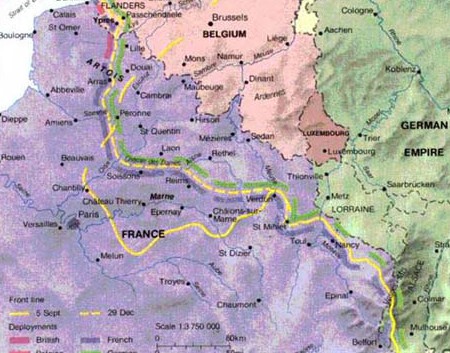
Before Christmas, France had nearly 900,000 dead or wounded. On November 11, both sides began to dig in and fortify whatever territory they now held in the 500-mile stretch from the English Channel to Switzerland and the long, horrible stalemate of trench warfare began.
During the first week in October, the Canadian Government approved the recruitment of a second division and recruiting started at once. On October 9, 1914 The Kingston Daily Standard stated that:
“ A new infantry unit is to be formed in Kingston.” It was also reported that – “Antwerp is now in the hands of the Germans.” and “British casualties totaled 13,541 from September 12 to October 1, 1914.”
There was ferocious fighting in Europe with the Belgian, British and French forces battling the enormous but slow-moving German army. The First Canadian Contingent had arrived in England in mid-month and commanders were continuing to organize the 1st Division and to train men for fighting in Europe.
 Stories