The Germans had held Vimy Ridge since the early days of the war. A French offensive in May 1915 and a combined French and British attack in September of that same year had met with little success and a huge loss of manpower. Their position had given them the advantage of being able to observe Allied positions from the hill and denied the Allies the ability to see across the Douai plain to the east. Vimy Ridge was considered one of the most important tactical points on the Western Front and it was in German hands. During the Battle of the Somme, Germany had begun building the Hindenburg Line, a system of trenches twenty five miles deep, stretching eighty miles from the south of France north to Vimy Ridge.
At Vimy there was a vast network of tunnels, three rows of trenches behind barbed wire and numerous machine gun nests. When the Allied plan to attack around Arras was being developed, there was some concern that Vimy Ridge could not be taken and should not be included. However the final plan of attack brought all four Canadian Divisions together and they, along with the British 5th Infantry Division, were assigned Vimy Ridge. Most historians concur that the Canadians were selected because of their achievements to date and that the capture of Vimy Ridge was vital to the success of the whole operation.
Berton:
“A German officer taken in a raid before the battle told his captor: ‘You might get to the top of Vimy Ridge but I’ll tell you: you’ll be able to take all the Canadians back in a rowboat that get there’”.
One author:
“The high standing of the Canadian Corps was at its best, with a good average of mental and physical qualities, excellent discipline and training and a shrewd individual common-sense, trained in the business of war. There was quick initiative and a disregard for red-tape which was effective when combined with discipline.”
Berton:
“The Canadians had been in the Vimy sector for five months…and were the best-trained, best-equipped and best-prepared troops on the Allied side.”
Up to this point, many battles had consisted of massing large quantities of troops in the forward trenches, laying down an artillery barrage and turning the troops loose to do whatever they could to drive the Germans back. The recent introduction of the creeping barrage and its coordinated infantry advance presented new possibilities. Having analyzed many of the battles fought in the previous year, Canada’s General Arthur Currie set out to create a winning battle strategy.
Berton:
“He had an almost obsessive insistence that everyone from private on up should know exactly what he was to do in battle. Everyone was told the details of the plan of attack; not only his own task but also the tasks of others so that, should someone be injured, there would be a man able to take over.”
This detail extended to the issuing of maps, showing complete details of their portion of the front to every group of ten or so soldiers. In the days leading up to their attack at Vimy Ridge, soldiers were given both the time to absorb their plans and the necessary training, including practice on a replica of the ridge built behind their own lines, to perfect their execution. Some parts of that training had been underway for much of the last two months and would continue almost up to the last day. Although these maps would show towns such as Les Tilleuls, Thelus, Carency, Souchey and Neuville St. Vaast, they were literally uninhabited piles of rubble. Even Arras, which was three miles behind the front, looked like this.
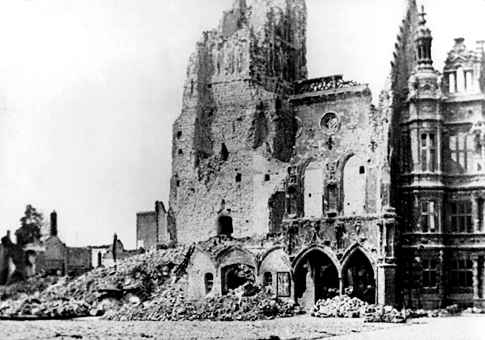 .
.
21st Battalion War Diary:
“March 26 to 31 – The battalion remained near Bois des Alleux, undergoing strenuous training such as ‘Platoon and company in attack’, ‘Physical Drill’ and ‘Bombing’. During this period the weather remained very bad- raining most of the time.”
Corrigall:
“On Mar. 30 we began to train for the particular part we were to play in the attack. Company practices were made over taped trenches and repeated until each man knew his duties perfectly. During the next three days we rehearsed the attack with the other battalions of the brigade. Nothing was left to chance and nothing kept secret. We were allowed and even encouraged to venture opinions. Every officer and every NCO was given a small large-scale aerial map which showed our front and indicated all obstacles to be crossed, as well as likely points of resistance. Units were carefully inspected and operative equipment checked.”
Berton:
“Every man was to be completely familiar with the battlefield; every shell hole, tree and stump, trench and tunnel, gun placement and sniper’s roost must be pinpointed on maps and registered in men’s minds so that they could walk blindfolded across no-man’s-land and still know where they stood.”
To create such maps, detailed information was required. Much could be obtained by aerial observation and interrogation of prisoners. However the best way to know the ground was to crawl over it and trench raids were very helpful in obtaining topographical data.
McBride:
“Infantry duties consisted of strengthening the trench system, protecting certain points with outposts, establishing listening-posts and constant surveillance of no-man’s-land through organized patrols. But they had to put teeth into their patrols and stage a raid occasionally.”
Berton:
“By March, we had accurate figures on the strength of the enemy as well as his intentions, the character of the reserves, times and places of relief, and the physical features of their positions.”
On the negative side, Canadians suffered 687 casualties out of 1,700 troops who attacked on March 1 in a badly planned and poorly executed major trench raid. Among many of the factors that had gone wrong, they had used both Phosgene and Chlorine gas that, due to poor weather conditions, turned on its users. Also the Germans knew the plans for the attack, which had been postponed several times. There were 1,650 casualties in the last two weeks before the attack on Vimy Ridge – the equivalent of almost two battalions. Most of these were as a result of trench raids and raises the still unresolved question of whether the trench raids were worth the cost. But the battle plans moved forward and reinforcements were quickly brought in.
A major obstacle in the past had been the mound of German barbed wire. If an artillery barrage did not blow up passages in the wire – which was often as high as a house – soldiers would become trapped and be easy prey for German machine guns. The British General Byng 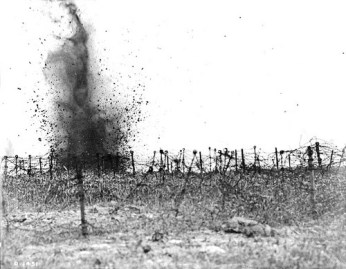 fought for and introduced the use of the new No.106 fuse, which caused shells to explode on contact with the wire rather than above it. At right, mortars attack German barbed wire.
Allied Commands had been slow to employ machine guns, relying largely on rifles and bayonets. In the process, hundreds of thousands had been killed by German machine guns, which, at the start of the war, outnumbered the Allied guns by 25 to 1. These guns were now an integral part of the plans for Vimy Ridge.
Another change in the battle plan called for increasing the effectiveness of artillery fire. Andrew McNaughton (who would later lead the Canadian Army in WW II) was made Counter-Battery Officer and given the task of obtaining pinpoint intelligence about the enemy positions and achieving pinpoint accuracy with Canadian artillery.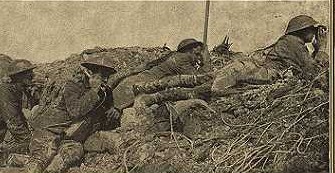
(The picture shows Canadian observers phoning information about enemy positions back to the artillery.) McNaughton also experimented with, developed, and employed techniques such as locating enemy guns by flash spotting and sound ranging and improving Canadian artillery fire by measuring and adjusting for gun barrel wear and the effect of wind on shell velocity.
Because the Germans were above the Canadians they could see for miles. This made it necessary to camouflage equipment, guns, ammunitions depots, vehicles, ration depots etc. within six miles of the front. Where possible things were moved underground to the many tunnels and the system of tunnels, which were often 30 foot under ground, was greatly expanded. New tunnels were built, others were lengthened and chambers were built off the tunnels to house headquarters, ammunition stores, communications centres, dressing stations and assembly areas. They also dug forward tunnels that would take the troops right to their jumping-off points underground and thus protect them from enemy fire until they emerged ahead of the front lines just as the battle started.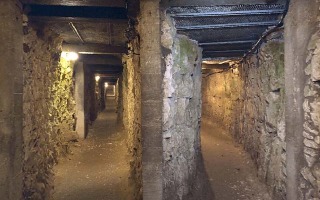
In the picture (above), the right tunnel is the main branch of the Grange tunnel and the other leads to the support areas. Some were short but one was 1.2 kilometres long. Electric generators lighted most and they contained water pipes and telephone lines. To dig them, they laid underground tramways (below) to take the dirt back well behind the lines, so that the Germans would not know what they were doing. The walking wounded soldiers were evacuated using the same system of tunnels.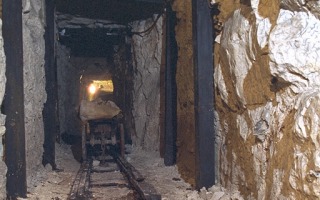
McBride:
“The Germans learned a great deal about our plans. In any case, to them Vimy was a point at which an attack was to be expected. Still they considered the position impregnable and had had a long time to make it so. At the time of the attack its defenders outnumbered the attackers by about two to one.”
At Vimy, about 100,000 men took part in the battle, including all four Divisions of the Canadian Corps. The Canadian Divisions and one British Brigade totaled 7,500 men and were given Vimy Ridge as their objective. The Canadian sector was 6,500 yards wide, the four objectives were Black, Red, Blue and Brown and the Brown Line extended as far forward as a thousand yards on the left and four thousand on the right.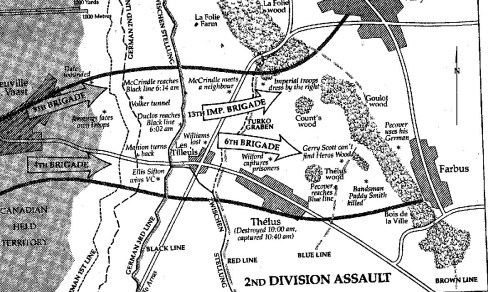
The 2nd Division had a frontage of fifteen hundred yards at the point of attack and widened to twenty five hundred yards at the final objective. The Black Line included the German front line to a depth of six and seven hundred yards. The Red Line took in the support trenches four to eight hundred yards farther and the Blue Line extended to thirteen hundred yards beyond that. The Brown Line embraced the enemy reserve area and forward artillery positions.
The 2nd Division was to attack the Black and Red objectives, with the 4th Brigade on the right and the 5th Brigade on the left, and then the 6th Brigade and 13th Imperial Brigade would move through and attack the Blue and Brown Lines. The 18th and 19th Battalions were to capture the Black Line and the 21st would pass through to secure the Red Line at Les Tilleuls. The 20th Battalion was assigned to mopping-up duties.
In the last week or so, volumes of paper were issued to plan and direct the proposed operation. From Division to Brigade to Battalion and down through the ranks. Troop movements were planned down to the minute in moving units from reserve to forward reserve to the front lines. Infantry, artillery, transport, hospital, medical, food services, engineers, tunneling, intelligence, signals, aircraft, machine gunners, ammunition stores, and dozens of other disciplines shared coordination of efforts. Copies of orders were circulated so that each unit would know who expected what of it and when. One of the biggest problems was finding enough relatively safe locations to assemble and conceal from the enemy such large groups of men as they moved forward.
The 21st spent the first seven days of April in training for the attack including at least two days to – “Participate in a Brigade Practice Attack on the specially marked training area”. The 4 Brigade TMB was to support the 18th and 19th battalions with two Stokes Guns each and the 21st with the remaining four guns. After participating in the initial barrage, the TMB was given instructions to follow the battalion that they had been assigned to. I am not sure whether Keith had returned to the TMB or had been reassigned in the 21st Battalion, so we will try to show what each unit was doing.
Deward Barnes, coming to join the 19th Battalion:
“April 7 1917 – We left Hersin at 10:30 AM and marched steady until 4 PM, through muck and slush as it had been raining. We had heavy marching order (full pack). It was the hardest march I had ever had. We went to McKenzie Camp in a wood near Mont-St. Eloi and slept in tents, and was kept awake that night by guns, as they were getting ready for Vimy. One fellow was so lousy that they made him sleep alone in a bivouac. He had hundreds of cooties outside his tunic.”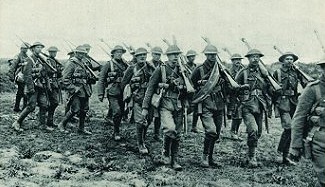
A report by one battalion, submitted afterwards to Brigade:
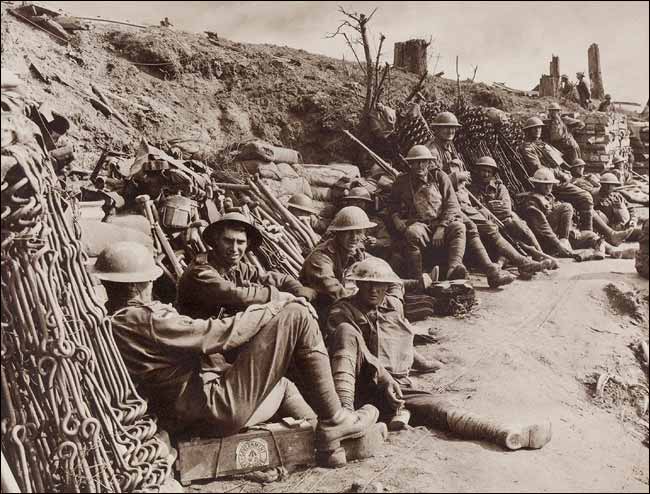 “The assembly area trenches were well-chosen, as only one casualty occurred before the time of advance. For several nights, clearing and marking passages through barbed wire, filling in or building bridges over trenches, marking routes and placing signs, established clear paths to our front lines. A hot meal was served in the assembly area along with a full ration of rum. A 50-man carrying party was based here to transport ammunition, rations, water and hot drinks to the front. The battalion was completely in position by 1:30 AM on April 9, 1917.”
Orders, which were accompanied by extremely detailed maps, were very specific about how, where and when to move. For example – “There will be a pause of 86 minutes for reorganising.” Not 80 minutes or 90 minutes or 1 ½ hours, but “86 minutes.”
Equipment to be carried by each man was carefully detailed. The Infantryman was to carry a haversack, greatcoat, Verey light, candle and box of matches, rifle and bayonet, 170 cartridges, mess tins and two day’s food ration, gas mask equipment, pick or shovel, four hand grenades, two sand bags and two aeroplane flares. Stress was placed on the fact that rations of food and water might have to last longer and that soldiers were not to fire their rifles without a specific reachable target, so as not to waste precious ammunition.
There was also one section I noticed under the heading:
“Removal of Wounded and Dead – Special parties have been designated to do this. No unwounded man will carry out or accompany a wounded man to the rear without an order in writing from an officer.”
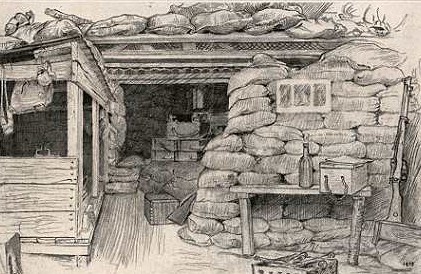
Crown Prince Rupprecht of Bavaria faced the Canadian Army with 140,000 troops under his command. His defences, built over the last 18 months, consisted of an extensive and intricate series of heavily wired trenches, with numerous fire and communication trenches, deep and elaborate dug-outs, caves and tunnels, concrete machine gun and trench-mortar emplacements (below), and cunningly constructed redoubts (small isolated forts), while along the whole front lay a chain of craters created by mine explosions. Vimy Ridge was key to the German defence system, protecting an area of France in which mines and factories were in full production for Germany. Because it rose gradually to a height of 61 metres (200 feet), Allied soldiers would have to attack over open ground exposed to artillery, machine gun and rifle fire.
On March 30, Von Bachmeister, of the 79th Reserve Division wrote:
“The Canadians are known to be good troops and are well suited for assaulting. There are no deserters to be found among the Canadians. It is very certain that the Canadians are planning an attack on a large scale in the near future.”
Berton:
“To the Canadians in the front lines, the German was universally and familiarly know as Fritz. The attitude was jocular, as expressed in such songs as ‘Keep your head down Fritzy Boy’ (Keith’s favorite). Letters and wartime reminiscences suggest that the Canadians often resented their own brass more than they disliked the grey-clad German. You shot at him because he was shooting at you, but it wasn’t a personal matter. He too was wallowing in the mud, only a few yards away.”
 Stories