The job of putting together the 21st Battalion and the rest of the Second Contingent now started. The Commanding Officer of the 21st was Lieutenant Colonel W. S. Hughes, the Warden of Kingston Penitentiary and brother of the Federal Minister of Militia, and his superior in the 4th Brigade was Colonel Denison. While there were many camps across the country, the 21st was based in barracks at Kingston. Work had begun on October 26 to empty out and prepare the Tete Du Pont Barracks, Artillery Park and a building known as the Cereal Works to accommodate the new battalion and by October 29, 350 men had arrived. Two days later the canteen at Tete Du Pont was placed out of bounds and no one was permitted to enter bars in the city before 6 PM.
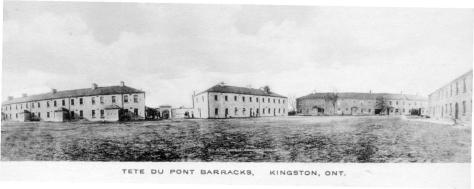
Each day, 10% of the men were given evening passes until midnight. The men, who started drilling on the Tete Du Pont Square on November 3, were now officially known as the 21st Canadian Infantry Battalion. The Kingston Daily British Whig reported that 904 men came to town that day, bringing the battalion strength to 1005. Although the main method of transport was by train, some walked many miles to get there. “The men, as a rule, are a fine looking lot; well built and intelligent.”
The battalion was housed in two separate buildings about a mile apart. The headquarters and “A” and “B” companies were quartered in the Armouries and “C” (Bill and Keith) and “D” companies were at the former cereal mill. This meant that “C” and “D” had to march an extra mile every day, because all parades and maneuvers started from headquarters.
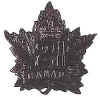
Their daily schedule started at 6 AM with breakfast at 7, Last Post at 10 PM and Lights Out at 10:15. Each battalion had a set of service colours and a cap badge. Their colours were identified as belonging to the Second Contingent, by the large ”C” and the roman numerals II. The cap badge is shown (left) with “21” and “Canada” on a maple leaf. It took many days to process the new group and about half had been issued uniforms by November 7. On Sunday, 920 men attended Divine Services in the Armouries and stood at attention while hearing the message. George and Arthur Jones each wrote a letter to the folks in Brighton, thanking everyone for the watches and the clothing they had been given- “Thanks to your good work, we were without a doubt the best equipped squad that came to Kingston.”
On November 9, the Whig reported that a 35-year-old man drowned himself off the Cereal Works wharf after being declared “unfit for service” due to bad teeth. There was also an unconfirmed report that a 71-year-old man finally accepted that he would not be permitted to join after his third unsuccessful attempt. The paper also noted that the men “took the cake when it came to singing ‘It’s a long way to Tipperary’” and “As each squad makes its way along our streets, citizens stand on the curb and watch them pass as if paying a tribute of respect.”
On November 13, Sam Hughes inspected the men of the new battalion. Among other things, he spoke of the evil of drink and used the expression that “he had looked for, but never found, a place that a drunkard could fill.” He also explained to them that the experience of the 1st Division, in the wet weather of Salisbury Plain in England, had prompted him to order 3-buckle galoshes for the 2nd Division. No doubt he also put in a good word about his favorite Ross rifles. He ended by saying – “I will meet you in Berlin, if I do not have an opportunity to visit there before you leave for the front.”
The next day a headline in the Whig said “Confirmation That Canadians In Action Against The Germans.” The 2nd Division was just starting to train, but the 1st Division was now in Belgium.
The editor of the Ensign wrote:
“Any person who is sufficiently interested in the members of “C” Company, 21st Battalion, now training at Kingston preparatory for services at the front, to donate a quantity of good eating apples, would gain the everlasting appreciation of the boys. Don’t all ship at once, but don’t fail to ship.”
Around November 18, the unit was now reported to be fully equipped. Their uniform was described by one source as “Over long johns or a cotton vest and underpants, a soldier wore a coarse grey-flannel shirt, khaki serge jacket and trousers, heavy boots and puttees – long strips of wool wound up from the ankle to the knee.”
McBride:
“During our training in Canada, we used the Oliver equipment. This was a fearful and wonderful arrangement of straps and buckles. There was a place for everything- in fact, so many places and so many little straps that one usually had to call on the services of another to get into or out of it.”
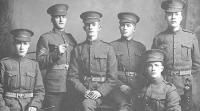
Pictured in the uniform are 6 men from Brighton- l. to r. Keith Roblin, James McCoy, Hugh Strong, Bill Nesbitt, Arthur Jones and George Jones. Their uniforms are so new they don’t have cap badges yet.
Troops were organized in sections of 10 to 15 men under a Corporal, a platoon of four sections under a Lieutenant (with a Sergeant as second-in-command), a company of four platoons (originally eight but later combined into four) under a Major or Captain, a Battalion of four companies under a Lieutenant Colonel, a brigade of four infantry battalions and a trench mortar battery under a Brigadier General, and a division of almost 20,000 men in three infantry brigades and support units such as Artillery, Engineers, Service Corps, Machine Guns and Medical under a Major General.
In 1914, Herbert McBride was no raw recruit; he was already a captain in the Indiana National Guard. But his country was not at war, so he came to Canada. He relinquished his earned rank and joined the 21st Battalion of the Canadian Army as a private. I am not sure that his views on warfare are representative of the average soldier or even Bill and Keith for that matter. He seems to have been extremely reckless, somewhat disdainful of authority and very opinionated. However he was with the 21st Battalion through much of the action we will follow and he seemed to be good at describing battlefield formations and the surrounding countryside. He rose to the rank of captain.
In the introduction to one of McBride’s books, Colonel (later Brigadier General) Hughes said:
“He served in my Battalion as private, non-commissioned officer and officer. He was one of the best fighting men I knew and was promoted and decorated on my recommendations. He was fearless, untiring, a genius for invention, and always seeking authority to be given the opportunity of damaging the enemy. I had the greatest admiration for Captain McBride as a soldier, and with an army of such men it would be an easy matter to win against any troops.”
I don’t know a lot about their training in Kingston but McBride in his book “The Emma Gees” described it this way:
“The training was of the general character established by long custom but included more target practice and more and longer route marches than usual. Two things we really learned was how to march and how to shoot, both of which stood us in good stead at a later date.”
Sergeant Harper wrote:
“We are taking long route marches nearly every day covering distances from five to twenty miles. Take my word for it, we are ready to march to Berlin.”
McBride:
“We trained at Kingston all winter. There was the usual routine of physical exercises, a little bit of close order drill, bayonet exercises and occasional small maneuvers that would be described as ‘Minor Tactics’.” But the best thing we did was to march and shoot- march and shoot. The program was calculated to do two things: to put the men in physical condition to endure long marches and to thoroughly train them in the use of their weapons. We had route marches in all kinds of weather, and winter in Ontario is real winter. Once, we marched from Kingston to Gananoque, through snow a foot deep and came back the next day- twenty-two miles each way. On all our marches, we were accompanied by our bands. We had two, a Bagpipe band and a Bugle band, and they were good. They would alternate in leading the march, the other either bringing up the rear or marching in the middle of the battalion. One of them was always playing. Coming into town after a hard and grueling march, when they would start “The Cock ‘o the North” – our regimental air – you could see the chins come up and the shoulders square away and we would stride along as though just coming from breakfast.”
One piece of equipment that they used was the controversial Ross Rifle. It had been developed in 1902 and was a fine target rifle, however it jammed easily and tended to heat up when fired rapidly. Also it was longer, heavier and more costly than the British Lee-Enfield rifle. Sam Hughes could not be convinced that a change should be made and indeed there were no supplies of the Lee-Enfield available, because the British desperately needed them.
McBride:
“One or two days of each week, we went out to the Barriefield rifle range for target practice. Later we had rifle competitions every week between teams picked from the various companies and detachments. We used the Ross rifle and Mark VI ammunition.”
Brighton Ensign, December 11:
“Arrangements are being made for the 21st Battalion to take a hundred mile march through the County of Frontenac in real hard winter weather, probably next month. Bivouacs will be made at suitable places along the route and will give the men a taste of marching in a typical Canadian winter.”
“Col. Russell, accompanied by G. H. Roblin (father of Keith Roblin), C. R. W. Proctor (Manager of the Standard Bank in Brighton) and W. S. Strong (father of Hugh Strong), were in Kingston on Wednesday to see the Brighton boys of the second contingent, and presented Corporal Nesbitt and Private Roblin with Iron Crosses, which the Kaiser had forwarded in recognition of their valour, who expressed tangible appreciation of the honour conferred by the Great German Willie.”
The Iron Cross is a German medal, so this is clearly some sort of spoof. One wonders why only these two were selected from the Brighton group and what they had done to merit this “honour”.
Brighton Ensign – Lieutenant A.S. Morrison wrote on December 15:
“Thinking at this time of year, when all is of a joyous and happy nature, that the friends and relatives of the members of “C” Co., 21st Battalion would be pleased to know how they are getting along, and if they are comfortable, and in order to set your minds at ease, I will endeavour to give you a short outline of our routine. The NCO’s and men are quartered at the Artillery Park Barracks. They are very comfortable, warm, well-lighted and sanitary buildings. Each building accommodates one company with their own cookhouse so that the men do not have to leave their quarters in stormy weather to get their meals.
They sleep in bunks three tiers high in each side of the building with tables in between so that they can play games and enjoy themselves at their leisure. Also in the same building are a large number of shower baths so that each man can have a bath as often as they like and be clean and comfortable. Each Monday morning our washing is collected and sent to the laundry so that the men have clean linen every week.
In regard to the meals, the Government rations are sufficient and of the very best quality, but the officers, believing that the men should have some extras that are not provided by the government, two officers and myself have been appointed to look after their meals. We deduct 5 cents per diem per man and give them porridge and milk for breakfast: also liver and bacon and sausages, when possible. We also give them pudding three times a week, so you can see they are well looked after in that respect. As to drill, they rise at 6 AM, make their beds and are on parade at 6:30 for an hour’s physical drill, after which they have their breakfast and are ready to fall in for drill at 8:15 until 11:30, when they are dismissed until 2 PM. In the afternoon they are given a route march until 4:30 and then they are through for the day. After which they can go and enjoy themselves at a large recreation room with everything provided in the way of reading and writing materials. All of which is free: also a piano and billiard table. They can also purchase light refreshments if they wish.
They are all good boys in the company, do everything wanted to be done willingly and cheerfully, a credit to any corps, and it is a pleasure to command them. We have just secured overshoes and fur caps for them so that they are warm and comfortable and ready in every sense of the word to follow our beloved Colonel Hughes, one of the finest officers in Canada, of whom we are very proud: also our two Majors and Adjutant. Consequently we are a united family working harmoniously together so that we are now ready to do our share for the good of the Empire, of which we are proud to be a part. Wishing you all the compliments of the season.”
It seems to me that Lieut. Morrison was painting a far rosier picture than really existed. Can we really believe that a randy bunch of young men in their late teens and early twenties would be content with reading and writing materials and light refreshments, and do everything willingly and cheerfully. I also suspect that they didn’t give a damn about Hughes or the Empire. More likely they were now discovering that there “grand adventure” had turned into something more like a jail term, and the war news would be starting to give them a better idea of what they had gotten themselves into. But that’s just my thought and I really have no evidence to go on.
Their stay in Kingston would be a little under six months of winter and spring- from November until early May and during that time they would have to learn to adapt to military life. When they signed their Attestation Papers, they gave up most of their civilian rights. They would learn that military law provided for “death or lesser penalty” for a score of acts, from cowardice in the face of the enemy to sleeping while on sentry duty. Lesser penalties ranged from extra drill to “Field Punishment No.1” – being lashed to a wagon wheel for such offences as “absent without leave “ or “dumb insolence.”
Soldiers forfeited privacy, dignity and autonomy and were discouraged from asking questions. Their pay was $1.10/ day and their meals usually consisted of porridge and tea for breakfast, stew and pudding for dinner, and bread, cheese or jam and tea for supper. This would need to be enough for them to hike with a large pack, haversack, greatcoat, spare boots, water bottle, rifle, bayonet and 150 rounds of ammunition.
 Stories