Around this time, Brigade Headquarters had been established at Dickebusch in a well-camouflaged location.
McBride:
“It had long been speculated that there were spies among the people and that they had effective means of communicating with the enemy. When Fritz turned his guns on that headquarters, a determined effort was made to find the guilty parties. When it was learned that several prominent citizens, including the mayor, were in on it, we summarily dealt with them. (They even had to fight those they were trying to liberate.) After dropping leaflets from the air, warning the citizens to flee, the Germans proceeded to level the city with artillery fire, just as the 21st Battalion was engaged in trying to convert the place into billets.”
Back in the trenches in June 1916, as a result of a disastrous German assault a few miles north on June 2 and the Canadian counterattacks that followed, it was a very active period. I. J. Pickell was reported missing (and never recovered) and J. A. Scott died. The TMB, with Bill and without Keith, was activated and kept in position for the whole month of June, with crews rotating in and out of the front for short breaks. They reported firing almost 1,300 rounds. Every day in the month their War Diary describes the weather as cool.
Corrigall:
“Early in the afternoon of the June 6, the enemy’s trench mortars were unusually active. About 3 PM the fire became intense and shortly after the enemy raided that section occupied by the 18th Battalion. Two platoons of the 20th were ordered to counter-attack. They worked their way forward and, under the covering fire of the Stokes Mortar Battery (Bill?) commanded by Lieut. Jago, drove the enemy out and re-established the line. A party of nine Germans under an officer, probably with the intention of securing identifications, had carried out the raid. That night we picked up a badly wounded German on the wire and brought him in. The identity of his unit was passed on to our Intelligence Branch, who used such information to make deductions about the enemy’s intentions.”
TMB War Diary:
“June 6 – Fired 160 rounds. Changed reliefs and also supplied four 3.7” trench mortars. R. N. Jago”
E. T. Jones was killed on June 10.
In the midst of this McBride turns both poetic and philosophical:
“Several of our gun emplacements were in the grounds of what had been one of the most beautiful chateaux in Flanders – the Chateau Segard. Now the buildings were but a mass of ruins. Not only this but the grounds had been wonderfully laid out in groves, gardens, moats and fishponds, with carefully planned walks and drives throughout the whole estate, which comprised at least forty acres. There were trees and plants from all over the world; beautiful borders and hedges of sweet-smelling, flowering shrubs and cunningly planned paths through the thicket, ending at some old wondrously carved stone bench, with perhaps an arbor covered with climbing rose bushes. All had felt the blighting touch of the vandal shells. The trees were shattered, the roads and paths torn up, the ponds filled with debris and the beautiful lawn pitted with craters, but in spite of all this devastation, the flowers and trees were making a brave fight to live. I thought as I wandered through this place, how well the mighty oaks and the little flowers typified the spirit of France and Belgium. Sorely stricken they were – wounded unto death; but with that sublime courage and determination, which have been the admiration of the world, they were resolved that they should not die.”
21st War Diary:
“June 12 – German front trenches being badly smashed by our Artillery and Trench Mortars, which cooperated with it.”
That night was dark and squally. The rain blew in great gusts, drenching the waiting battalions to the skin and filling the assembly trenches knee-deep in water. P. S. Dark, W. Head, C. L. Peace and F. Wilkinson breathed their last breath.
Corrigall:
“As the 1st Division was attacking Mount Sorrel on the 13th, a heavy bombardment opened on that sector to the north for three and a half hours in the early morning. On our front we cooperated with the Trench Mortars. The attack was successful and the 1st Div. recaptured what had been lost on June 2.”
TMB War Diary:
“ June 13 – 385 rounds in conjunction with attack on left. Reliefs held in extra day.”
21st War Diary:
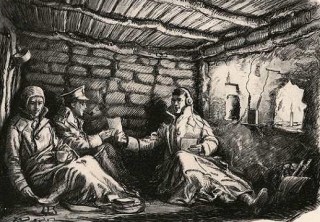 “June 14 – Enemy artillery, during the day, sent over 865 rounds (I wonder whose job it was to keep track). Enemy was active with ‘Rum Jars.’ We retaliated effectively with Trench Mortars and Artillery. Twenty shells fell short and damaged our supports and front lines. These proved to be from our own artillery. One fell on a dugout, (perhaps like the one above) killing one and wounding several others. Total casualties – seven killed and seventeen wounded.”
Rum Jars are light sheet-metal containers full of TNT and depend for their effectiveness on the shock and blasting effect of the detonation.
McBride:
“The havoc created in a trench by one of the large rum jars or ‘flying pigs’ passes belief. Where there was a strong, well-built wall eight feet or more in height, there remains a hole or crater fifteen or twenty feet in diameter and several feet deep. Any man who happens to be in this area is blown to atoms, while men in the near vicinity are killed instantly by the shock.”
Whether it was by Rum Jar or friendly artillery fire, eight men of the 21st died that day. J. Deruchie, W. Fleming, G. Hamilton, S. Hamilton, G. Harvey, C. Lighton, F. Steward and W. Worden. During that spell in the trenches the weather was very wet and the trenches became “almost untenable”.
McBride describes the Canadian Artillery:
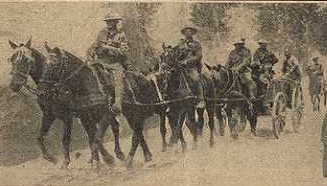 “During that time we had many opportunities to watch the splendid work of the ammunition column, taking shells up to the batteries in the broad daylight and within plain sight of the enemy. It was one of the most inspiring sights I have ever seen. Down the road they would come, on the dead gallop, drivers standing in their stirrups, waving their whips and shouting at the horses, while the limbers bounced crazily over the shell-torn road, the men holding on for dear life and the shells bursting with a continuous roar all around them. It was the sight of a lifetime and whenever they came past our men would spring out of the trenches and cheer as though mad.”
Beaverbrook:
“On June 16, one Captain looked over the field of battle, now recaptured and noted that it looked like a devastating blight had descended on these woods and fields and hills, blotting out the natural green of Nature and churning up the earth into sordid masses of mud. The blaze of sunshine and the blue sky could not wipe out the ugliness. Here and there a bunch of scarlet poppies might have drawn their intense colour from the gallant blood, which had soaked the earth. Beneath are innumerable shell holes and old crumbling trenches full of the memories and odours of death. But we held once again the lines of Mount Sorrel. The experience had been a hard one and the cost of life severe, yet the task was accomplished and defeat was turned into victory.”
J. Simpson died on June 17 and J. Starkey died of wounds three days later. Both the 20th and 21st Battalions were withdrawn on June 17, with the 20th at Dickebusch and the 21st at Bedford House.
The latter was described by Corrigall:
“as a place where the troops lay in shelters amongst the trees, which formed a belt on the north side of the buildings. In the cellars of the Chateau near Bedford House was a dressing station, around which there was always a good deal of movement, apparently observed by the enemy, for he frequently shelled the ruins. The aim was very inaccurate and ‘overs’ often pitched among our tents.”
About Dickebusch, he had this to say:
“It was fairly regularly shelled at this time. We occupied cellars, which provided some cover, but the shelling was gradually razing the buildings. The church was demolished. The principal estaminet (pub) was badly shattered, but its old sign still clung to the ruins, and the street lamp in front stood almost intact.”
After the battles at St. Eloi and Mount Sorrel, it was finally decided that the Canadian troops could not be expected to fight the Germans with the Ross Rifle. On June 21, orders were issued to change to the British Lee-Enfield rifle.
McBride:
“The first time we were called upon to repel a determined attack, and sustained rifle fire was in order, it was found that the Ross would not stand up under that kind of treatment. Wonderfully accurate as it was, it was never built for fast rough work. The bolts would stick and all hell could not open them. At that time I believed that all that trouble was due to some fundamental defect in the rifle itself, but I am now inclined to the opinion that it might have been due, in part at least, to the ammunition.”
Fred Comrie, a private in the 21st Battalion from Cobourg wrote:
“I have been in the line for six days and it was six days I will not forget. On the left of us the Germans got through a week ago and it had to be got back again. We were ordered to repeat fire and when we did both our artillery and Germans started and it was a perfect hell. You would wonder how a human person could live in such a place, but we all stuck to our posts. I must add that the old boys of the 21st Battalion showed us new arrivals a good example. For being cool and brave is half the battle to new men in the trenches. It was a terrible battle but our losses were not heavy. Some of the draft that came with me were among them but they did their duty and fought like heroes.”
The 21st War Diary shows that there were 54 wounded and 13 killed during this tour. Comrie seemed to be very sanguine about such a large number of casualties or perhaps they were in another section of the line and he really didn’t know how many there were.
Around that time, a Cobourg nurse, in a hospital well behind the front, describes one of her patients:
“We had one poor Belgian boy who left the hospital last night to return to the trenches for the fourth time. He is very despondent and is wishing he would be killed the first day he is in action. His brothers have been killed in the war. His home has been destroyed and his people captured by the Germans. He has been trying to find his mother and sisters since last August but gets no reply to his letters. He is so sad. It makes one’s heart ache. This is such a terrible war and we only see a small portion of it.”
Desmond Morton:
“Maheux’s first wounds came in June. Two gashes from shell fragments were not enough for Maheux to report sick – not if his belongings would be stolen in his absence. Nor were army doctors likely to be helpful. After a German mortar exploded nearby, his ears caused him continual pain ‘but the doctor, anything wrong with you, it makes no matter if it sore eyes, he always give Caster Oil’.”
Maheux:
“It is a fright, it is like butchery my dear wife, it is not war, there (is) no name for it. I see poor fellow’s legs cut off, trying to pull himself to some place or shelter against the shells, but only to die.”
Keith was posted to the 39th Reserve Battalion in Shorncliffe, England.
21st War Diary:
“June 24 – We have fine support from the Trench Mortars and Stokes Guns. They certainly love to be able to retaliate and we give them all the opportunities we can for doing so. Casualties- five killed and ten wounded.”
On June 27, the 20th Battalion, which was to the right of the 21st, undertook a raid. They started by asking the artillery and trench mortars to demolish the enemy’s wire. After a half hour of shelling in the early evening, scouts said that the wire still presented a significant deterrent but felt there was a good chance of passing through it successfully. Again scouts started out, through a ground mist at 10 PM, and got within twenty yards of the wire. While flares were lighting the area, they selected what they felt was the most vulnerable spot and returned to the trenches. Then the raiding group (ten men) and support group (seven men) moved forward under the direction of Lieut. Anderson. A further artillery and mortar bombardment was initiated to cover their movements.
Just when Lieut. Anderson gave the order to prepare to rush, an enemy sentry started to fire and a shot struck and killed a private. The sentry was quickly disposed of but the German rifles and grenades opened fire. The group waited for orders to advance until it was discovered that the lieutenant had also been killed. With the element of surprise gone, it was decided to return to the trenches. The casualties were two killed and four wounded and the results were negligible.
20th War Diary:
“June 28 – This experience only confirms the belief that such enterprises cannot hope to succeed without a great deal of preparation.”
This loss was followed the next day by the desertion of a man from the 20th Battalion: “the only disgrace of this kind ever suffered by the battalion.” Apparently he was of German origin and simply walked across no-man’s-land in daylight. The trenches were very close together and by the time he was spotted it was too late to stop him.
Corrigall :
“It was significant that during that afternoon the trenches were heavily shelled from one end to the other. One shell dropped on a large built-up shelter, killing two officers.”
Charles G D Roberts now took over the narrative of Canada in Flanders from Lord Beaverbrook:
“Between the heroic actions in the Ypres salient in June and the commencement of our strenuous thrusts on the Somme front in mid-September, no unit of the Canadian Corps was engaged in any major offensive. But the routine work of holding and strengthening our positions continued. The vitality of our opposition to the confronting masses of men and machinery did not lessen for an instant. Relieved from the recent terrific efforts of defence and counter-attack, we were stationery yet aggressive.
(The average soldier on the front line had no way of knowing whether such a condition would last a day or a week or a month until another journey into hell began.) Hostile trenches and strongholds were raided and bombarded, wire was cut by hand and smashed by shell fire, and mines were sprung. The mental peace and physical security of the occupants of opposing positions were shattered constantly by bayonet and grenade, trench bomb, bullet and shell.”
The recent deaths from the 21st Battalion included A. L. Delisle, H. Disney, R. Freeman, R. Gifford, H. H. Goss, P. Herbert, G. Mayhew, L. S. Peverelle and A. H. Powell.
 Stories