Another reason for hurrying the 2nd Division into the trenches was to supply a diversion for a British attack, some miles to the south at Loos. I’m not sure how much Keith would know about how this happened.
The Brigade War Diary indicated that everyone should be prepared –“to attack if the enemy retires.”
Corrigall’s unit had to carry straw bags seven miles to the front:
“Until Wulverghem all went well, but there the whining of spent bullets was rather disconcerting. Many carrying parties caused progress through the communication trenches to be slow. There was much slipping and stumbling on wet trench mats. At the front line, the party laid the bags on the parapets and made a hasty retreat. All had experienced a new sensation – that of being close to the edge of eternity.”
Beaverbrook:
“The advantage of the diversion is the uncertainty for the enemy as to where the real blow will fall. Until he knows, he dare not shift his reserves. We were asked to produce, without loss of life, the appearance of an attack. On the night of September 24 at 4:56 AM the guns opened on the enemy wire and cut great gaps as if to open the way for the assaulting columns. At dawn the enemy could see great and dangerous activity in our trenches- platoon commanders blew their whistles and shouted orders– ladders and bayonets were shown above the parapet. At 5:45, sacks full of wet straw were lit and thrown over the parapets to blow smoke towards the enemy and then our troops opened fire with rifles and machine guns. The enemy responded by shelling our support trenches and moved their reserves forward and our artillery shelled the communication and support trenches severely. By the time it was too late to move their troops to Loos, the Germans could see that there was no attack and the fighting died down.”
Major (later Lieutenant Colonel) E. W. Jones:
“At 4:56 all the artillery from Switzerland to the sea opened up a heavy bombardment all along the line. It was wonderful. I stood in the slight rain and watched the shells fall. For forty minutes it was a tremendous roar of heavy guns – terrific thunder – tremendous blasts- overwhelming earthquakes – all rolled into one. Now a German shell came over our heads, and oh how close. But this time we learned not to duck because it didn’t help. Then came the screech of high explosive shells mixed with shrapnel, over us, on each side of us: I wondered how it missed us.
The men laughed, they joked, their faces pleased, a few serious, but no one afraid. (Either he was exaggerating or perhaps they didn’t know enough to be afraid yet.) And now there is not a sound near us. The birds are singing, the sun is shining and except for the booming of cannons in the distance one would never know there was such a thing as a war. We have orders to be ready to move on two hours notice. I think this is the beginning of the end”. (He certainly had that part wrong.)
21st War Diary:
“Enemy replied with heavy fire on our trenches- four men wounded.”
Lieutenant Gregory Clark of the 4th Canadian Mounted Rifles (who would become a writer of folksy humour in the Toronto Star and Star Weekly) tells of his first experience of being under fire. I am assuming that it was a day like this he was referring to.
“ In two wars, I have never met a fearless man. I met any number of men who had mastered their fear; that is what makes heroes. Most men are heroes. Now for the first time I was under intense shell fire, I was in the curious situation of having rigor mortis set in before I was dead. My muscles went stiff. My throat seized up. I found it necessary to prop myself up against the wall of the trench in order to remain vertical. This was bad enough. But on top of it all, I was full to the brim with bitterness and a profound sadness. For here I was, a peewee lieutenant, and beside me stood a major who, out of all the men in the world, I most revered and respected as a man.
Life does things like that to you. Half an hour before I had been fairly trembling with joy. My battalion had sent me to find the left flank of our unit and make a definite junction with the next battalion on the left. They told me a major would meet me at a specified corner of a certain trench. Imagine my feelings on arriving, through the dark and the fury, at my destination to discover the major to be a man I and thousands of my generation had cheered madly from the bleachers as he plunged and raced and leaped upon the football field. In the war he had covered himself with glory. He was a living legend. And here was I standing beside him. I must have grown a foot in the next few minutes.
Quickly we made the necessary distribution of our men and sent messages to our commanders. Then we came together and stood in the smashed trench. At that moment, the Germans laid down a terrible counter-barrage, my first experience of intense shell fire. I felt the old familiar pall of fear descend upon me, deeper, darker than ever before in my life. I was completely paralyzed with fright. But the tragedy was that this should happen to me as I stood beside a MAN. A man and a jellybag, side by side………….
Desperately, I seized the covering explosion of every near one, and every loud one, to try to clear my throat. I knew that if I could talk, the fear might not show. My voice returned. I started to talk. Still leaning for support against the trench, I chattered brightly of the games I had seen him play; I recalled, with enthusiasm, some of the great plays I had seen him make. There, in the tumult, I did my best to hide the awful truth of my condition and to express the sense of honour I felt at making his acquaintance.
The major did not speak. Suddenly he struck the trench parapet a furious blow with his stick. ‘Great God, kid’ he said. ‘Aren’t you scared?’ And he sank down and sat on the firestep, his face buried in his hands. It was as if a great stillness fell, though the air screeched, the earth shook and the dirt and smoke and clouds swirled around. After a while I said: ‘Major, I am scared stiff. But I have been afraid of something all my life, so I know what to do about it. Maybe you just met something you had never met before’. The barrage died away. The major stood up and took my hand. ‘That’s it,’ he said quietly. In the many times I saw him before he was killed that year, we always greeted each other with secret grins, as men who knew something: that it is best to be familiar with fear, for then you know what to do with it.”
The men of the 21st, including Bill and Keith, would have to deal with their fear; to become “ordinary heroes.” A very few would break under the strain, but even the “heroes” would carry the burden of having had to deal with such utter chaos throughout their lives. Many hoped for a small wound or “blighty”, which came from the Hindustani for “A country across the sea.” The idea being that the loss of a few fingers or even a hand or foot was not considered too high a price to pay to get out of hell to England for a few months or even be sent back to Canada.
Corrigall:
“ In our first trip to the front we developed a strange intangible feeling of kinship, which differentiates those who have been ‘there’ from those who have not.”
After their first week in the trenches the 21st was relieved on September 27 and marched in pouring rain to Divisional reserve at Dranoutre, carrying all their gear and ammunition with them – a chore they would grow to detest.
McBride:
“After eight days of it we were relieved and went back to Dranoutre for our first ‘rest.’ We soon learned to dread these rests and would have much preferred to stay in the trenches, as it was customary in those days to move out everything, including one’s ammunition supply. A month’s stay in the trench would have been preferable to having to lug all that stuff in and out so often.”
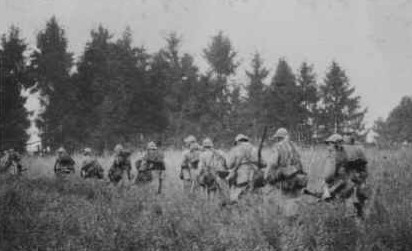
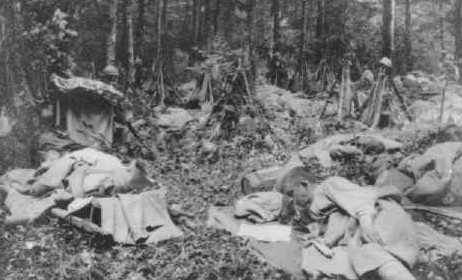
The photo (above) shows what they might have looked like as they marched out. Then they got a bath and a change of clothes- their first since West Sandling two weeks before. Remember their stay at Kingston when “They could have a bath as often as they liked and be clean and comfortable and have clean linen every week.” Here they slept under whatever they could find, such as waterproof sheets hung between poles like the troops below.
 .
.
This was their first chance to meet for any length of time with the locals.
McBride:
“The town was jammed with refugees with little or nothing except the clothes on their backs. They told of enduring the direst hardships and suffering; of cold and hunger, yet they seemed to think such things were to be endured as a matter of course.”
“As Bouchard was showing me a jam can which had attracted yellow-jackets, a bullet came and took the can and its contents and a slice of Bouchard’s finger. Several salvoes of whiz-bang shrapnel were poured into a communication trench just in front of us. We didn’t pay the least bit of attention to them other than to idly wonder if they ‘got anyone’. As I write this, I would be scared stiff if a shell burst near me. But in those days, when we all took it as a matter of course that we were all going to be bumped off most any time, we just didn’t worry about it.”
At least that is the way McBride felt about it.
21st Battalion Medical Office:
“Oct. 1 -15 men reported sick.”
After four days, during which it rained steadily and turned cold, they were sent back to the front on Oct. 2 and things heated up there.
Maheux:
“My hotel here is a hole in the ground about 3 ½ feet deep and 3 ½ feet wide. The noise is ten times worse than thunder and it takes all our nerves to tough it”. About his fortnightly bath – “For that I don’t kick, I never care much to wash in the morning.”
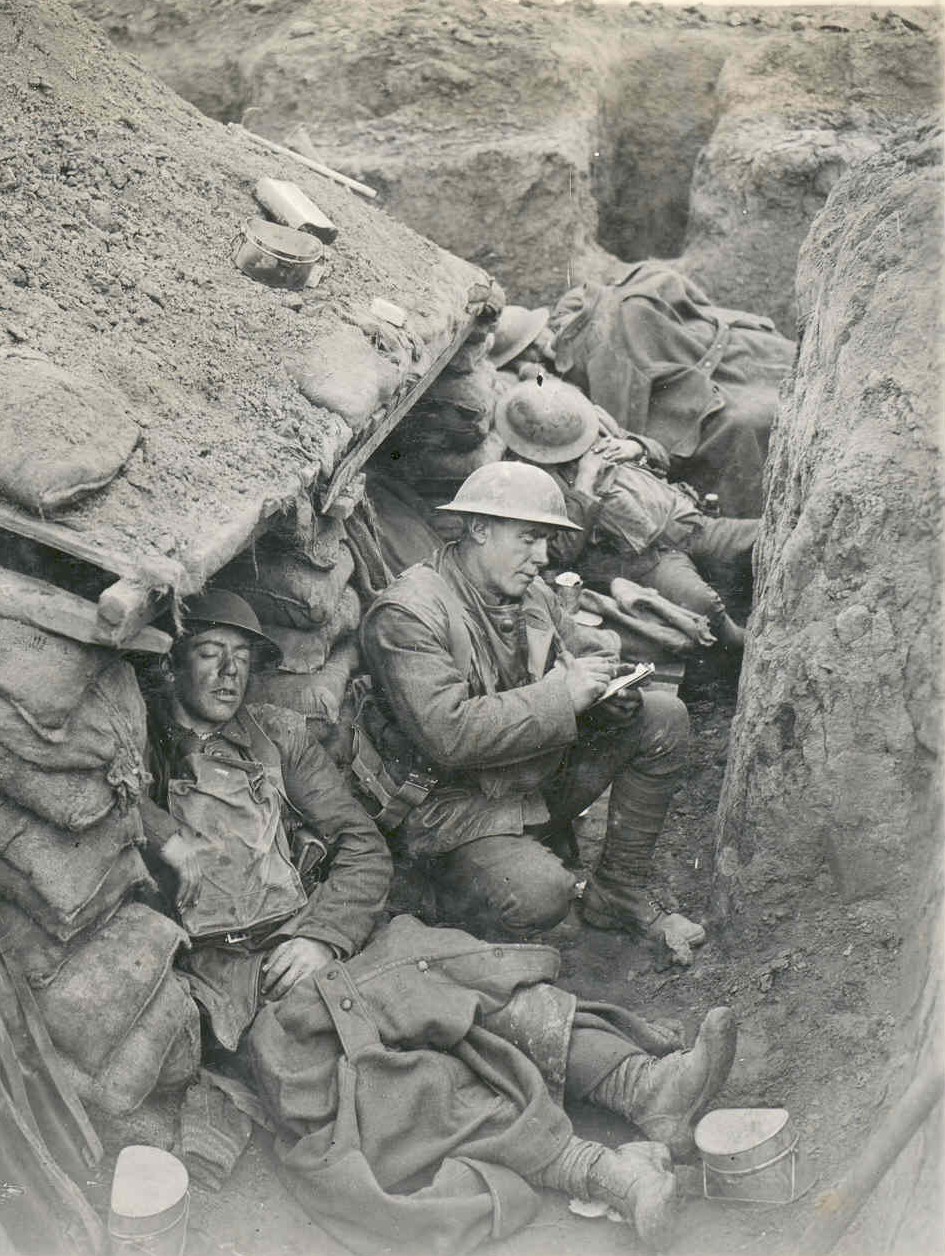 Trench life was active under the cover of darkness and quiet during the day. (See what it might have looked like – (although, at this time, the 21st had not yet been issued metal helmets) At the most likely times for attack, dawn and dusk, men stood fully armed for an hour. Night was the workday when men made repairs to trenches and barbed wire, restocked ammunition and building materials, and brought in water, food and supplies. Some would patrol no-man’s-land, camouflaged with blackened faces and armed with clubs, knives and grenades. They hoped to more accurately chart the enemy’s position, collect identification from a dead enemy (to identify the unit they were fighting) or even to capture a prisoner. One source says that all men were required to take part in patrols, so we can assume that Keith would have been involved. Men were often ordered to occupy a shell hole, which had been created in front of the enemy lines, to use it to spy on the Germans. They would crawl on their stomachs in the dark, hoping to spot any patrol activity from the other side before the enemy spotted them.
Beaverbrook:
“In the sharp night air, when one knows a rustle in the grass or the trees might mean an enemy; the stealthy crawl with fingers on the trigger, are jarred by the fitful flare of the star shells and the rasp of barbed wire, and understand that life depends on personal swiftness of action. Life runs keen in the veins because Death lurks behind every shadow.”
Corrigall:
“From this area the scouts retrieved several relics of French equipment. Many letters and personal belongings were sent through the proper channels to the next of kin.”
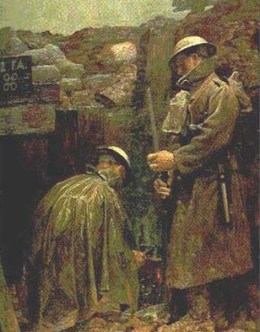 During the daylight only minor work could be done and most of the troops could sleep or rest. They had to cook their own meals , which included canned bully beef, corned beef, soup powders, cheese, bacon, and jam and butter with hard-tack biscuits and tea. How different from their time at Kingston when:
“they do not have to leave their quarters in stormy weather to get their meals”.
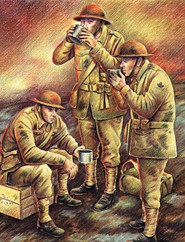 ” One staple was their daily ration of “Service Rum, diluted”
One Canadian soldier said: “When the days shorten and the rain never ceases; when the sky is ever gray, the nights chill and trenches are thigh deep in mud and water, we have one consolation in gallon jars marked SR.”
It is easy to understand how Keith, under such conditions, would develop a life-long problem with alcohol.
Officers occupied a dugout off the trench. One was described this way.
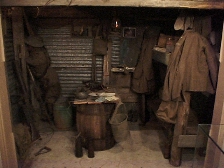 “Although only six feet square and four feet high, it included a canvas on frame bed, raised from the ground on straw, a box for a table, a candle and fireplace, empty sandbags canvas on the floor, board walls and a corrugated iron roof.” Officer’s meals were usually better and they had a greater choice of ‘beverages’. The picture shows a Canadian Company Command Post dugout.
21st Medical Officer:
“ Oct. 2 – One man who was standing a foot below the parapet was wounded in the head when a bullet glanced off his rifle barrel, passed downward through his cap badge and creased his scalp.”
McBride:
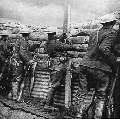 “The first casualty in the 21st was a scout who was killed on his initial trip into no-man’s-land on his first night in the trenches. The next day one man decided he could not see enough with a periscope (see use of periscope, left), so he took a look over the parapet. Both men were buried in a garden nearby.”
The two men were J.C. Bowyer and W. Starkey and these events were described in several ways.
21st War Diary:
“Oct. 3 – Morning quiet – our artillery active – Enemy active during night – many flares came over – one casualty shot dead.”
21st Medical Officer:
“Oct. 3 – This, the first fatal casualty, had a very depressing effect.”
21st War Diary:
“Oct. 4 – Situation normal; In PM, enemy shelled our front line and communications trench– one casualty shot in head – enemy active in night – two privates buried at St. Quentin Farm.”
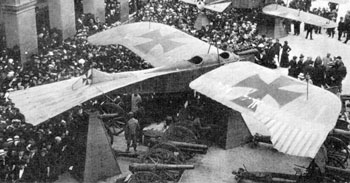 I am sure by this time Keith had gotten the message that his current job could be hazardous to his health. By day he could see enemy reconnaissance aircraft (such as the German Taube or its English name Dove, above) trying to determine their positions and could hear the continual rumble of artillery fire from the Loos area far to the south, which would go on uninterrupted for another week. Although the Canadians had managed to keep German troops from leaving their lines to help at Loos, that battle was a disaster. Undermanned and supported by raw British units, gassed by their own weapon and subjected to overwhelming German artillery fire, the French and British losses were enormous, with little or no territorial gain.
One historian wrote:
“Of all the British actions in the war, Loos was the one which did least credit to the high command.”
On October 5, a trench mortar landed nearby in a trench full of men from the 22nd Battalion.
Beaverbrook:
“As a Major of the 22nd attempted to pick up a German trench mortar and throw it out of the trench, he slipped in the mud and the shell exploded in his arms.There died a very gallant gentleman.”
Pte. Throop wrote on December 17 :
“I was wounded on October 7 and am in bed yet. My wounds are nearly all healed and I hope to be able to return to the trenches and get another chance at the Germans.”
21st Medical Officer:
“Oct.7 – One man was sent back because ‘his nerves were all gone to pieces’. The officers make the men worse by talking to them in this strain. All he needed was a good nights’ sleep.
Oct. 8 – At 2 AM, a man with a self-inflicted wound was brought in.”
By the end of the war, Canada had executed 23 Canadian soldiers for failing the test of courage in battle.
The second tour in the trenches for the 21st ended on the evening of October 9. The casualties were – 2 killed, 13 wounded (2 badly, by accidental rifle discharge), 2 nerves and 1 self-inflicted. When they left, they marched northward in the rain arriving at a new billeting place at La Clytte (Klijte) at dawn.
McBride:
“When we came out again, we marched, that very night, away off to the northward. The word went up and down the line that we were bound for ‘Wipers’ (Ypres) and after the usual hard march in the rain we stopped at daylight at the town of La Clytte, which was to be our billeting place for many months. If the Duke of Wellington’s soldiers had heard the things we said, while marching from Dranoutre to La Clytte, about ‘the mud in Flanders’, they would have hung their heads in shame.”
I am sure they were also looking forward to another shower and to eat the meals of stew, roast beef and mutton prepared by the field kitchens for those behind the front lines. La Clytte seems to have been an artillery base and several mentioned that they slept in or under wagons, which were probably used for hauling artillery shells.
D. J. Corrigall, whose 20th Battalion would share the trenches with the 21st, described their journey:
“Oct. 8 – We left Dranoutre and headed northwards in the direction of Ypres. The day was cloudy and there was a cool touch of winter in the air. Trees were shedding their leaves, leaving only the bare limbs and branches. We passed through La Clytte and reached Dickebusch. From there it was two and one half miles to the front as the crow flies (see route in red, below). We were led across a swamp to Ridgewood; past the dressing station and ration dump at the Brasserie (formerly a brewery) and on another half mile to Bois Carre, which served as the location for the company in support. From there the narrow communication trench ‘Chicory Lane’ led to the right boundary of our sectors M, N, O and P.
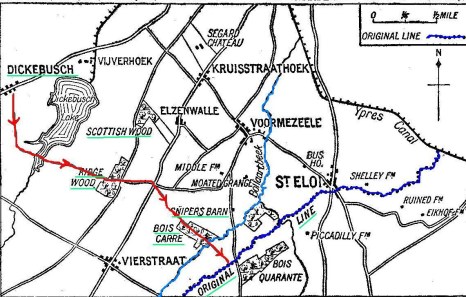
Just in front of the tiny Ballaartbeek stream (light blue) was an old support trench, which served as quarters for the scouts, machine gunners and bombers. The battalion observation post was located in Sniper’s barn. The trenches were in poor condition because their sandbags had rotted and the earth was crumbling away.”
Corrigall:
“La Clytte had a peace time population of about three hundred and stood at a major crossroads, with its red-tiled, white-washed houses along all four roads. Near the church were the billets of the 4th Artillery Brigade and the 4th Field Ambulance had its main dressing station in the school. Battalion Headquarters was in a house on the outskirts and the companies were quartered in huts to the northwest of the village. There was also an estaminet run by Martha and Marinda, who served eggs and chips, coffee and Cognac.”
McBride:
“While the infantry rested for a few days, the machine gunners moved right up. We went via Kemmel, I remember, because it was there that we made a short halt for rest. I simply flopped on my back, in the middle of the road; my head on my pack, and was sound asleep- instantly. During the ten minute stop, I got a good night’s sleep in the rain.”
The next day, 30 men of the 21st reported sick and were followed by 40 the next day, 50 the day after that and 25 more two days later.
21st Medical Officer:
“They are resting and have nothing else to do.”
Still there were frequent soccer games between the companies and musical entertainment by the regimental band. Men could walk to and sightsee in the heavily shelled, historic city of Ypres that had a population of 200,000 in the 13th century, but in 1914 was down to 20,000.
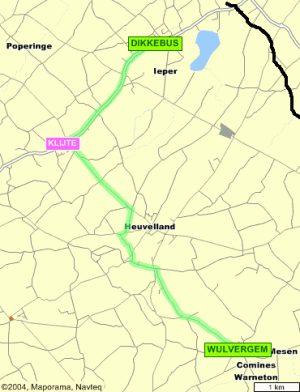 While the 21st Battalion spent nearly a week in Divisional reserve at La Clytte, their Brigade took over a new section of the line about 8 kilometres further north in the southern section of the Ypres (Leper) Salient (see black line, left), which would be their home away from home for the next six months.
4th Brigade Diary:
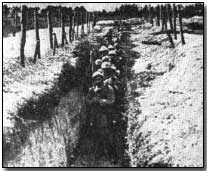
“The line taken over is in a very bad state. The parapet of the fire trench needs rebuilding. Only one communication trench is fit for use and it is used in common with the brigade on our left. (see a typical communication trench, above )
Because the situation was described as “quiet” and the weather was fine, much hard labour went into repairing the trenches.
McBride:
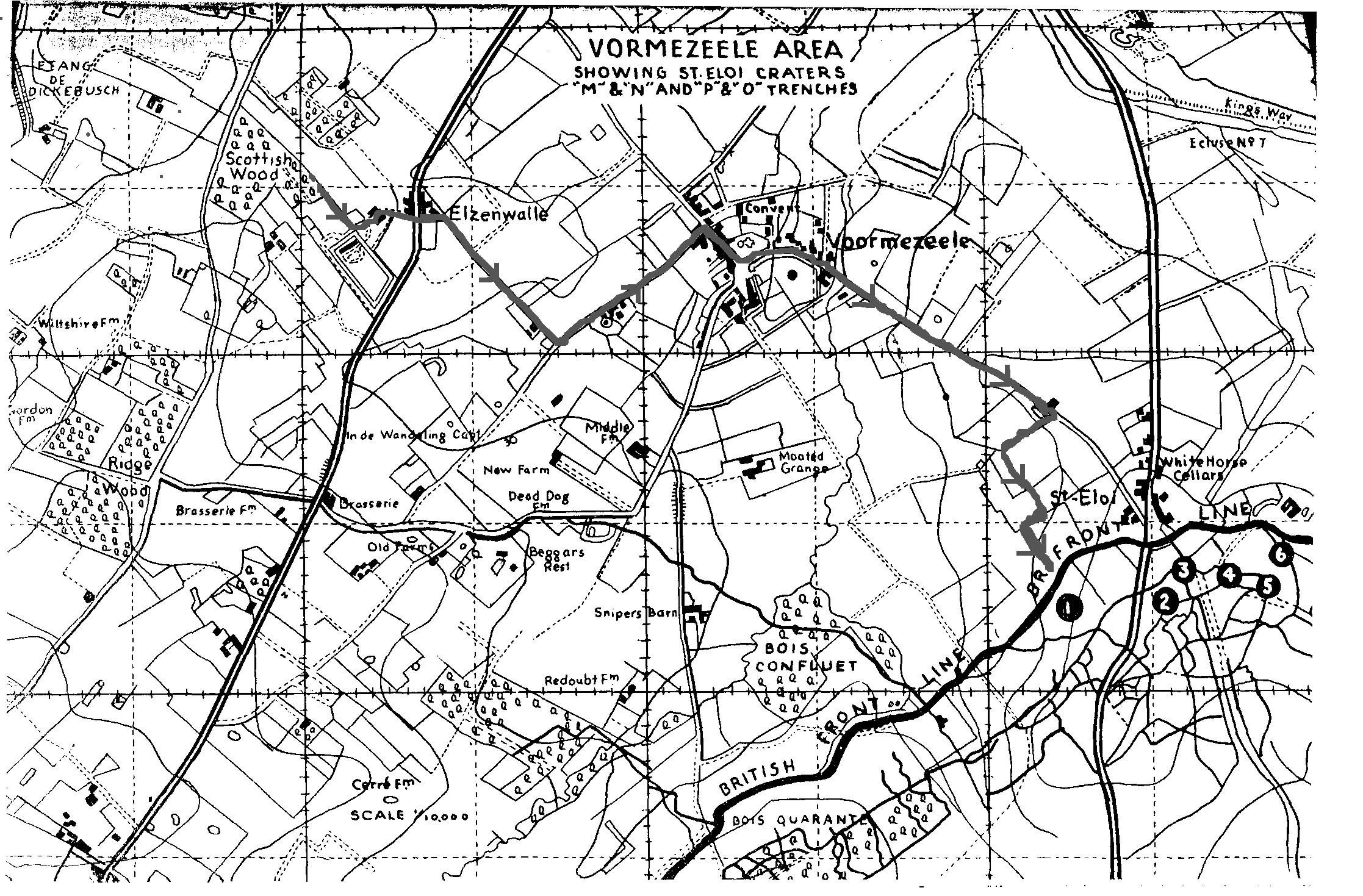
“Our position stretched from in front of the village of St. Eloi (far right centre) to the Voormezeele-Wyschaette road, about 1100 yards to the left (where the “B” in British is at bottom centre). Directly opposite us was the Bois Quarante, along the front of which were the German front line trenches. The distance between our lines varied from about seventy yards on the right, to something over two hundred yards at the left, where the Germans held a dominating hill called ‘Piccadilly Farm.” This merged with the high ground in the village of St. Eloi, which was designated as ‘the mound’.
Back of our front line, at a distance varying from four hundred to six hundred yards, was our support line, which was not really a line at all but a series of redoubts or strong points with a few bits of trenches. The redoubts were concealed among the trees of the Bois Carre and other woods. Back of that, ranging from eight hundred to twelve hundred yards was the General Headquarters line, which was our last defense. This was unoccupied while we were there. Just back of this was Ridge Wood (centre left), a considerable forest, where Battalion Headquarters was located and where we established a cemetery.
When a brigade took over a new sector of the front, there would be many extra jobs to do. Outgoing troops would clear away all their rubbish and pack their kit bags. Lists were made of trench stores; such items as bombs, ammunition, periscopes, rifles etc. and there would be a thorough inspection of the sector by the outgoing unit, which would prepare a report on trenches, dugouts, saps, wire, no-man’s-land, enemy activity and work to be done. The advance party of the incoming unit would check and sign for stores. After dark, the new unit would move into position and the new sentries would get an informal update on current conditions from their outgoing counterparts. Only after the head of each unit was satisfied, would the outgoing group march out, signalling progress as they went until they were able to finally signal to battalion headquarters ‘Relief Complete’.
 Stories