Portions of the 21st Battalion, such as Transport, Machine Gun and Signals, left West Sandling Camp on September 12 – entraining for Southampton and shipping out for LeHavre. Their ship proceeded in the inky darkness until they saw a brilliant light on the horizon. It wasn’t until they came abreast that they realized that this was a hospital ship, headed back to England with its awful cargo of wounded men. Upon docking at Le Havre, the unit began the heavy work of unloading the ship, including the many horses who had shown themselves unwilling to board in the first place and now balked at going down the steep, narrow gangway. After a welcome cup of coffee on the docks, they loaded their wagons, hitched up the horses and made their way to a “rest camp” on the outskirts. At midnight, they marched to a train in the pouring rain, soaked to the skin, and sloshing through mud and over unknown roads and streets. Once again the horses and carts had to be loaded and the men were crammed into tiny rail cars for the overnight trip to St Omer.
Meanwhile the main contingent of the 21st Battalion formed up, were inspected and addressed by their C/O. They bade farewell to the area around West Sandling and marched the 16 kms to Folkestone, and if they were like other units, suffered greatly having to break in the new equipment. There were German Zeppelin bombing raids near the area they had just left, at Westenhanger. They began to sail across the English Channel from Folkestone on September 14, 1915, but were turned back shortly after departure. No doubt Bill and Keith were anxious to know what was going on and, being crammed into one of many boats accompanied by ghost-like destroyers hoping to fend off German Submarines, would hardly have relieved their anxieties. Many would suffer from seasickness, made less bearable by the laughter of their mates. Unknown to them, a British destroyer had collided with a paddle wheeler carrying Brigadier General Lord Brooke’s 4th Brigade staff. It was not until the paddle wheeler was towed to Boulogne that the rest of the fleet was allowed to sail again the next morning. There was a concern for mines and new sweeps had to be conducted. Among those landing in France around this time as part of the 5th Brigade were the men of the 22nd Battalion, who were all French Canadians. Imagine how the French felt when the sons of those who had left many years before came to help them in their hour of need.
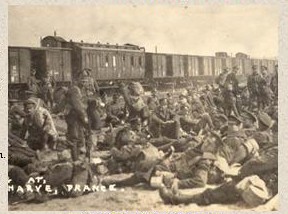
The photo shows Canadian soldiers waiting to board trains near Le Havre. The compartments were loaded with either eight horses or forty men and their equipment. Following the pattern of their advance party, the 4th Brigade moved via the rest camp and train to St. Omer.
McBride described what happened on his train:
“There was no room to lie down or even to sit down, without piling up two or three deep, but we managed to get along somehow. We were soaked to the hide and all our equipment was in the same condition, but those birds decided to sing and kept it up all day long. We had some cheese and bully beef and a few chunks of bread, so we made out nicely.”
Bill later reported that as he walked off the station platform he fell. He strained himself and a lump arose in his left groin. The brigade was reunited at Abbeville and rode on the same train to St. Omer. The next day, they marched 20 kms to Hazebrouke and arrived there at 7AM. After breakfast and a rest, a very hot march took them another 8 kms to Eeke.
Corrigall :
“ From the ridge north of Hazebrouke, an expanse of rich, rolling, pastoral country came into view. The gentle slopes of this hill, crowned by the pointed spires and gables of terraced buildings, made a rich subject for the brush of a painter. Mainly because of blistered feet, only three-quarters of the battalion marched into camp. The remainder had to be attended to by ambulance personnel.”
McBride:
“This was the hardest day we had had. It was very hot and everyone was overloaded and our packs and clothing had not dried. We were carrying forty or fifty pounds of water in addition to the regulation sixty-pound equipment. The roads were made of cobblestones, so ankles were continually turning and our iron-shod soles slipping on the knobbed surface of the cobbles. We kept going on our nerve after we were worn out physically and, whenever we did stop for a short rest, every man was asleep in less time than it took to lie down. I consider it the hardest march I have ever made in my life.”
I can’t help but think this is the march that Keith always talked about, when Bill took off his boots during a rest break and, because his feet swelled, couldn’t get them back on. It was a beautiful evening and the whole countryside was quiet, except for the faint sound of antiaircraft fire and slight rumble of artillery fire coming from the direction of Ypres.
It is likely that the men of the 21st were billeted in the open or around the property of one of the local farms, as were some men of the 20th who “went to the hayloft and settled down in the straw for the night.”
The next day they were continuing to dry out and organize their soggy gear and allow the stragglers to catch up when, at 4 PM, they were told to form up for a two-mile march to be welcomed to the war zone by General Sir Edwin Alderson, who had commanded the 1st Canadian Division and was now in charge of the entire Canadian army. They were now really there but didn’t realize that their new commanding officer had a little surprise in store for them.
 Stories