Berton:
“For most of that record winter, the Canadians were cold, wet, hungry, tired and (though they did not admit it) frightened. The cold was unbelievable. The temperature did not rise above zero Fahrenheit for one month. The ground froze two feet deep, making it impossible to bury the horses and mules that died of cold and exposure. Fog and rain mingled with snow and sleet; the water in the shell holes froze overnight; the mud turned hard as granite so that men were actually wounded by flying chunks of earth. They clumped along the duckboards, swathed in greatcoats and jerkins, hooded by balaclavas under their steel helmets, their rifles wrapped in sacking; and they took their boots to bed to keep them from freezing stiff. It was so cold that the bread froze after it came from the ovens and had to be cut with a hacksaw. Colds were so common that before a man could be sent to the rear he had to be suffering from pneumonia.”
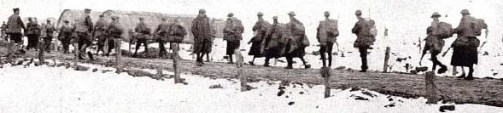
The 21st Battalion spent January 18 and 19 resting and cleaning up in a blinding snowstorm and then marched to Ruitz to a training area, where they stayed for a cold week of training, route marches and sports. Then they marched to Barlin and Marles Les Mines, where they were billeted until February 11 to carry out ‘special training’. One highlight (?) was an inspection by General Burstall of the 2nd Canadian Division and another was a bath they were able to get between February 9 and 11. Then they marched to the new ‘A’ huts at Bois-des-Alleux.
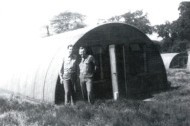 4 CMR War Diary:
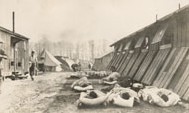
“These (the huts at Bois des Alleux) were, for the most part, Nissen Huts (see typical Nissen hut, left), tucked away in a green wood beside the river Scarpe. They lay in the shadow of the church at Mont St. Eloy, a battered remnant of a previous war; although occasionally shelled, it served as an excellent observation post commanding a wonderful view of Vimy Ridge.”
Pierre Berton spends some time in his book commenting on why men who returned from this war were unable to describe the experience:
“Any healthy young man can survive a few days in a ditch. But a week in a ditch, a week out, bored to death, committed to back-breaking toil, with only a little leave, no chance of seeing home and family and no idea when it would all end. Small wonder they did not try to describe the indescribable.”
Berton felt that Gregory Clark’s picture of the trenches deserved to be quoted at length:
“Historians have forgotten to remind us of one thing, that from the sea up near Ostend, some hundreds of miles, waving and weaving across Belgium and down through France over hill and valley and plain and river, down across and back up into the mountains, three hundred and some miles… was this ribbon of stealth. Some places it would be only a few miles wide, other places, because of the flat terrain, it was wider. This ribbon or belt of absolute stealth, day and night, week after month after year for four years – never changing; this band of deadly stealth, in which no man moved or spoke loudly. When you entered it from behind whatever hills or other cover enabled you to be yourself (chatting and marching and slouching along with your unit) suddenly you entered this strange, mysterious, unearthly land of stealth. And in that stealth millions of men lived years of their lives.
There were sounds: there was the distant sound of the guns firing. There was the weird, unearthly howling of shells…the crack and explosions of shells. There would be strange meaningless rifle shots, little random unassociated rattles of half-dozen bursts of machine guns in the night. These sounds in this stealth only accentuated it and gave it a more unearthly and slightly lunatic sense. You were living in this strange, weird and wonderful thing not a little while. Battles came and broke it and smashed it into a thousand million pieces but then the battles subsided and the stealth returned. Now they speak of trenches in this strange ribbon of deadly stealth across Europe. Trenches is too romantic a name – these were ditches. As time went by we had no garbage disposal, no sewage disposal – they became filthy. You threw everything you didn’t want out over the parapet. If you ever stood at a place where, with powerful binoculars, you could look at the trenches you saw this strange line of garbage wandering up hill and down dale as far as the eye could see. In that setting men lived year after year in a sort of garbage dump ditch. The latrines were little trenches off the main trench. These, when they became too offensive, were filled in and a new one dug; but the main trenches were held sometimes months on end. The smell in those dugouts was a sour, strange odour overlaid in winter by the smell of coke gas.
This land of stealth went through towns and villages but mostly through farm fields, abandoned and of course running wild with turnips and some other farm crops. A weird tangle – you would think it would come alive with game, but no. There was nothing in it except rats by the countless millions. Wherever you went, in daylight and at night, the whole place was squeaking and squealing with these huge, monstrous rats living on this garbage.
The tension never for one moment relaxed. The stealth never relaxed day or night, winter, spring summer, autumn. The tension never ended. You never knew at what moment one of those perfectly meaningless sounds would get you. It wouldn’t have taken a great deal in this dreadful, prehistoric circumstance for men to have lost heart and they never did. We had a thing called shell shock in our war: it wasn’t anything of the kind. It was just fatigue – not so much in battle as in those long intervals of living under these conditions.”
By the end of January 1916, Bill had spent twelve and a half months and Keith slightly over thirteen in “the ribbon of stealth” since they had arrived in France and Belgium sixteen and a half months before. In sharp contrast to the tedium and tension of routine life in the trenches, they must have constantly remembered the sheer terror during the fighting at St. Eloi and Courcelette.
Armageddon:
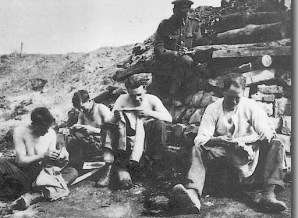 “Men were constantly infested with lice. Such was the misery that men woke up bleeding from scratches gouged to relieve the itching. In the foul conditions, infection often followed.”
The unknown soldiers in the picture are attempting to delouse their clothing. When not in the trenches, sometimes lighted cigarettes or candles would be used to burn the lice, but this could have unwelcome side effects, such as destroying the clothes. Body lice needed warm conditions and found them in the body heat and warm clothing of the soldiers, often huddled together to keep warm. As a result the lice moved easily from person to person. Lice reproduced quickly, with each female producing more than ten eggs per day.
McBride:
“Another hitherto unknown disease which developed was what is commonly known as Pyrexia or ‘trench fever’. The victim’s temperature runs up around 103 degrees, he has shooting pains in his legs, he is affected with lassitude and general debility and requires from three weeks to a month in hospital to put him in shape for duty.”
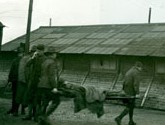
On February 2, Lieutenant Bill Nesbitt was admitted to No. 12 Stationary Hospital in Rouen with Pyrexia. I don’t know whether Bill would need a stretcher but the pictures shows someone being carried into a portion of that hospital and patients waiting for X-rays and surgery there. Bill would not return to his unit until April 19, while it was still engaged in the fighting after the initial assault on Vimy Ridge.
Armageddon:
“Only in 1918, was Trench Fever (Pyrexia of unknown origin) traced to body lice.”
In the second week of February, the 4th Brigade left their winter quarters and headed to the Vimy area. The 20th left on February 10 and the 21st followed two days later. A few days after that they would be side by side, in their assigned trenches, until February 19.
Corrigall:
“Feb. 10 – We left Auchel in bright and frosty weather, spent one night at Haillicourt and then we had a long march to the reserve area of the Vimy front. We were quartered in huts, but found some difficulty in keeping warm. Our first night in the trenches was cold and the earth frozen. Living so long in billets had softened us and the trenches were old and had poor shelters. Enemy trench mortars, which were very active, caused us many casualties. The relief was welcomed, for the seven days in the trenches had been a severe ordeal because of the intense cold.”
Sandy Bain, who had just arrived on February 14 in the 4th Brigade Reserve area to be assigned to the 21st Battalion:
“I fell asleep in a corrugated iron Nissen hut at a camp about a mile from Mont St. Eloy. I was awakened by a battalion coming into camp, right from the trenches. The men were in terrible condition- simply covered from head to foot with mud, four or five days growth of beard on their faces, which were black and grimy with dirt, and their eyes sunken in their heads with loss of sleep. I wondered if they would ever get clean again and I could see that it was no joke taking a turn in the trenches.
We got on the move again at 5 PM, but had to wait until it got darker, as the road from there on was under observation from the enemy who occupied the high ground – Vimy Ridge. We passed an anti-aircraft battery mounted on trucks so they could be moved quickly. After we passed through a completely ruined village, we entered a communication trench. We passed along this trench for a mile and were very tired when we reached Battalion Headquarters in a dugout. We were told that ‘You will be in a good safe place tonight, as you will be about seventy feet underground’. Zivy Cave was an old chalk mine and was quite close to our front line trenches – making quite a distance further for us to walk, so by the time we reached there I was all in. The entrance was down an old broken stairway, cut in the chalk. Pushing open a flap of canvas at the foot of the steps, we entered the cave. The place was pretty well crowded with men and their candles, and charcoal braziers cast a red glow over all. It reminded me of pictures that I had seen of pirate’s caves. I could not rest yet as I was picked to go for rations. When I got back it was midnight and to say I was tired would not be using the right word. I laid my ground sheet down on the hard chalk floor and, rolling up my blanket, I was soon sound asleep.”
The 21st had three Other Ranks – W. Standing, D. MacDonald and W. R. A. Palmer – killed and twelve Other Ranks wounded, so it was a rude reintroduction to the front lines.
A Lieutenant Williams of a machine gun unit wrote:
“Please excuse this letter’s lack of neatness. I am covered in mud, writing by candlelight.” In his next letter he berated his family for making light of his condition – “I don’t see anything amusing about writing by candlelight – that is all we have here. You can’t even get a coal oil lamp of any kind, nothing but candles. It is pitch black without them.”
Meanwhile, in mid-February, the 4th CMR (without Bill) settled down to five weeks of arduous training, which was in reality their first preparation for the assault on Vimy Ridge.
4th CMR History:
“Nothing was left undone which had any bearing on the necessary preparation for a machine-like assault at the appointed time.”
After a strenuous week in Brigade Reserve, the 21st returned to very different conditions in the trenches.
21st Battalion War Diary:
“ Feb. 25 – Trenches in an awful state, mud being in some places knee deep. R. M. Smith was killed” (During their next tour at Brigade Reserve ) “Mar. 4 to 8 – Every man was on fatigues daily. During this period the men obtained a bath which was greatly appreciated.”
There are many references to an increase in air activity, which seemed to indicate that the Germans were gaining the upper hand. Patrols were out every night but found nothing. Both artilleries were very active.
Zivy Cave, that was mentioned by Sandy Bain, was later described by Corrigall:
“Zivy Cave, destined to conceal many of the troops in the forth-coming attack, was in the forward support line. It was being turned into living quarters and electric lights had already been installed. By zero hour it was to be occupied by the advance headquarters of the 4th Brigade, a battalion of infantry, a company of infantry and a dressing station, complete with temporary operating tables and beds made of chicken wire. An ample supply of water was available from pipes connected to water tanks in the rear.
There was little time given for rest as every available man was employed in day and night reliefs on the construction of new trenches, dugouts and emplacements under the direction of the engineers. This included the construction of deep dugouts, machine gun and trench mortar emplacements, shellproof bomb stores and the assembly of the material for building them – metal beams, corrugated iron and revetting wire. The engineers planned the work, but we supplied the labour.”
Berton:
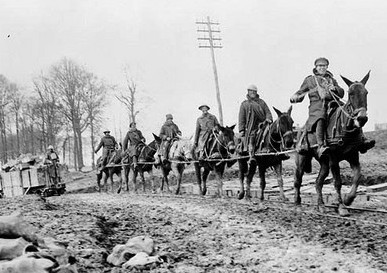
“The entire corps was dug in below the slopes of Vimy Ridge and every Canadian in Europe was learning to endure the unendurable. (Not only the rats and the mice but) they had seen mud so bad that the horses died of exhaustion trying to pull loads through the gumbo. They had seen men in shock cry and shiver if a shell dropped 100 yards away, and they had seen others shoot themselves in the foot to turn themselves into hospital cases – anything to escape, if only for a few days. Hideous death had become a familiarity.”
During the early part of March, the 21st alternated with the 20th, either in the trenches or at Bois des Alleux, suffering the loss of F. G. Jocham.
On March 9 the support trenches were described as – “In an awful state, mud in some places knee deep”.
21st Battalion War Diary:
“Mar 10 to 14 – The Battalion remained in Brigade Support for very large fatigue parties including 760 men for permanent fatigue work with 185 Tunneling Company and several other large parties for the building of artillery emplacements, dressing stations etc., while the remainder were employed in the cleaning up of communication trenches. The weather was bad during this trip.”
Berton tells the story of a Private Bill Breckenridge as he joined his new unit, in March 1917:
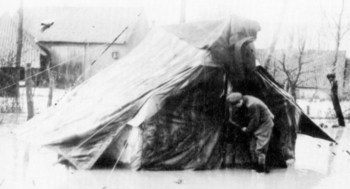
“After a 24 hour train ride, 40 soldiers were dropped off at Bruay where they stayed overnight in a barn during a blizzard. In the morning, they left for a 20-mile march to their battalion rest area, 6 miles behind the front. Breckenridge could feel the straps of his 80-pound pack biting into his shoulder as members of the group fell by the wayside exhausted. The sights and sounds of war increased and the tension began to build. Little trains rumbled by on narrow-gauge railroads, loaded with shells. Long lines of battle-weary men began to appear, their faces grey with exhaustion, their uniforms spattered with mud. The reinforcements enjoyed a bit of food and an hour’s rest before setting out again. Suddenly there came a dramatic change. All sound ceased. All signs of life vanished. It was still daylight and the German positions astride Vimy Ridge were only 6 miles away. They had come within reach of the enemy guns but they had no choice but to continue. They moved on in parties of 5, marching at intervals of 100 yards, until they reached the rest area in a swampy wood, where the Black Watch were camped. They spent the night in bivvies no more than 3 feet high, built of sandbags and draped with tarpaulins. The camp was covered in a foot of water, and the troops waded through the muck to their knees. That night the Canadian artillery opened up a practice barrage to get the range of the German trenches and Breckenridge felt as if he were in the middle of a blast furnace. ‘What would war be like?’ he asked himself.
 One night at dusk the battalion marched off in single file to enter the labyrinth of the Vimy trench system. In what seemed like a large city, there were 100,000 men working frantically during the night. Here a confusing network of trenches and sunken roads, more than 2 miles thick, wriggled and squirmed through the mud along the 4-mile front. The trenches were mud-coloured; the men themselves, in their muddy khaki with their mud-coloured helmets, mud-coloured packs and mud-coloured webbing, blended with their surroundings. So did the rats that scuttled through the mud-coloured garbage.
Three more or less parallel lines of trenches – forward, support and reserve – faced the Germans, all linked by the long communication trench down which the Black Watch sloshed and stumbled. As the battalion neared the front, there came the faint rattle of machine guns and the whine of an occasional bullet overhead. All talking ceased, as the troops, in crouched position, negotiated the wooden trench mats that lay in the slime beneath their feet. As they entered the forward lines, the only sound was the thud of heavy boots. The front lay just ahead. Beyond that were the great mine craters, in which sentries were posted. Beyond that lay the dead world of no-man’s-land and, invisible in the darkness, the great bulk of the ridge.
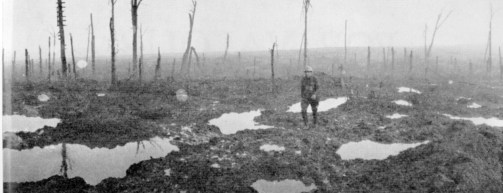
They relieved a battalion, which had been there for a week. RELIEF was written on the faces of those who had survived a week of standing at the alert, eating cold food, sleeping in their clothes, 12 hours on and 12 off; never free of rats, lice, rain, snow or mud and the constant hammering of guns. They had heard their own artillery as well as the roar, whine, crump, and moan of the German mortars, minnies, howitzers, and whizbangs plus the sharp stutter of the machine guns and the snap of the snipers’ bullets. Breckenridge had arrived and would quickly begin to look forward to his own relief.”
Because it had been the scene of battle for over two years, the area below Vimy Ridge was a literal graveyard. Skeletons and skulls lay all around. Old trenches and ditches were littered with broken rifles, rusting bayonets, bombs, and tangles of barbed wire. Everywhere rotting French blue and German grey uniforms held their consignment of bones. J. V. Sullivan joined the ranks of the dead on March 20.
Berton:
“There were subtler hints that could send a shiver up the spine of those who had been hardened by a long acquaintance with the dead. In the French cemetery at Villers-au-Bois, thousands of temporary crosses marked those bodies that had been awarded a formal burial. On each of these crosses, the French had placed a small metal triangle as makeshift identification. In the night, when a breeze blew, the men in the trenches could hear the eerie clink-clink-clink of those thousands of tin triangles, a reminder of the vast and ghostly army that had preceded them.”
McBride:
“Winter was over. It was open season for soldiers. They would be expecting anything at any time; whether in the way of offence or defence, for a soldier simply waits for either one, knowing as little about the plans of one side as the other.
Waiting is a little less apprehensive when there are signs that his side is preparing for offence. He will not be unexpectedly smothered by a barrage, against which he can do nothing save dig himself and his guns out while the hours pass. When suddenly the barrage lifts, he knows that all he can count on to protect him against whatever the gathering light brings is the rifle in his hand and the few men he can see in the smoke and fog around him. But for the moment, there is only a man and a rifle, against everything that may come over the parapet within his reach.
On the offensive it is a little better. He will be on hand to receive the counter-barrage. But he has first heard the music of his own artillery, and seen the signs of activity as he came up the night before: the concentration of guns, ammunition in the bays up front, handy for the machine guns: signalers with their coils of wire, and stretcher-bearers waiting innocently beside stacks of stretchers. It is comforting to remember these things while waiting for the barrage to lift. If it is raining and he has to wait for several hours, this knowledge may be cold comfort but it does a good deal to boost his confidence in himself.”
Corrigall:
“On Mar. 24 at Bois des Alleux (along with the 21st Battalion), we were shelled by long-range guns, one man being killed and another wounded. With no shelter from the shelling all we could do was disperse in the open fields. It was decided to vacate the huts the next day and we moved back about a mile and established ourselves at Yukon Camp, where there was practically no accommodation. Improvised shelters were quickly erected giving us some cover from the cold and drenching rain.”
Berton:
“One soldier was plastered with a thick layer of mud from his head to his boots. It had poured rain all night. The trench was a quagmire. Parts of the wall had caved in, burying half the ammunition. The roof and the stairway of his dugout were threatening to collapse, and the men had been roused to stand by with picks and shovels. Water tumbled down the steps like a miniature Niagara. The mud was so deep that one of the platoon runners had been stuck waist deep and forced to leave his boots so he could be extricated.”
Corrigall:
“March 27 – All day we saw a continual stream of traffic on nearby highways, moving forward almost unbroken. In the fields around us were other camps filled with troops. Preparations for the attack were assuming gigantic proportions.”
 Stories