McBride:
“After many false alarms, we finally received orders to move and, on the evening of May 5, we entrained for Montreal. The citizens of Kingston gave us a grand send-off. At other towns and cities along the way rousing demonstrations were staged for our benefit. We had just recently received the reports of the fighting at Ypres and the hideous savagery of the enemy in using poison gas against the Canadian 1st Division. Hundreds of casualties were being posted daily – names of many of those from these very towns – and we were to go over and clean things up.”
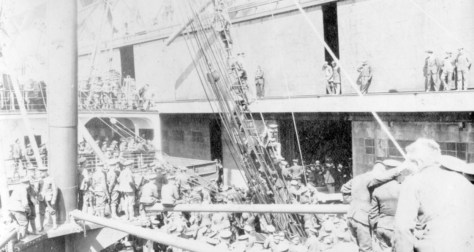
The 1,006-strong battalion sailed the next day on the RMS Metagama. The picture (right) shows them during boarding in Montreal. Unlike the arrangements for the 1st Division, which sailed as a convoy with escorts, this fleet consisted of unescorted individual ships.
No. 7 General Hospital History:
“Those of us who were on the Metagama still picture the cheering, waving crowd as she loosed her hawsers to head down the mighty St. Lawrence.”
Captain Corrigall of the 20th Battalion:
“As we steamed down the St. Lawrence, the countryside looked calm and peaceful. On both sides the farms stretched out up the slopes of the low hills. Villages dotted the landscape, each with its large church, characteristic of French-Canadian communities. Farmers could be seen tilling their fields, hardly seeing the passing ship or its passengers.”
Emergency procedures were prepared and frequent practice drills were carried out to ensure that everyone moved to their assigned positions. Days were spent in physical drills in the morning and deck sports and boxing in the afternoon. The men attended lectures or concerts in the evening until “lights out” at 9:30 PM. This really meant lights out because the ship was blacked out with curtains on the portholes and deck patrols checking for any source of light. Lookouts were posted and kept watch for submarines and mines – described by one officer as “footballs with spikes on them.” On the way, they passed boats in the Irish Sea hunting for some of the 1,200 bodies from the ocean liner Lusitania, which had been torpedoed by a German submarine two days before.
McBride:
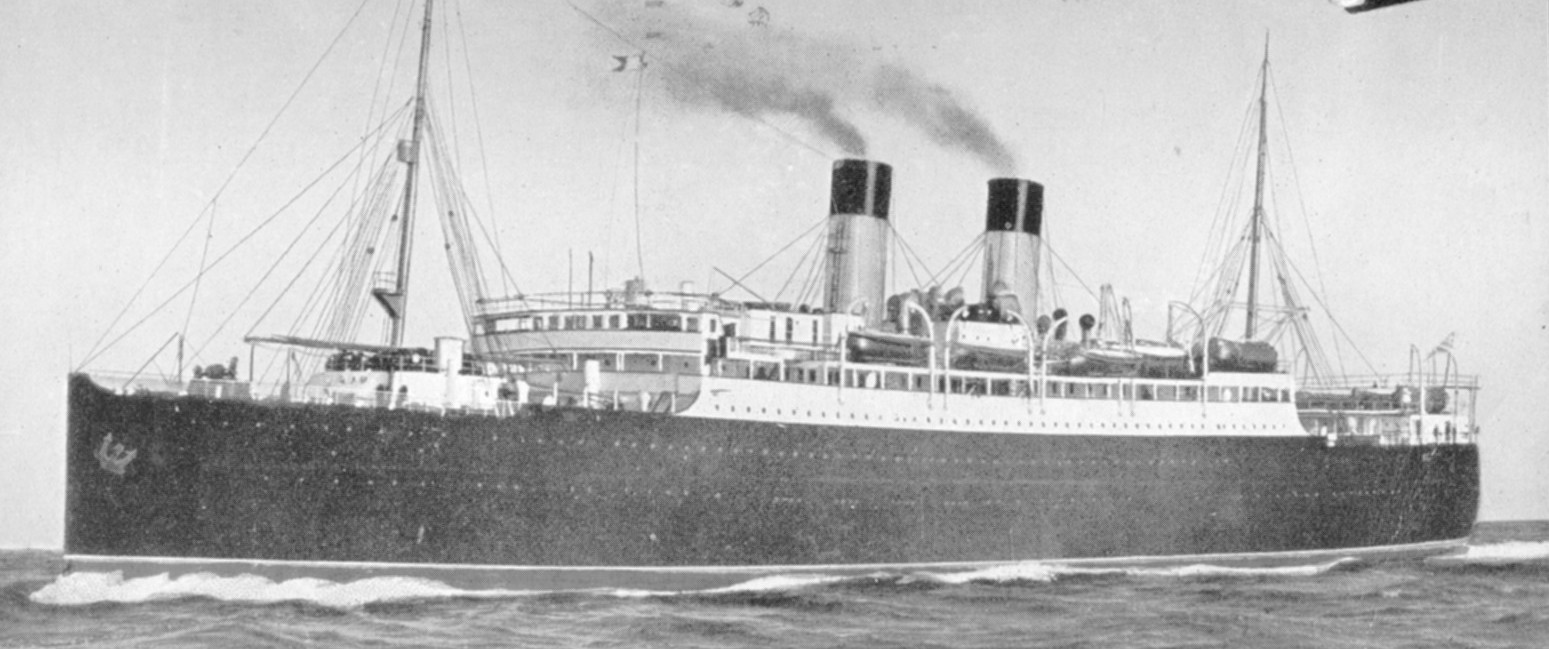
“We had on board several hospital units, including about 150 Nursing Sisters, in their natty blue uniforms. They were immediately nicknamed the “Bluebirds.” Many’s the man who has since had cause to bless those same bluebirds in the hospitals of France and England. We ran into ice at the mouth of the St. Lawrence and for two days were constantly in sight of bergs. It was a beautiful spectacle but I’m afraid we did not properly appreciate it. We remembered the Titanic. Then we got word by wireless that the Lusitania had been torpedoed. Personally I didn’t believe it. I began to believe it the next day when were we ordered to go down in the hold and get our guns and mount them on the deck. Two were mounted on the forward deck, two on the flying bridge and two on the aft bridge. I am not sure what we were expected to do against a submarine with machine guns. I was with the forward guns and, as we had several days of pretty rough weather, it was a wet job. We had no convoying war-ships until, one night about nine o’clock, several dark slim shadows came slipping out of the blackness and established themselves in front, on both flanks and behind us. The Metagama (below) was running without lights and the destroyers were also perfectly dark and we could barely discern their outlines as they glided silently along. When the rest of the battalion (who were not allowed on deck) heard the news about the British destroyers, the grapevine started overtime, with guys guessing which port we were headed for.”
 Maheux:
“I am pretty certain some of the nurses made something in their pants because one night I pretty near myself.”
Corrigall:
“It was with feelings of reverence that we first looked upon the land of our ancestors. We gazed in silence. The land to us was the ‘Old Country’ of which we had heard ever since we were old enough to understand.”
McBride:
“Just before sunrise (4 AM) we dropped anchor inside the Plymouth breakwater. This was a surprise as we expected to land at Liverpool or Bristol, but any port in England looked good.”
Corrigall
“We saw very little of Plymouth, one of the most famous seaports of England. It was the last port in England to be touched by the Pilgrim Fathers on the Mayflower.”
The training of the 1st Division had been a disaster in the rain and mud of the Salisbury Plain and British authorities elected to move a British division from Shorncliffe Camp near Dover and use it for our 2nd Division. It was into this situation that the 21st arrived from Plymouth on May 16, 1915.
McBride:
“We lay there at the dock and unloaded cargo and supplies all that day. It rained all day, but we gradually got all our stuff off the ship and loaded on the trains and about dark we pulled out. We were eight men to a compartment, equipment and all, and we traveled all night long in those stuffy little carriages. No one knew where we were going. The only training camp we had heard of was Salisbury Plain and we were not anxious to go there. We journeyed along the northern shore of the English Channel, through a panorama of lovely vistas of green-topped, red sandstone cliffs with little villages nestling in the coves, all bathed in warm sunshine.
Passing Exeter, we sped over the downs to Salisbury ‘whose cathedral stands up, perfect in proportion and exquisite in workmanship’. (I wonder if many of the young men spent much time looking at the scenery in this way.) We then crossed a beautiful stretch of inland pastures to the outskirts of the great City of London- the capital of the British Empire. Crowds lining the platforms of the stations greeted us with great enthusiasm. Skirting the southern suburbs of London, the train traveled into open country again through the hop vineyards of Kent into Westenhanger. Soon after daylight the train stopped and we disembarked at Westerhanger. After a march of about three miles, we found our new home at West Sandling Camp.
And how proudly we marched up the long hill and past Brigade Headquarters, our pipers skirling their heartiest and the drummers beating as never before. (Keith said he didn’t care much for bagpipes but they were marvelous to march to.)
We were on exhibition and we knew it. The roads were lined with soldiers and they cheered as we came marching in. There came a time when we hated that hill and that camp as the devil hates holy water, but that morning, marching into a British camp, eager to keep right on across the channel and clean up Kaiser Bill and feeling as though we were able to do it single-handed – why the meanest private in the 21st Canadians considered himself just a little bit better than anyone else on earth. Having hung up our equipment, we were marched to the field kitchens of the 21st Battalion and given a hot meal.”
 Stories