What did the residents of the little town of Brighton, Ontario know about the war, which was going on thousands of miles away? Excerpts from The Brighton Ensign, in date sequence, in late October and November have frequent references to the war but which, unlike our current instant communications, were many days behind the action.
- “A dispatch from Paris says: the hardest engagement since the war started is on from the coast down to Arras…Around Lille the German troops threw themselves in masses against the Allied troops… mostly British…Both sides have suffered terribly here…There has been no respite except during the dark of night, but even then the artillery of both armies keep up a continuous duel.”
- “In the area of Verdun there is incessant, violent fighting with no decisive outcome…victories of the Allies were won north and south of Verdun…The army of the German Crown Prince was beaten back in the Argonne Forest and a regiment of his troops was cut to pieces…French artillery destroyed three German batteries on the Upper Meuse.”
- “More than 100,000 Belgians refugees are in Britain…the boats from Flushing and Calais are still bringing large crowds of refugees daily.”
- “Many ask why France, with 4,000,000 trained men and the support of Belgium and England, has not been able to turn a million and a half Germans out of France. The answer probably is that though France has all the trained men she claimed in her army, neither France nor Britain ever seriously contemplated it would be necessary to place such vast forces in the field.”
- “A dispatch from Paris says-‘ There is only one conclusion to be drawn from the very definite and complete reports issued by the French Government; that the Germans are being fought to a standstill in Belgium and are losing ground everywhere in France. It is now entirely probable that there will be news soon of a decisive victory by the Allies and a general retreat by the Germans’.”
- “So fierce has been the fighting around Ypres that the casualties of the Germans are believed to have reached 100,000, though these figures may prove to have been exaggerated.”
- “The Berlin press states that eight German Princes have been killed in the war- six of them aged between 18 and 20. There is nothing to confirm the report that the Crown Prince is dead.”
- For three weeks the position near Ypres has been held under a rain of shells, which hardly ceased by day or night. During this time the enemy has poured successive waves of infantry against it, only to see them break to pieces, one after the other. They were driven back, leaving piles of dead behind.”
A British reporter named Hamilton Fyfe joined the French Red Cross as a stretcher-bearer, because reporters were banned from the front lines:
“What caused me acute discomfort were the illustrations of the bestiality, the futility, the insanity of war and of the system that produced war. The first cart of dead that I saw, legs sticking out stiffly, heads lolling on shoulders, all the poor bodies shoveled into a pit and covered with quicklime, made me wonder what the owners had been doing when they were called up and told to kill, maim and mutilate other men like themselves, with whom they had no quarrel. And all to no purpose – for nothing.”
It was in this environment that our two Brightonians, Bill Nesbitt and Keith Roblin, joined the Canadian Overseas Expeditionary Force. From a notation on their Attestation Papers, which says “Brighton, October 19, 1914”, I assume that there was some sort of recruiting effort in Brighton on that day. From The Brighton Ensign there was the following report on October 30.
A FINE SEND-OFF FOR THE BOYS
“The second contingent volunteers from Brighton were given a befitting farewell Monday last, when the citizens of the town congregated in the Opera House and demonstrated their appreciation of the loyalty that prompted the boys in enlisting to take part in upholding the flag that has ever stood for freedom and justice. An appropriate program was arranged. Reeve R. J. Boes occupied the chair, and after a few brief remarks, called upon Reverends A. K. McLeod, Rural Dean Pickford, W. Elliott and S.H. Lamb in succession, all of whom addressed the gathering suitable to the occasion.
On the platform with the boys were the members of the Village Council and Mr. Sam Nesbitt, M.P.P. (Bill Nesbitt’s uncle). Fervent prayers for the boys’ welfare and safe return were offered. Near the conclusion of the proceedings Mr. Nesbitt was called on, and after an appropriate speech, presented each of the boys with a monogrammed wrist watch on behalf of the citizens of the Village and Township, and his personal gift in a sealed envelope, which he requested them not to open until they were on the train. Following this Mrs. McLeod, Mrs. Pickford and Mrs. Elliott, on behalf of the town, presented each with a parcel of knitted articles. Colonel Russell was given an opportunity to reply for the boys and upon the conclusion of his remarks Mr. Nesbitt arose and explained that the Colonel was one of the first to enlist for overseas service, but on account of the seniority list in service, has not as yet been accepted.
The addresses were interspersed with patriotic selections by the band, the favourite being the marching song of the British forces in the present war. “It’s a long way to Tipperary”, which the Boy Scouts sang heartily to the band’s accompaniment, and upon being played a second time the audience joined in. The program was closed with the singing of “God save the King.” Rousing cheers were given for the boys, the flag and King. Leaving the Opera House a procession was formed of numerous automobiles (remember this was 1914), hand wagons and pedestrians, leading to the (train) station where the conclusion of the memorable farewell to the boys took place. Wristwatches were also purchased for the boys who went from Brighton with the First Contingent, and these will be forwarded to them in England. Capt. H.P. Snelgrove, of Cobourg, who is in charge of the Company to which the Brighton boys of the First Contingent belong, will also receive a wristwatch, the gift of Mrs. Sanford.
The boys who left Brighton with the First Contingent are: J W Briggs*, G Davis, S[tanley] Hare*, A Jenkinson, F Johnson, Frank Richardson*, R Suddell, J Tough*, W Taylor* and G Withers. The Second Contingent boys are D Cooper, Ralph Francis Dusenberry, William John Hebbert, Arthur Edmond H Jones, George J L Jones, R Johnson*, James McCoy, F A Mutton, William John Nesbitt, Hugh Proctor, Hubert Keith Roblin, Hugh B R Strong, L Webberson and Edward Young.”
[Those marked * did not return.]
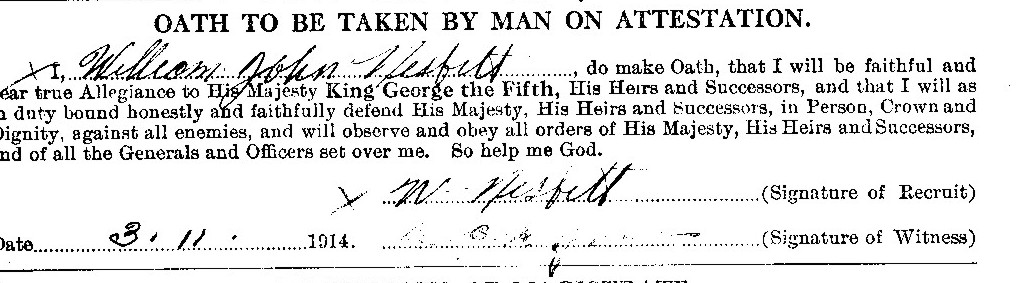
A few days later on November 3, Bill officially joined the 21st Battalion of the CEF in Kingston when he signed his Attestation Paper showing he was 24 years and 6 months of age and stood 5’ 9 1/2.”
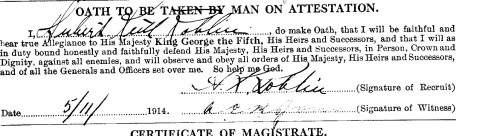
Keith followed 2 days later at 19 years and 3 months and 5’ 7 ¾.” Both single men promised to serve for one year or until six months after the current war ended, if they were needed that long.
 Stories