Private George Dawe of the 21st wrote home:
“January 8, 1916 – We are out in billets for a six day rest. Our time is up tomorrow (Sunday) and we go in again for eighteen days of mud and water and dodging whizbangs. We get fatigue parties every night and get great practice flopping in the mud when a star shell goes up. Sometimes in the day when on fatigue we are out in the open in full view of the German trenches. Then Fritz gets busy and shells us and it is to the small timber for us. We had a pretty good Christmas dinner, plum pudding, candles and nuts to finish off our old standby (stew). I was over to a little town at night and had a good time for a couple of hours. We got back to the dugout sometime the next morning, soaking wet and covered with mud, as I lost my way in the darkness and rain. I must tell you about an experience I had. One night I was out with a working party burying a telephone wire and did not finish, so had to go back the next day. It was a little foggy but the snipers spotted us and made it warm for us. They kept us lying in a ditch for nearly an hour. We couldn’t move or we would get it in the head. We waited until they cooled down and beat it one at a time. There is nothing that can make a fellow dangle faster than a sniper pumping lead at him. All the Cobourg boys had a present from the Daughters of the Empire and appreciate it very much. I get the papers you send me. I remain as ever, George.”
W. Alf Smith wrote:
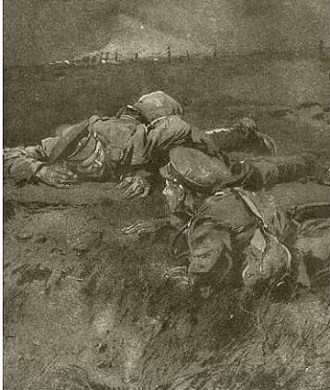 “One night I was out on the listening post near the German lines (artist’s rendering).
I could hear them talking and whistling. One of their snipers crawled out and took up a position just a few yards away from the hole we were in. The chap that was with me was seized with a coughing fit. Well you should have heard the bullets slipping over our heads. Once I looked out and my eyes were filled with dirt from a bullet right beside my head. I signaled in for a flashlight and the machine gun section got range on the shrubbery where he was hidden and poured 250 rounds in a figure eight circle. They got him and his body was riddled.”
I don’t mean to minimize what happened during the first three months of 1916, but the daily and nightly grind was spent in the “N” and “O” trenches, at the Brigade Reserve in Ridgewood or the Divisional Reserve at La Clytte. The weather was still cold and wet and enemy activity was persistent, with Grenades, machine guns, rifles and artillery creating just enough chaos to keep Keith and Bill and the 21st from getting comfortable.
T.M. Flanagan, D. Miller and C. G. Mash died in the first two weeks of January. The 20th Battalion, in front of the trenches that they shared with the 21st, discovered another hazard of patrolling No-Mans-Land. After dark on January 20 a patrol, approaching the German front lines, was surprised by an enemy patrol throwing bombs and heavy rifle fire from the trenches.
21st War Diary:
“Jan. 23 – Our machine gun strafing at 6 PM apparently annoyed the enemy, for between 6:30 and 6:50 he planted 29 whiz-bangs in the area of Sniper’s Barn, evidently thinking that our guns were located there.”
E. H. B. Cambridge died of wounds that day.
Corrigall:
“ As the scouts had previously been able to walk about that area undisturbed, the unexpected strength of the enemy at this particular moment was not understood. It became clear afterward, when German listening sets were discovered.”
They were apparently installed close enough to our lines that they were able to overhear a running commentary of the operation as it was being telephoned back to battalion headquarters. The Germans had introduced some ‘modern’ technology to the battlefield.
McBride:
“Early in 1916, we got an issue of genuine Canadian pacs with sixteen inch tops and, while in the trenches, had rubber boots. We even received regular Mackintosh capes of excellent quality.”
In the Canadian Division in January, there were five officers killed and twenty-five wounded; ninety-three Other Ranks killed, four hundred and fifty five wounded and two missing. The figures for February were similar- two officers killed and nineteen wounded; seventy-seven Other Ranks killed, four hundred and thirty-three wounded and four missing.
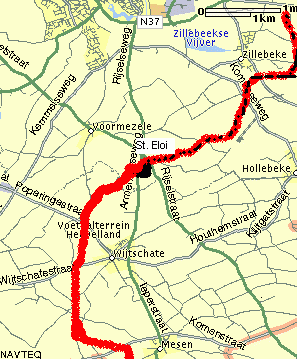
In late January the first units of the 3rd Division were gradually being deployed, allowing for greater backup and extending the width of front lines covered by Canadians. On February 12, British trenches (Red and black line below) were to the left and north of the Canadian position (Red line). A German attack resulted in a significant loss of Allied territory at The Bluff (heavy black spot). W. Glass was killed on February 27.
A major attack on March 2 called for the 21st Battalion to stay in Brigade Reserve at Ridgewood in case of a counterattack. The most significant feature of this very successful attack was the artillery barrage supplied by the Artillery of two Canadian and one British Division.
McBride:
“Winter was over. It was open season for soldiers. They would be expecting anything at any time; whether in the way of offence or defence, for a soldier simply waits for either one, knowing as little about the plans of one side as the other.
Waiting is a little less apprehensive when there are signs that his side is preparing for offence. He will not be unexpectedly smothered by a barrage against which he can do nothing save dig himself and his guns out while the hours pass. When suddenly the barrage lifts, he knows that all he can count on to protect him against whatever the gathering light brings is the rifle in his hand and the few men he can see in the smoke and fog around him. But for the moment, there is only a man and a rifle, against everything that may come over the parapet within his reach.
On the offensive it is little better. He will be on hand to receive the counter-barrage. But he has first heard the music of his own artillery, and seen the signs of activity as he came up the night before: the concentration of guns, ammunition in the bays up front, handy for the machine guns: signalers with their coils of wire, and stretcher-bearers waiting innocently beside stacks of stretchers. It is comforting to remember these things while waiting for the barrage to lift. If it is raining and he has to wait for several hours, this knowledge may be cold comfort but it does a good deal to boost his confidence in himself.”
21st War Diary :
“Mar.1 – The battalion ‘stood to’ in readiness to help the English division on our left who were engaged in recapturing ‘The Bluff’. The artillery covering us was extremely active. Enemy shelling in our area, only five rounds. Rain and Hail.”
Beaverbrook:
“This action was one of the first to demonstrate the increased blasting force of massed artillery, which became the standard weapon of offence on either side during the battles of the next five months. The continued piling up of munitions and guns had begun to modify profoundly the tactics of the Western front. A line more lightly held by the aid of machine guns and wire entanglements, as opposed to the fire of a rifleman every three feet, were the signs of a new era. Three battalions of the Canadian 4th Brigade were assigned to assist the British in the event of a counterattack and they provided some diversionary smoke bombs and small arms fire to make sure that German troops stayed in their assigned areas.”
A British Artillery Officer wrote:
“Ypres, 2nd March 1916: I got up at 4 AM and went over to the battery. It was pitch dark and I nearly broke my neck crossing the little trestle bridge over the moat. At half-past, to a second, bombardment began with an appalling crash, hundreds and probably thousands of guns, from 18 pounders up to “Grandmama”- the great 15-inch howitzer- let fly together. For the next hour, the noise was simply indescribable. It was almost impossible to distinguish the report of one gun from that of another; the only thing it can be compared to is the roll of a drum. We have the ramparts of the town near us, and the noise was intensified by the continuous echo. It was quite impossible to make one heard, even by yelling in a person’s ear. After an hour, it began to die down and by the time I came over to breakfast at 8 o’clock it was fairly quiet. The Hun, to my surprise, took it lying down – at least as far as our area was concerned; he did not fire at all. As soon as the bombardment began, we saw the German SOS signals going up all along the zone that was threatened. There were red rockets bursting into red stars. Soon after, rockets of all colours went up – white, green, red, golden rain, and even red golden rain. I imagine these were meant to confuse us.
About 9 o’clock the wounded began to stream down the road. All those who could walk took themselves to the field hospitals. Only the bad cases can be taken in the motor ambulances; these went by in streams also.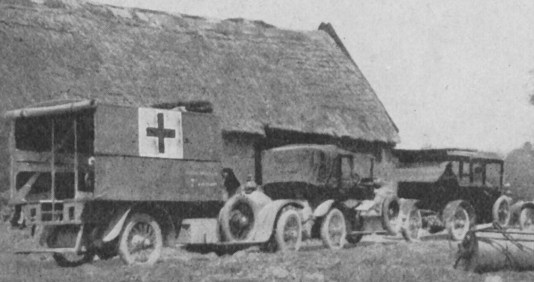 Most of the men were very cheerful at the prospect of a slight wound that would take them home for a bit. They were principally men who had been hit through the arm or leg by rifle bullets. They told us they had got back our lost trenches and also had some of the old German trenches. They said they had been wonderfully supported by the artillery, whose fire had kept just in front of them as they charged.
In spite of the bombardment, the German trenches were full of men, and we had to charge under very heavy rifle and machine gun fire. The Suffolks and the Gordon Highlanders seem to have lost most. Some of the former said their battalion was wiped out; but men always say they are the sole survivors. Later, convoys of German prisoners came through and escorts with fixed bayonet – I should think about 200 and 300 in all; no officers. They were a good lot of men, in the prime of life. All wore the flat round cap – no helmets. They have been trying to get into Ypres for 18 months, and now they have succeeded!”
Major Wm. Beattie, a Chaplain from Cobourg wrote:
“Mar. 5 – Services were marked by Divine love and forgiveness. One could almost feel ones soul throb. The knowledge that death lurks upon their trail helps somewhat, but one is seldom conscious of the presence of that as a dominant thought. There is much more the feeling of the bigness and worth of the task to which they have given themselves.”
4th Brigade War Diary:
“Mar. 12 – One Other Rank from 21st Battalion suffering from shell shock.
During this stay in La Clytte, the battalion furnished three 500-strong fatigue parties for the “P” trenches. There were five killed and four wounded doing this work.”
One journalist reported:
“The shell shock cases were the worst to see and the worst to cure. At first shell shock was regarded as damn nonsense and sheer cowardice by generals, who had not witnessed its effects themselves. They had not seen strong, sturdy men shaking with ague, mouthing like madmen, figures of dreadful terror, speechless and uncontrollable.”
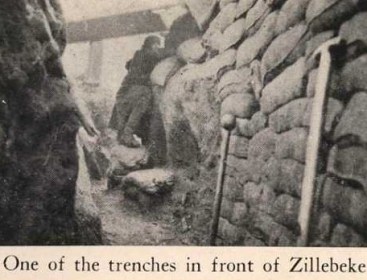
Since the beginning of January, there had been one killed and thirty-six injured up until these work parties, which made them perhaps the most dangerous duty of the year to date. There had also been one death from pneumonia – G. P. White -, which was the first death from disease in the battalion. Added to the fatality list in March were F. A. Carter, H Deuxberry, H. G. Lester, L. F. Evans, W.A. Hamilton, and J. H. Rodgers, There were frequent reports of aircraft from both sides flying over the trenches and even the occasional ‘dog fight’ to occupy the interest of the men in the trenches. Early in March 1916, orders were issued to exchange the fronts of the British “V” Corp and the Canadian Corps. I have difficulty understanding why such a big change was made, although perhaps it had to do with the fact that the British had incurred heavy losses in that area for nearly a year and needed to be moved to a quieter sector to rebuild.
Beaverbrook:
“The transfer of a sector from one Army Corps to another is a slow and intricate process- nothing less than the gradual interchange of all the population of two countrysides and all the means of feeding and clothing them. This is a wave of immigration and emigration affecting more than 120,000 people and must be carried out with the minimum of disturbance, since the inhabitants must be ready to man the trenches and fight a battle at any time. Although a brigade may be holding a frontage of a couple of hundred yards, its section runs back through miles of land crowded with reserves, with light and heavy artillery, with transport services, hospitals, depots and all the paraphernalia of modern warfare. The moves began on March 17 and ended on April 8.”
There had been an instruction from Corps Headquarters on February 10 that – “Effective March 1, Steel helmets will be issued instead of the present soft caps.” There is some evidence that at least the ‘attacking troops’ were issued helmets by that date.
There were other things happening at this time to Keith and Bill. On Mar 19, they were appointed to the 4th (Light) Trench Mortar Battery of the 4th Infantry Brigade. Although I have not been able to obtain much information on this unit, it seems to have been created from 24 men of the four battalions in the brigade and was commanded by Lieutenant A. S. Morrison. He was the one who had written to families in December 1914, telling them how well their boys were doing during training at Kingston.
2nd Army Conference notes- Feb 1916:
“There was considerable difference of opinion among artillery commanders as to the organization of trench mortar batteries. The majority seemed to be in favour of placing the heavy and medium batteries under the divisional artillery commander and the light batteries under the infantry brigade commanders to be as much a part of the brigade as the machine gun company or any other brigade unit. As soon as the agreement of the Corps commanders has been obtained as to the general principles of the command of these trench batteries, a committee will be assembled to work out the details of the organization.”
It was later decided that, rather than having a group of bombers working in each battalion, the new unit would support the entire brigade and be directed at the brigade level. Although I cannot be absolutely sure, it would seem that Bill Nesbitt was promoted to sergeant major and Keith Roblin to corporal at this time.
2nd Division Ammunition Column War Diary|
“Mar 21- Trench Mortars now with this Division to be supplied (with ammunition) by Divisional Ammunition Column direct.”
This would seem to indicate that, rather than sending mortar equipment and ammunition to each battalion, it was sent to the brigade unit to be used to support the entire brigade. The role of an ammunition column was to use horses and wagons to transport ammunition to the front, as well as hauling water, coal, and stores.
McBride:
“To even get up to where the real fighting is requires almost incredible endurance and devotion to duty. These men have to go through one or more barrages of artillery fire, and rifle and machine gun bullets will be continually picking off men, here and there. Probably it will be raining- it always is when there is a fight on- and the mud will further handicap the burden bearers.”
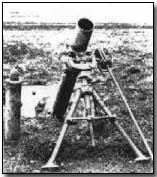 The trench mortar was a tube designed to fire a projectile at a steep angle so that it fell straight down on the enemy. The chief advantage of the mortar was that it could be fired from a trench without the crew being exposed and would fall straight down, with luck, in the enemy trench. It was also much lighter and more mobile than other, larger artillery pieces. In 1914, the Germans had a large supply of mortars and the Allies had none. It wasn’t until late 1915 that the British production of mortars became available for general use. The Vickers Mortar turned out to be unreliable in that the shell often broke apart rather than exploding on impact. The Stokes Mortar (left) became the weapon of choice and its availability probably prompted the creation of the Trench Mortar Batteries. The gunners dropped a three-inch cast-iron bomb weighing about ten pounds into a tube. When the bomb hit the firing pin at the base of the tube, it would activate the propellant charge in the bomb and fire it. They could fire up to twenty-two bombs per minute, up to 1,200 yards.
Apparently the soldiers in the trenches had mixed feelings about the TM Battery; they liked the support they got from the trench mortars, but when the TMB fired off several rounds and then moved to a new location, it left them in a position to receive the German response.
McBride:
“Trench mortars are all very well in the trenches, where their ammunition can readily be replenished and where they can be serviced every day or two. But just as you attack or make any sort of advance away from the supply detail, they are soon ‘out of ammunition’, leaving the infantry to push ahead with nothing but their rifles and ammunition.”
In order to accomplish the major shift, it was decided to switch the reserve units of each corps and then send them into the front lines from there. This process had to be done gradually to ensure that all fronts were covered and that each unit would have adequate time to become familiar with their new territory before being called upon to participate in a major action.
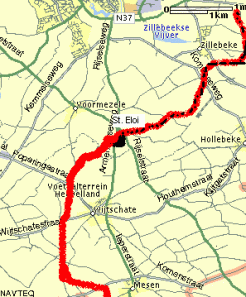
The 3rd Division, which had not been fully committed, was the first to take on its new assignment, replacing the British in the northern sector of the line near Zillebeke (top right on map) in the third week of March. Then the 1st Division moved into their area just to the south and finally they were to be flanked by the 2nd Division on their right running as far south as St. Eloi (centre).
McBride”
“St. Eloi consisted of perhaps fifteen or twenty brick and iron buildings and was located at the end of the two main roads paved with granite block that ran to Ypres and Voormezeele. The village itself, except for two or three outlying buildings, was inside our lines. The portion held by the enemy included a prominent eminence, called the ‘mound’, which dominated our whole front line for a mile or two.”
(See a picture, below of modern-day St. Eloi and craters 2,3, 4 and 5, about which we will learn more later.) Because their brigade had not begun to move, the 21st Battalion was back in its usual trenches on March 17, when it took over from the 20th. The weather was fairly good and the Germans threw a little of everything at them during their 5 days there. The Brigade Diary records four killed and eight wounded.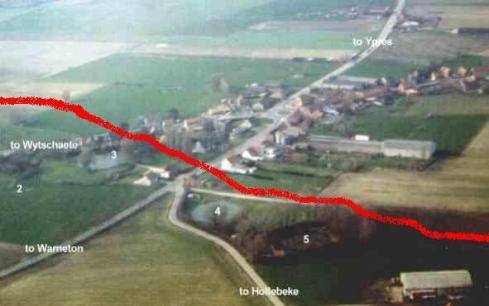
The 21st Battalion had been formed more than eighteen months ago and had been in Belgium for six months. By now there had been enough things happen in the unit to make everyone realize that the 21st Battalion had changed and would continue to change. Officers had been reassigned, NCO’s were being sent to England for Officer Training and others were being promoted to fill their ranks. New men were added to replace those who had been taken prisoner, wounded, killed or were just unaccounted for in the mine craters, mud holes and demolished trenches of the Western Front. No doubt it was hard, after all they had been through, but the battalion veterans had to welcome the new men and try to build the trust and comradeship that was necessary to put your life in the hands of another, day after day, in that horrible place.
While the 21st was in the trenches the artillery was giving them support. C. Gray died on March 26.
At this time the enemy seemed to have superiority in the air, particularly with the Fokker fighter plane .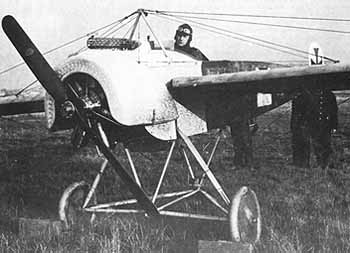 Their machine guns were synchronized with the propeller to enable the guns to be fired more effectively from the front, through the rotating propeller. Pilots were warned not to fly over allied territory in case they would be shot down and this invention discovered and copied. The British answer was the French-built Nieuport 17 which was a very successful fighter.
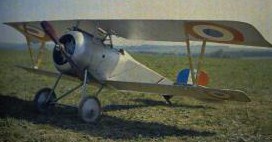 Although early editions used machine guns, they were quickly adapted to produce the synchronized firing too. This plane quickly outdid the Fokkers and the seesaw battle for air superiority continued, with each side modifying existing models and introducing new ones.
There was still a lot of talk that the war would end soon. Letters from home often mentioned the few good things that had happened and of course failed to mention the significant losses that had occurred to the Allied Forces and the grinding war of attrition that the soldiers of the 21st knew all too well by this time. There was an undercurrent among the men that was betting on a return to Canada for Christmas 1916. On the other hand there was a group who spent most of their time moaning about the way their commanders were running the war and predicting the war would last for years.
 Stories