Stanley Hare was born in Hull, Yorkshire, England on October 22, 1895 to Louisa and Walter Hare. He had two sisters, Irene and Kathleen, and two brothers, Cyril and Roland. His family moved to Toronto around 1905. Some time after 1911 they moved to Brighton, Ontario. By 1914, he had left school and was working as a farm labourer for W. B. Robinson. He attended St. Andrew’s Presbyterian Church and taught in its Sunday School.
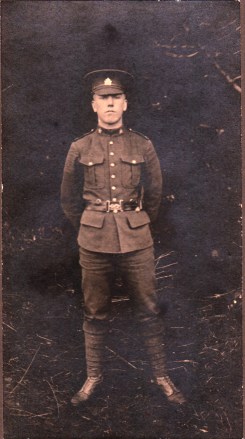
In August 1914, ten Canadian Army recruits, including Stan, paraded through Brighton to the train station. Their MPP Sam Nesbitt later sent them watches in England as a gift for volunteering. On August 31, Stan wrote to Mr. Robinson from Camp Valcartier in Quebec detailing his daily routine and said – “I think I like soldiering fine”.
On September 5, 1914, he took his army physical, which listed his age as 18 years and 11 months and showed his height as 5 ft. 6 ½ inches. He was inducted officially into the Canadian Expeditionary Force on September 22 and assigned to the 2nd Battalion as a private.
Gordon Lapp was born in Brighton on January 17, 1904 to Clarence and Rose Lapp. Clarence was the Publisher of The Brighton Ensign. Gordon attended school in Brighton and was a Sunday School pupil of Stan Hare. He was at the parade to say goodbye when Stan left for the army.
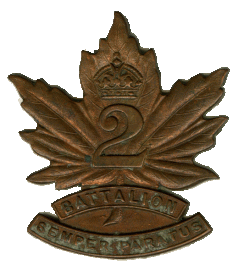
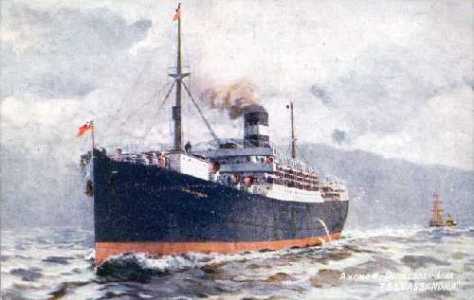
Stan had little time to train in Canada because, three days after he formally enlisted, the 2nd Battalion sailed on board the SS Cassandra from Quebec City. However they anchored in the Gaspe Basin for a week while the convoy of more than 30 ships formed up, sailing for England October 4 and arriving in Plymouth Harbour on the 14th. After another delay, they finally disembarked in Plymouth on October 25 and moved to Camp Bustard in the Salisbury Plain – a journey from Valcartier of one month.
As Stan explained to his mother in a letter dated November 12, the weather and living and working conditions there were awful:
“We have had very wet weather – with only 6 fine days since we have been here and there is mud up to our boot tops, but we are very dry in our tents. We get the same food all the time: tea and bacon for breakfast, stew for dinner and tea, jam, cheese and bread for supper. (For this they were paid $1.10 per day.) We were reviewed by the King and Queen a week ago.”
They mostly trained in rain and brutal mud for the next three months, except for Christmas leave. Their first casualty was a man who “fell off a train to London”. They broke camp on February 7, 1915 and sailed to France on the former cattle boat, SS Blackwell. Pvt. Withers called it – “the dirtiest looking tub I have ever seen”. Many men were seasick. They gradually moved to Armentieres where the 2nd Battalion experienced their first days in the trenches starting on the 19th. Two men were killed. They spent 12 days in the front lines in March (4 days in and 4 days out) with 7 killed and 18 wounded. Sunday School teacher Stan was not with his unit on March 30 because he was fined $5 in Rouen??? March was just a warm-up for April when, after three weeks of route marching, training and inspections, the 2nd Battalion was hastily thrown into the middle of the 2nd Battle of Ypres. This battle saw the use of chlorine gas by the enemy, lasted five days and cost the British and Canadians a little territory and 59,275 casualties. Although the “Brighton Boys” came through safely, the 2nd Battalion, although fighting valiantly, lost 6 officers and 68 men killed, 4 officers and 158 men wounded, and 5officers and 302 men missing – more than half the battalion. This was the battle portrayed in Colonel McCrae’s poem “In Flanders Fields”.
In early May, they were in the reserve trenches at Festubert rebuilding the battalion, but were thrown into battle at the last minute and had almost 100 casualties. June was spent bringing the battalion up to strength again and digging trenches. For the next three months they endured an average of twelve days per month in the front line with casualties almost every day. Drilling and tedious work parties – digging and repairing front-line and communication trenches – spelled this off. October and November featured torrential rain, blustery winds, sleet and cold. The trenches collapsed and the men were thigh deep in water. Stan got eight days leave starting November 22.
On December 18, Pvt. George Withers wrote on behalf of the “Brighton Boys” to thank the townspeople for their support and to express the Boys’ great displeasure with some local Brighton citizen or citizens –
“News has come to my ears at different times and from different people stating they had heard we, the Brighton Boys, had never been in the firing line or anywhere near the trenches. I think I am justified in saying that there isn’t another Canadian Battalion in the firing line that has done the work we have. We have traveled right along the whole line and back again, and never away from the front line. But, if God spares me, my diary will contradict false statements that have circulated about me and the boys.”
It must have upset them terribly to have to justify that none of them had been killed or wounded and to dispute the story that they had not been in battle. He went on to talk about the dreadful rainy weather and “Our casualties during the last four days have been very heavy, only a few short of 100 killed and wounded.” A short time later Stan wrote to his mother that he had never felt better in his life.
On March 3, 1916, the Brighton Ensign reported that Gordon was doing well in his last year in Public School and Stan’s brother Cyril had joined the Cobourg Heavy Artillery Battery. In January and February, the 2nd Battalion continued with the same front line routine plus an unsuccessful trench raid and then it was Stan’s turn to speak to the people of Brighton in a letter dated March 3. He thanked them for their parcels, complained about the weather and enthused about a machine-gun course he had attended. – “I received a letter recently telling me that a certain man had told a certain woman that Stanley Hare had not been in the trenches yet, also how was it that he had never been wounded”. After making a veiled reference as to who the man was, he went on – “He ought to take into consideration that every man hasn’t got to be wounded because he is in the firing line. Pvt. Withers’ letter didn’t seem to be enough to make him keep quiet. There are very few of us left who came over with the first contingent. It is remarkable that the boys from Brighton have not received a scratch yet. We have all been through it together and have been in some tight corners, but have succeeded in coming through so far”.
On the same day that Stan’s letter was published in the Ensign, an obituary was included for Frank Richardson who, on March 15, became the first Brighton Boy killed in action. War Diary – March 15: “Enemy again active with rifle grenades and minnenwerfers. We replied with eighty rifle grenades and fifteen trench mortar bombs and effectively silenced enemy.” That was too late for Frank.
Time also ran out a short while later for William Briggs of Brighton, who died on April 4 at age 21. War Diary:
“Day fairly quiet. All available men worked on the trenches which were in bad shape.” Brighton Ensign – April 28 – “In a letter just received, Pvt. Stanley Hare states that the beloved comrade Pvt. W Briggs rendered his supreme service by the enemy’s high explosives while in the act of erecting a parapet”.
The unit again added reinforcements in late March and early April but returned in late April to major action in the front lines. A German mine buried 14 men at Hill 60 and a large attack was launched by the enemy, which was repelled by heavy machine-gun and artillery fire. Forty-three men were killed and 68 wounded. This was described in detail in a letter from Geo Withers – “Before the battle, our orders were to hold our posts at all costs and we, one and all, were under the same impression – if Fritz wants this trench, he must take it over my dead body”. Geo Withers penned another, very long, letter that was received on April 28. He referred to a man who lived “eight miles northeast of Brighton” who said this to a soldier’s wife :
“I don’t believe that he or any of the Brighton boys have been in the trenches or near the firing line, or seen a German, or fired a shot, or had any hardships. It seems so funny for them to say that they are in the trenches, yet not one of them has been wounded or killed”.
Withers went on to passionately describe, in as much detail as he was allowed, what they had experienced – being under fire, the battles, the weather, the rats and lice and foul-smelling dead bodies, and he hoped he would never be buried alive by German artillery fire or mines. In May, their turn in the front lines was quiet and the rest of the month was spent as working parties. Stan was appointed Lance Corporal.
In June, they were in the front line after the heavy action at Sanctuary Wood but still suffered many casualties. During their second tour up front in July, and their last in the Ypres area, both sides used every form of weaponry at their disposal to inflict heavy damage. The 2nd had 52 casualties, including 16 killed. On August 9 they left the trenches and marched for four days in the summer heat. They spent 16 days training before taking a train and marching 2 ½ days to Albert in the Somme region.
The very next day they manned their new trenches and, because of heavy shelling, there were 25 killed and 90 wounded. There was a major two-day battle at the ruined village of Pozieres on September 9, with the 2nd Battalion following a three-minute artillery barrage (with many casualties from friendly fire) and, despite heavy machine-gun fire, taking their objective in 23 minutes. This was part of the outstanding allied advance that captured Courcelette on the battalion’s left. Stan was slightly wounded – “It is only a graze. I will be back to the battalion in a couple of days. A shrapnel shell burst over our heads and struck me just below the elbow”. The 2nd lost 92 men killed and 143 wounded.
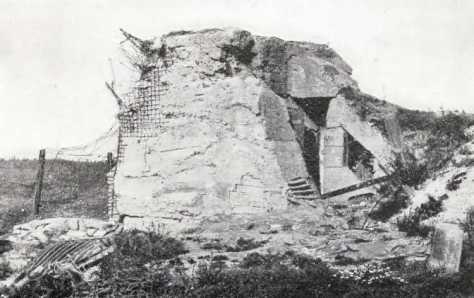
While entrenched north of Courcelette, Stan was also wounded on September 21, along with 34 others, but again returned quickly to his battalion. War Diary – September 22 – “Enemy snipers very active during the day. Artillery duel continued night and day. Enemy made a bombing attack on our right – which was repulsed.”
Nineteen-year-old Pvt. Jack Tough of Brighton and 8 other men were killed. General Currie wrote to the 2nd Battalion on September 26 – “I wish to congratulate you and your battalion on the really splendid work done by them in their two tours in this battle. The successful operation on the 9th was really one of the best things done in all this battle. It was simply splendid.”
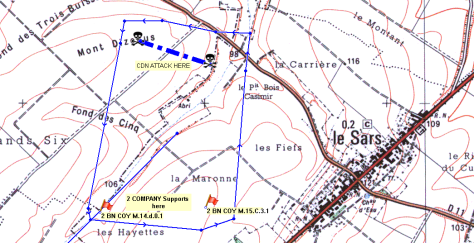
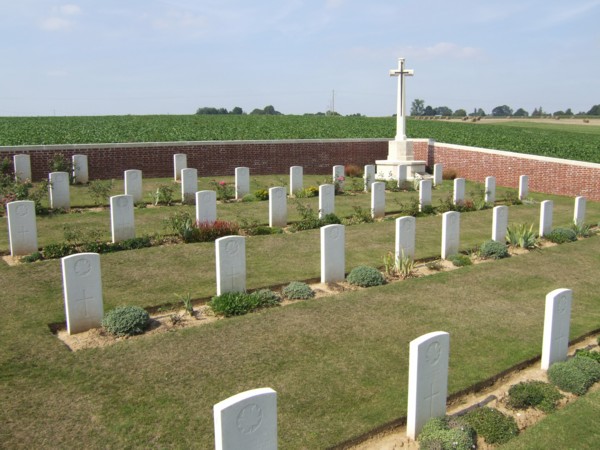
On Oct 6, the entire battalion spent most of the day digging trenches. War Diary – October 7 – “We are in brigade support trenches. Artillery of both sides is very active. Enemy shelled considerably in the area of Bapaume Rd without doing much damage.” Stan was killed in action that day, five days after his 20th birthday. His parents were notified of his death 19 days later. He is buried in the 2nd Canadian Cemetery, Sunken Road, Contalmaison, France. The tally of 9 officers and 186 men killed, and 9 officers and 415 men wounded during six weeks at the Somme included the two Brighton Boys.
Gordon, in first year high school, got 82 in Geography and 87 in Latin. Results for all students were printed in the paper. Gordon and his brother delivered the two Toronto daily papers to their Brighton customers. After graduating from high school he, perhaps influenced by Stan, went into youth work.
His obituary –
“He was predeceased by his wife Aula and left one son, Martin. Gordon’s entire life was one of ministry to others. In his early years he was associated with both Provincial and National Boys Work Boards and for many years directed boys’ camps across Canada. He is widely remembered for his writing for young people, published under the name ‘Jack Pine’. His seven-year full time lay ministry in Alberta and Northern Ontario progressed into four more years of part time lay ministry while he studied at Emmanuel College. He was ordained in 1937, going on to serve seven pastoral charges in sixty years”.
In 1970 he received an honorary Doctor of Divinity from Victoria University. He never forgot his Sunday School teacher. We see how much Stan influenced his choice of a career when he wrote the following in a church publication in 1990 – seventy-six years after he had last seen Stan.
“It is a beautiful August morning in 1914. A barefoot 10-year-old, I trudge the dusty village road, alongside red tunics, blue striped trousers, and awkward South African War rifles. But there is nothing comic about these sturdy fellows, militia men when not on the job as farmers, fishermen, store clerks, carpenters, bank tellers, bricklayers or road workers. Now the British Empire and the Dominions are at war. The call has come and these Brighton, Ontario boys are marching to the train station. My chosen place in the parade was beside 20-year-old Stan. He was my Sunday school teacher and one of our best baseball players. “Stan! Hey Stan! Send me back a postcard. The card came back. Stan didn’t. His name is on the war memorial in Brighton.”
The Teacher (Stan) died in 1916 at age 20 and the Preacher (Gordon) died in 1998 at age 94.
 Stories